Modern Mitsubishi vehicles are built with some of the most advanced safety technology on the road today, and at the heart of that technology sits the forward-facing camera mounted to your windshield. When that windshield is removed, replaced, or even adjusted, the camera's alignment shifts and your Mitsubishi's ADAS suite needs to be recalibrated to factory specifications. Mitsubishi ADAS calibration is not optional, not cosmetic, and not something that can be skipped after auto glass work. It's the critical final step that brings your e-Assist safety system back online and confirms that every lane line, vehicle, and pedestrian your Mitsubishi detects is being measured with the same accuracy it had the day it left the assembly line.
ADAS stands for Advanced Driver Assistance Systems, and Mitsubishi ADAS calibration is the process of realigning the cameras, radars, and sensors that power those systems after any service that disturbs them. For most Mitsubishi owners, that service is windshield replacement, because the multi-purpose camera that handles lane detection, forward collision warning, and adaptive cruise control is mounted directly to the glass. When a new windshield goes in, even a perfectly installed one, the camera sits at a slightly different angle. Calibration restores its line of sight to factory tolerances so the vehicle interprets the road exactly the way Mitsubishi engineered it to.
Mitsubishi packages its driver assistance technology under the e-Assist umbrella, which combines a forward-facing camera, millimeter-wave radar, ultrasonic sensors, and rear corner radars into one integrated safety net. The camera reads lane markings, traffic signs, and the silhouettes of vehicles and pedestrians ahead. The radar measures distance and closing speed. Together they feed real-time data to modules that control braking, steering input, and warnings. Every one of those decisions depends on the camera being aimed precisely where it was at the factory, and even a one-degree variance can throw the system's calculations off by several feet at highway distances.
The Mitsubishi multi-purpose camera does not move with the glass when a new windshield is installed; it gets removed, reset to the new pane, and locked back into its housing. Even with perfect installation, the new glass has microscopic differences in thickness, curvature, and optical properties compared to the original. The camera bracket also sits at a fractionally different height. Mitsubishi service procedures require recalibration after any windshield replacement, and skipping that step can lead to delayed warnings, false alerts, or systems that disable themselves entirely until properly recalibrated by a qualified technician.
Not every Mitsubishi on the road has the full e-Assist suite, but the list of models that do has grown rapidly since 2017. If your vehicle has a camera bracket behind the rearview mirror, has lane-keeping or adaptive cruise control on the steering wheel, or has any forward collision warning icon on the dashboard, it needs Mitsubishi ADAS recalibration after windshield work.
The Outlander and Outlander PHEV from 2017 onward carry the full Mitsubishi e-Assist package, with the camera mounted high on the windshield behind the rearview mirror. Both models use a combination of static and dynamic calibration depending on the year and trim. The 2022 redesign added more advanced lane centering and a wider-angle camera, which made precise calibration even more important. Outlander PHEV owners also rely on a regenerative-braking-aware adaptive cruise control system, and that integration only behaves predictably when the camera is dialed in to factory spec.
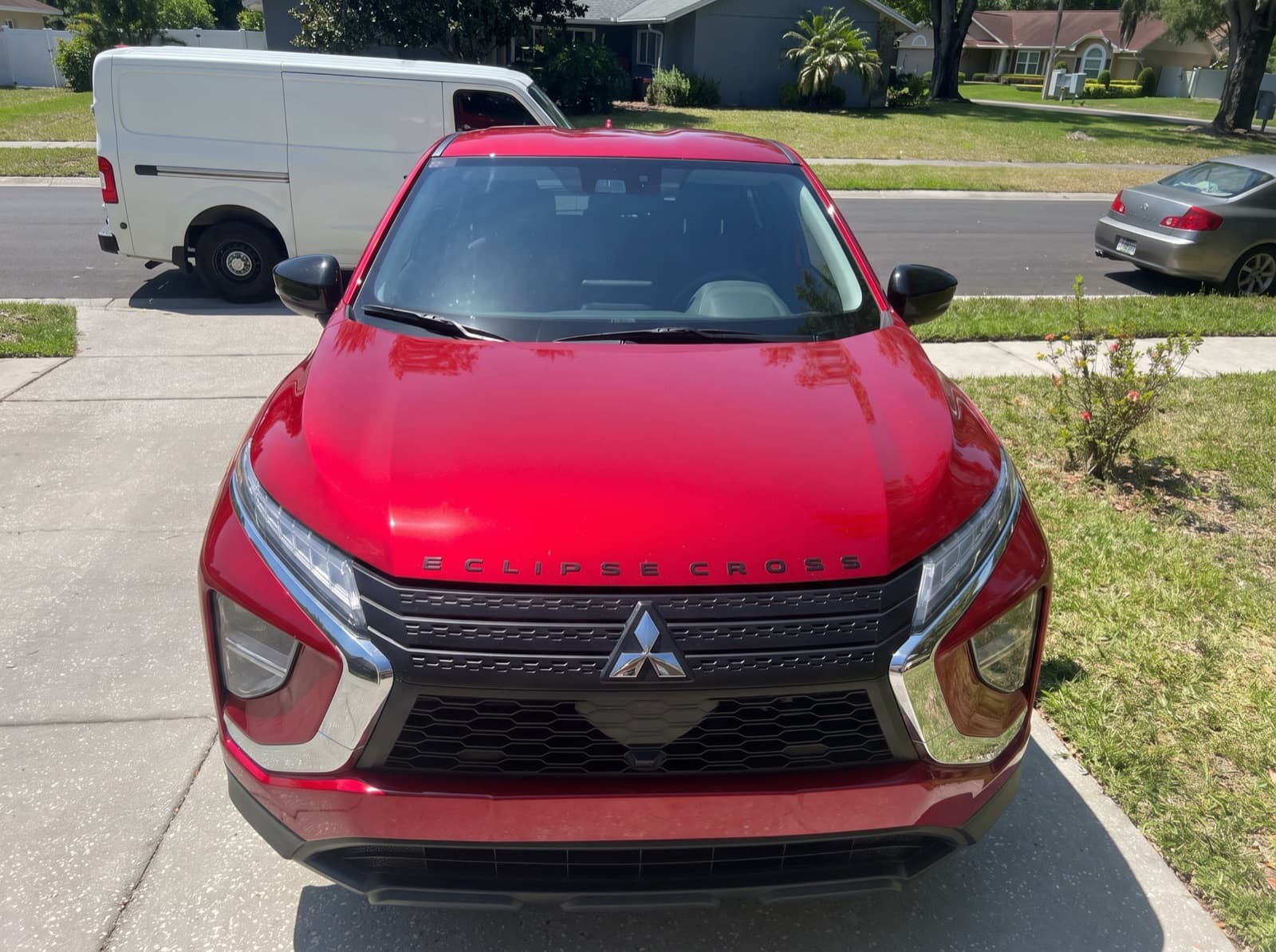
The Eclipse Cross has shipped with forward collision mitigation, lane departure warning, and adaptive cruise control on most trims since 2018. The camera in the Eclipse Cross is particularly sensitive to angle because the vehicle's steeply raked windshield places the optics at a steeper pitch than most other Mitsubishi models. The 2022 facelift also moved the camera bracket position slightly, which means calibration procedures differ between pre-2022 and post-2022 Eclipse Cross models.
The Outlander Sport, also known as the ASX in some markets, received the e-Assist package in 2020 across most North American trims. It uses primarily static calibration with a target board placed at a specific distance and height in front of the vehicle. Owners often notice the lane departure warning is the most sensitive to even minor camera misalignment, so the Outlander Sport almost always benefits from a verification drive after the static procedure completes.
Higher trims of the Mirage and Mirage G4 from 2021 onward include forward collision mitigation and lane departure warning, which require recalibration of the windshield-mounted camera after any glass replacement. The Mirage uses a simpler single-camera system compared to the Outlander, but the calibration tolerances are just as tight, and skipping the procedure will trigger a permanent dash warning until corrected.
Several of the safety and convenience features your Mitsubishi relies on every drive will not function correctly without precise calibration of the windshield camera and supporting sensors:
There are three categories of calibration that may apply to your Mitsubishi after a windshield replacement, and the right one depends on the model year, trim, and the specific systems installed. We identify the correct method during scheduling so the right equipment and procedure are ready when we arrive.
Static calibration is performed with the vehicle stationary in a controlled environment using a precisely positioned target board. The board has patterns the Mitsubishi camera recognizes, and our calibration system communicates with the vehicle's onboard computer to teach it the new reference position. Static calibration requires level ground, specific lighting, and exact distance measurements from the front of the vehicle to the target. Most Outlander and Eclipse Cross models depend on this procedure.
Dynamic calibration is performed by driving the Mitsubishi at specific speeds, typically between 25 and 45 miles per hour, on a road with clearly painted lane markings. The vehicle is plugged into a scan tool during the drive and the camera relearns its alignment by observing real-world references. This procedure is common on certain Mirage, Outlander Sport, and Eclipse Cross years.
Several newer Mitsubishi models, including 2022 and later Outlander and Outlander PHEV, require both static and dynamic procedures performed in sequence. Static is completed first to set the baseline, then a dynamic drive confirms the system is reading the road correctly. Skipping either half of a combination procedure will leave the e-Assist module in a partially calibrated state that can fail without warning weeks later.
Our mobile calibration process is built around precision and convenience, so your Mitsubishi gets the same factory-spec recalibration it would receive at a dealership without the trip, the wait, or the loaner-car shuffle. From the moment we arrive at your driveway, office, or jobsite, the workflow is the same every time:
A lot of Mitsubishi owners assume ADAS calibration has to happen at a dealership or a brick-and-mortar shop, and that assumption costs them a full day off work for what should be a straightforward appointment. Bang AutoGlass operates as a fully mobile Mitsubishi auto glass and ADAS calibration service, which means we bring the targets, the scan tools, the urethane, and the OEM-quality glass directly to your home or workplace. Most Mitsubishi windshield replacements are completed in 30 to 45 minutes, followed by the one-hour cure time during which we set up and run the calibration. By the time you'd have arrived at a dealership, signed paperwork, and waited for an open bay, your Mitsubishi is already back in service in your own driveway.
We also offer next-day appointments on most Mitsubishi makes and models, so a cracked windshield or a triggered ADAS warning doesn't have to sit on your calendar for a week. If you call today, we can almost always get your Outlander, Eclipse Cross, Outlander Sport, Mirage, or Mirage G4 handled tomorrow.
The full appointment, including windshield replacement, urethane cure time, and ADAS calibration, typically takes between two and two and a half hours from the moment we arrive. The glass installation itself is 30 to 45 minutes, urethane cure adds one hour, and the calibration runs anywhere from 20 to 45 minutes depending on whether your Mitsubishi requires static, dynamic, or combination calibration. You do not need to remain with the vehicle during the appointment, only be available to confirm completion at the end.
After any windshield replacement, recalibration is automatic in our workflow, but there are also situations where an existing Mitsubishi might be driving around with miscalibrated ADAS without the owner realizing it. Watch for warning lights that read e-Assist, FCM, LDW, or ACC on your instrument cluster, which usually indicate the camera or radar is reporting an alignment fault. Pay attention to lane departure warnings that trigger when you are clearly centered in your lane, or adaptive cruise control that brakes too late or too aggressively. If your Mitsubishi has had a recent windshield replacement somewhere else, a front-end collision, suspension work, or a bumper replacement, the ADAS suite may need recalibration even if no warning has appeared yet.
Most comprehensive auto insurance policies cover windshield replacement and the associated ADAS calibration for your Mitsubishi, and many states require coverage of safety-related recalibration without a deductible. We work with virtually every major insurance carrier, and while we do not file the claim on your behalf, we walk you through the process step by step so you can file confidently and avoid common mistakes. We provide the documentation insurers ask for, including pre-scan and post-scan reports, the OEM service procedure followed, and itemized labor for both glass and calibration. If you have not yet filed your claim, we recommend calling your insurer before scheduling so we can coordinate paperwork around your appointment time and make sure your coverage is applied correctly.
Every Mitsubishi windshield we install is OEM-quality glass, meaning it meets or exceeds the optical clarity, thickness, acoustic dampening, and bracket specifications of the original windshield that came on your vehicle. The camera bracket on Mitsubishi windshields is particularly sensitive to manufacturing tolerances, and lower-grade glass with a slightly off-spec bracket can introduce calibration errors that no amount of scan tool work will resolve. We use OEM-quality glass for every Outlander, Outlander PHEV, Eclipse Cross, Outlander Sport, Mirage, and Mirage G4 we service, paired with OEM-spec urethane and primer to maintain the structural and acoustic integrity Mitsubishi engineered into the original.
Every Mitsubishi windshield replacement and ADAS calibration we perform is backed by a lifetime workmanship warranty for as long as you own the vehicle. If anything in our installation or calibration ever shows an issue, from a leak to a wind-noise complaint to a recurring ADAS fault code tied to our work, we come back and make it right at no additional charge. We stand behind every Mitsubishi we service because we know the safety systems in your vehicle are not optional features, they are the technology you and your family rely on every time you pull out of the driveway.
If your Mitsubishi is showing an e-Assist warning, your windshield is cracked or chipped near the camera, or a recent replacement was done without recalibration, the safest move is to schedule a service right away. Bang AutoGlass offers mobile Mitsubishi ADAS calibration with OEM-quality glass, next-day appointments in most areas, a 30 to 45 minute installation window, one-hour urethane cure, and a lifetime workmanship warranty on every job. Use the contact form above or call the number at the top of this page and we will get your Outlander, Eclipse Cross, Outlander Sport, Mirage, or Mirage G4 back to factory-spec safety performance, usually as soon as tomorrow.