Isuzu Rear Glass Replacement
Isuzu left the US passenger market after 2008, so every Trooper, Rodeo, Amigo, Axiom, Ascender, VehiCROSS, Hombre and i-290 still running is a sourcing question as much as an install. We come to you across Arizona and Florida, verify the pane by VIN, and back the work for life.
Isuzu Rear Glass Replacement for a Fleet That Outlived Its Dealer Network
Isuzu stopped selling passenger vehicles in the United States after the 2008 model year, and that fact shapes this whole job. Every Trooper, Rodeo, Amigo, Axiom, VehiCROSS, Hombre, Ascender and i-290 still on the road belongs to someone who has learned to be resourceful about parts, and who reasonably assumes a broken rear window means a long hunt. Bang AutoGlass performs fully mobile Isuzu rear glass replacement across Arizona and Florida, and the honest short version is that most of these panes are easier to source than the badge suggests — because of who actually built these vehicles. Installations run about 30 to 45 minutes of hands-on work plus roughly an hour of adhesive cure. Next-day appointments are typically available, and every job carries our lifetime workmanship warranty.
A Discontinued Badge Is Not a Discontinued Part
Glass follows platforms, not badges. Much of Isuzu's American lineup was built alongside high-volume vehicles from other manufacturers, and glass for those platforms is still in production. Knowing which of your vehicle's relatives are still supported is the difference between a next-day appointment and a long wait.
The GM-Built Isuzus
The Ascender shares its architecture with General Motors' midsize SUVs of the same era, the Hombre with GM's 1990s compact pickup, and the i-290 with GM's mid-2000s midsize truck line. Those donor vehicles sold in enormous numbers and OEM-quality rear glass for them stays in production, which is why an Ascender liftgate pane or an i-290 back window is usually a routine order.
The Honda Connection
The Rodeo was also sold under Honda badging for much of its life, roughly doubling the population a given rear pane fits. Rodeo owners get the benefit: it is one of the better-supported discontinued SUVs in the country for glass.
Where the Search Gets Real
The Isuzu-designed vehicles are a different story. The Trooper, Amigo, Axiom and above all the VehiCROSS were never shared out to a partner, so their glass exists in the quantities Isuzu made and no more. Call us about one of these and we will tell you honestly what we can source, and how long it takes, before booking anything.
Why There Is No Such Thing as Repairing an Isuzu Rear Window
Rear glass is typically tempered rather than laminated. It is heat-treated so that when the surface tension is broken anywhere, the whole panel relieves itself at once into thousands of granular pieces instead of long shards. That is a deliberate safety feature, and it is why rear glass cannot be repaired: there is no chip to fill and no crack to arrest, because there is no longer a pane. Replacement is the only correct answer, which suits us — Bang AutoGlass is replacement-only. A minority of applications use laminated glass in a rear position, so we confirm the specification against your VIN rather than assuming.
Isuzu Models and How Their Rear Glazing Actually Differs
Isuzu's American range was narrow but unusually varied in body style. Grouping these vehicles by badge tells you nothing; grouping them by how the glass is mounted tells you everything.
Rodeo, Axiom and Trooper: Three Different Rear Openings
The ones we see most, and the badge tells you nothing about which arrangement you have. Only the Axiom is a true liftgate: a bonded pane set in a top-hinged gate that lifts as one piece. The Rodeo instead carries a flip-up rear window above its tailgate — hinged at the roofline and opening on its own — so the glass is a moving assembly with hinge, latch and strut hardware attached to it, and that hardware has to be transferred and aligned on a replacement. The Trooper's rear glass sits in a door that swings sideways on body hinges rather than lifting at all. All three usually carry a defroster grid and, on many trims, a rear wiper whose motor shaft passes through a hole drilled in the glass. That hole is the ordering trap on Isuzu specifically: trim variation across a fleet this old is wide, wiper equipment was never universal, and a pane with a hole where yours has none is useless. The Axiom's sharply raked tail sends fragments sliding forward across the cargo floor.
Ascender: Rear Glass That Opens On Its Own
The Ascender has the most mechanically interesting rear window in the range. Like its GM siblings, its rear glass opens independently of the tailgate on hinges at the roofline. That makes the pane a moving assembly, not a fixed window. Hinges, latch hardware, strut mounting points and defroster tabs all attach to the glass, and each has to be transferred and aligned on a replacement. Set it slightly out of true and you get a gate that rattles at speed, a latch that will not catch, or water tracking into the cargo area. We cycle it through full travel and check the seal before leaving. The seven-passenger Ascender adds a third-row footwell to clear.
Open-Top SUVs: Amigo and Rodeo Sport
The Amigo, later renamed Rodeo Sport, often turns out not to be a glass job at all. Where your vehicle wears a hard top there is a genuine tempered pane at the back and we replace it normally. Where it wears the soft top, the rear panel is a flexible section of the top itself rather than bonded glass — a soft-top repair, not something we install. Call and describe what you have; it saves you an appointment. On hard-top cars the compact cargo area concentrates broken glass into a small ribbed space with the spare and jack underneath.
VehiCROSS
A shortened chassis, heavy composite cladding and a steeply raked tailgate give the VehiCROSS a small, strongly curved rear pane that shares nothing with the rest of the range. It was sold here for only three model years in small numbers, so we talk frankly about sourcing and lead time rather than pretending it is a stock item.
Pickups: Hombre and i-290
Pickups behave nothing like the SUVs. The rear window is a small, near-vertical pane in the back of the cab, and the question that decides the job is whether your truck was ordered with a fixed back window or a sliding one. A slider is a multi-piece assembly with tracks, seals and a latch, and when a pane lets go the granules pour straight into the lower track. Cab configuration matters just as much: on an extended cab, glass drops into the well behind the seat backs, which you cannot reach without pulling the seat forward.
NPR
Worth saying plainly, because owners are often surprised: Isuzu withdrew its cars and SUVs from the US, not its trucks. The NPR and the rest of the low-cab-forward line are still sold and supported here, so it is the one Isuzu on this page with no legacy sourcing problem. It is also a different vehicle to work on — the cab sits over the engine and tilts forward for service, the rear cab wall is short and close behind the seats, and whether there is a window there at all depends on how the truck was specified and bodied. Fragments drop straight into the space behind the seat where batteries, tools and wiring live. The real cost on an NPR is downtime, so we come to the yard and work around your run schedule.
What Is Built Into the Pane Itself
A rear window on these vehicles is rarely just glass, and the attached components are where a careless installation shows up weeks later.
- Defroster grid — printed onto the glass and fed through tabs bonded near the edges. The replacement must be the heated variant with the tabs re-made cleanly. A defroster that reads dead afterwards is almost always a connection never properly reattached, so we test it on site.
- Rear wiper penetration — where fitted, the motor shaft passes through the pane, so the seal and the torque on reassembly both matter. Overtightening a wiper nut against fresh glass creates a stress point.
- High-mount stop lamp — depending on the vehicle this is bonded to the glass, mounted through it, or carried on the spoiler above. We establish which before ordering.
- Privacy tint — Isuzu's SUVs commonly carried factory-darkened glass from the rear doors back on better trims. That shade is in the glass, not a film on it, and it has to match its neighbours or the back of the vehicle looks visibly wrong.
- Antenna elements — some applications route reception through the rear glazing, others use a conventional mast. Across a fleet this old we confirm against the VIN rather than assume.
The Cleanup Problem on These Particular Vehicles
Owners underestimate this part, and on Isuzus there is a specific reason. These are utility vehicles: textured cargo floors, exposed seat rails, ribbed wheel-well trim, fold-flat or removable rear seats, and a spare well under the load floor. A tempered pane does not break into pieces you pick up — it becomes thousands of pebbles with real momentum, and they go under the carpet, into seat tracks, behind trim panels, down the tailgate cavity, into an Ascender's third-row footwells, and into the well behind an extended-cab seat back. Glass left in a seat rail works its way out weeks later. Glass in a slider track stops the window sliding. Extraction is a core part of the job here, not a courtesy sweep at the end.
How We Do the Job
- VIN and glass verification — year, model, body style and exact specification: heated grid, wiper hole or none, tint shade, stop lamp arrangement, fixed or sliding on a pickup.
- Sourcing confirmed before booking — quick on the shared-platform vehicles. On a VehiCROSS, Axiom or early Trooper we confirm availability first and give you the real timeline.
- Mobile arrival and protection — our technician comes to you and masks paint, trim, seats and cargo area.
- Bulk glass extraction — loose fragments come out of the cabin, cargo bay, seat tracks and tailgate cavity before any cutting starts.
- Old pane and adhesive removal — remaining glass and the original bead are cut out without gouging the pinchweld or surrounding paint.
- Hardware and electrical transfer — defroster tabs, wiper hardware, stop lamp and, on an Ascender, hinges and latch components. The bonding surface is cleaned and primed.
- OEM-quality glass installation — the new pane is set on a fresh adhesive bead, aligned to factory position and supported while it takes.
- Testing, cleanup and inspection — the defroster is tested, any opening glass or slider is cycled through full travel, and carpet, rails, wheel wells and footwells are worked over for fragments.
How Long It Takes
Most rear glass replacements take about 30 to 45 minutes of hands-on installation. Because rear glass is adhesive-set, plan on roughly an hour of cure before driving — different from door and side glass, which is hardware-held and generally has no cure wait. Heavy cargo-area contamination, a slider on a Hombre or i-290, and the hinge and latch work on an Ascender all add time.
Insurance and Isuzu Rear Glass
Rear glass damage is frequently covered under comprehensive coverage, particularly after a break-in, vandalism, road debris or a storm. We file the claim and handle the paperwork — give us your carrier and policy details and we document and coordinate approval so your appointment is not held up.
Arizona
Arizona law (A.R.S. 20-264) requires insurers to offer optional no-deductible safety-glass coverage, and that definition reaches windshield, door and window glass. The operative word is optional. It is coverage a driver must have elected when the policy was written, and it is never automatic. If you elected it, your rear glass claim may carry no deductible. If you did not, ordinary comprehensive terms apply. We can help you check which is true of your policy.
Florida
Florida law (Fla. Stat. 627.7288) requires the deductible to be waived for windshield replacement on a policy carrying comprehensive coverage. That statute is windshield only — it does not apply to rear glass. A Florida rear window claim runs under your ordinary comprehensive terms and your normal deductible. We would rather you hear that from us now than be surprised later.
After Your Replacement
- Allow roughly one hour of cure before driving, and take the first few miles gently.
- Avoid automated car washes and high-pressure rinsing for 24 to 48 hours.
- Leave any retention tape or support tabs in place for the full 24 hours.
- Close doors and the tailgate normally rather than slamming them for the first day — pressure spikes in a sealed cabin push against a fresh bead.
- On an Ascender, work the rear glass gently at first and confirm the latch catches cleanly.
- On a Hombre or i-290 slider, stop if the window feels gritty — that is glass in the track, and we will clear it.
Mobile Service Across Arizona and Florida
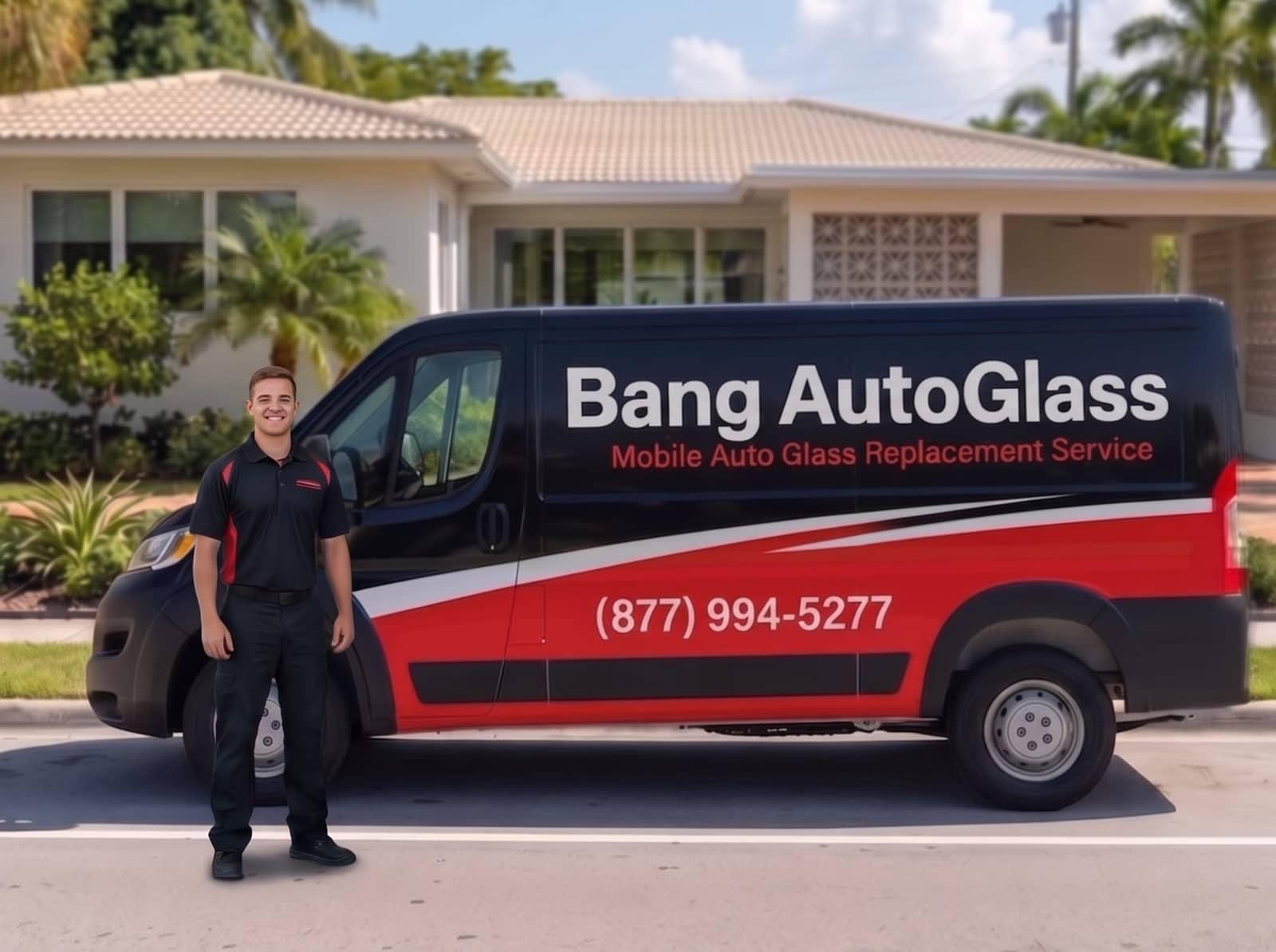
Bang AutoGlass is fully mobile. There is no shop to drive to, which matters for a thirty-year-old Trooper you would rather not drive with an open rear aperture, and for a working NPR that cannot spare a trip across town. We come to your home, garage, workplace or fleet yard anywhere in our Arizona and Florida service areas, provided there is safe, level access. Company-wide we have completed more than 17,000 jobs and hold a 4.8-star rating across 350+ Google reviews. Next-day appointments are typically available, and we schedule rear glass quickly because an open aperture lets in weather and dust.
Book Your Isuzu Rear Glass Replacement
An orphaned marque deserves a shop that knows where its parts actually come from. Our experienced technicians verify the specification against your VIN, tell you honestly what is stock and what is a search, install OEM-quality glass with premium adhesives, test the defroster and cycle any moving glass rather than assuming it works, and clear out the fragments you would otherwise find in a month. Every Isuzu rear glass replacement carries our lifetime workmanship warranty: for as long as you own the vehicle, if a leak, wind noise, a failed connection or unseated trim traces back to how we installed it, we come back and put it right at no charge. Use the form at the top of this page or call (877) 994-5277 to book a mobile appointment.
Isuzu Rear Glass Replacement — common questions
Can a cracked Isuzu rear window be repaired instead of replaced?
No. Rear glass is typically tempered, so it disintegrates into granular pieces rather than cracking, leaving nothing to repair. Replacement is the only correct fix, and Bang AutoGlass is replacement-only.
Is rear glass still available for a discontinued Isuzu?
Usually yes. The Ascender, Hombre and i-290 share platforms with high-volume GM trucks, and the Rodeo shares with Honda, so glass is still produced. Trooper, Axiom and VehiCROSS panes can take longer to source.
Does the replacement pane need a hole for the rear wiper?
Only if your vehicle has one. Wipers were not standard across Isuzu SUV trims, and a pane with a hole where yours has none is unusable. We verify wiper, defroster and tint spec against your VIN before ordering.
What is different about the Ascender's rear glass?
It opens independently of the tailgate on its own roofline hinges. Hinges, latch hardware, strut points and defroster tabs must be transferred and aligned, then cycled through full travel, or it rattles or leaks.
Where we do Isuzu auto glass
Bang AutoGlass is a mobile auto glass company serving Arizona and Florida. We don't have a shop you drive to — we come to your home, your job, or wherever the car is sitting, with next-day appointments in most areas. In Arizona that means the whole Valley — Phoenix, Mesa, Scottsdale, Chandler, Gilbert, Tempe, Glendale and out to Tucson and Prescott. In Florida we cover Tampa Bay, Orlando and Miami, from St. Petersburg and Clearwater across to Kissimmee, Winter Park and Fort Lauderdale.
Browse every city we serve in Arizona and Florida, or read how coverage works under Arizona's glass statutes and Florida's § 627.7288.
Mobile auto glass — cities we serve
4.8★ on Google · 350+ reviews from AZ & FL drivers
“I needed my windshield replaced and they made the entire process easy. Bang AutoGlass is the best!”
“Top-notch auto glass service. They handled my windshield replacement quickly and professionally.”
“Bang AutoGlass made my windshield replacement simple from start to finish.”
Need Isuzu Rear Glass Replacement?
We come to you across Arizona and Florida — often $0 with insurance.
We reply within minutes during business hours.