Aston Martin Rear Glass Replacement
Rear glass on an Aston Martin is tempered, so it does not crack — it releases into granules that pour through a DB11, Vantage, Rapide or DBX cabin all at once. Bang AutoGlass replaces it at your home or garage across Arizona and Florida, backed by a lifetime workmanship warranty.
Aston Martin Rear Glass Replacement at Your Home, Garage or Storage Unit
When the rear window of an Aston Martin lets go, it does not leave you a crack to live with. Rear glass is almost always tempered, so it does not split — it releases all at once into thousands of blunt granules that pour down the rake of the backlight into everything underneath: the parcel shelf, the rear seat bases, the boot channel, the hand-stitched leather. Bang AutoGlass performs fully mobile Aston Martin rear glass replacement across Arizona and Florida, arriving with OEM-quality glass, the correct primers and adhesives, and the extraction equipment this job actually needs. Hands-on installation usually runs about 30 to 45 minutes, followed by roughly an hour of adhesive cure. Next-day appointments are typically available, and every replacement carries our lifetime workmanship warranty.
Tempered Rear Glass Cannot Be Repaired
A windshield is laminated — two layers of glass around a plastic interlayer — which is why a chip in one can sometimes be filled. Rear glass is heat-treated instead, so when surface tension breaks anywhere on the pane, the whole sheet relieves itself into granular pieces rather than long blades. That is a deliberate safety feature, and it is why there is no repair option: no chip to fill and no crack to arrest, because there is no longer a crack — there is a pile. Replacement is the only correct answer, which suits us, because Bang AutoGlass is replacement-only. Some applications do use laminated rear glass, so we verify against your VIN rather than assuming from the model name.
What an Aston Martin's Structure Changes About the Job
Aston Martin spent a generation building cars on a bonded and riveted extruded aluminium architecture — the platform underneath the DB9, Vanquish, Rapide and the Vantage family — and the later DB11 and DBX sit on bonded aluminium structures of their own. Adhesive here is structural, not a finishing material, which has three consequences at the glass aperture.
- The flange is aluminium, not steel. Bare aluminium and the wrong primer invite corrosion and an edge bond that fails later, so the surface is cut back carefully, cleaned and primed rather than scraped to metal and covered over.
- You cannot pry at a bonded body. Where panels and extrusions are held by adhesive as much as by fasteners, leverage on the surround is a bad idea. Old glass and bead come out with wire and blades.
- Some of the surround is composite. Aston Martin has used carbon fibre body panels on the Vanquish and the DBS Superleggera, and composite takes heat and load differently than metal, so the removal method changes. Deep hand-finished paint and stitched trim forgive neither a slipped tool nor a dropped fragment, which is why the rear of the car gets masked before anything is cut.
Aston Martin Models, Grouped by How the Rear Glazing Actually Differs
Aston Martin sells no pickup and no van, so there is no sliding rear window and no drop-down back glass anywhere in the range. There are four genuinely different rear-glass architectures, and which one you own changes the part, the method and the cleanup.
Fastback GT coupes: DB9, DB11, DBS, DBS Superleggera and Vanquish
Long, heavily raked backlights bonded into the body, with a separate boot lid below and a carpeted shelf and small rear seats beneath the glass. The rake is the problem. A vertical pane drops its glass at the base of the aperture; a pane laid back this far launches it forward, down the shelf, into the seam where the shelf meets the rear bulkhead, and into the rear seat bases. The DB11 adds a wrinkle: the bodywork just outboard of the rear glass carries the intake for the AeroBlade system, Aston Martin's ducted virtual spoiler, which draws air in at the base of the C-pillar and exhausts it at the trailing edge of the decklid. Tempered granules find open ducting, so that gets checked.
Vantage hatchbacks: V8 Vantage, V8 Vantage S, V12 Vantage, V12 Vantage S and Vantage
This is the group most often described wrongly over the phone. The Vantage coupe is not a notchback with a fixed backlight and a separate boot — the rear pane is bonded into a lifting tailgate over the load bay, which makes it a moving assembly. Fragments land inside the tailgate structure, around the strut mounts and the latch, and announce themselves weeks later as a rattle nobody can locate. The pane is also opened and shut for the rest of the car's life, so a bond that is merely adequate becomes a wind whistle or a water track. Afterward the tailgate is cycled and checked closed.
Four-door: Rapide and Rapide S
The Rapide and Rapide S stretch the same bonded aluminium thinking into a four-door with a genuine rear cabin, which changes the human side of the job more than the technical one. Rear seats here get used, and a tempered pane above occupied seats deposits glass into seat rails, belt buckles and the crevice behind the rear backrests. Where your car carries a lifting rear opening rather than a fixed backlight, tell us when you call.
SUV: DBX
The DBX is the outlier — the one Aston Martin with a true liftgate window, and the most conventionally complicated pane in the range. Where your DBX is equipped accordingly, that pane works alongside a rear wiper and washer, a printed defroster grid, and a roof spoiler shading the top edge. A wiper adds a spindle, a spline and an arm that has to return at the correct park position. The load bay below adds sub-floor storage, seat-fold mechanisms and quarter trim, all of which swallow granules. The DBX also offers a large fixed roof glass panel, so we ask which pane broke before ordering.
Convertibles
Aston Martin's fabric-roof cars — badged Volante on the DB and DBS lines, Roadster on Vantage — do not carry the rear window in the body at all. It is a heated glass pane set into the folding top: it flexes with the roof on every cycle, it sits in a fabric surround rather than a painted flange, and when it breaks the granules fall into the top stack and the mechanism itself. If your soft top has lost its rear window, stop operating the roof and call us — folding a top with loose glass in the stack turns a glass job into an upholstery job.
What Is Printed, Bonded and Wired Into the Pane
Defroster grids
Where your car carries a heated rear screen, that grid is printed onto the glass and fed through tabs bonded near the edges. The replacement has to be the heated variant, the tabs remade cleanly, and the circuit tested before the technician packs up. A defroster that reads dead afterward is almost always a connection that was never properly remade — and on a fabric top that matters more, because there is no other way to clear it.
Antenna and telematics elements
Rear glass frequently doubles as an antenna. Depending on how the car was ordered, radio and sometimes telematics reception route through elements laid into the pane rather than through a mast. If reception was fine before the break and poor afterward, that is a glass-side connection, not a head unit fault. We establish which elements your pane carries during VIN verification.
What most Aston Martins do not have back there
Outside the DBX there is no rear wiper motor drilled through the pane, and the high-mount stop lamp on the coupes is generally carried in bodywork rather than bonded to the glass. Heavy privacy tint is not an Aston convention either — the coupes run a light factory tint shade, and a rear pane a shade off from the quarter glass beside it is obvious from twenty feet away. Cars personalised through Aston Martin's Q programme can also differ from a standard build sheet, one more reason we check the VIN.
Sourcing Glass for a Low-Volume Marque
Honesty is more useful here than optimism. Aston Martin builds in small numbers, and rear glass for a low-volume British GT is not stacked on a shelf the way a mass-market pane is. For current cars availability is usually straightforward; for older ones it can be the thing that sets the schedule. The Vanquish name alone covers two entirely separate generations with separate parts, and a V8 Vantage from early in its long production run does not necessarily take the same pane as a late one. So we verify against the VIN and confirm availability before committing to a date. The labour is measured in tens of minutes; the honest variable is the glass.
Cleanup Is Most of the Real Work
Owners consistently underestimate this part. A tempered pane does not break into pieces you can pick up — it becomes thousands of pebbles with momentum, and they travel. On a raked GT coupe they end up under the parcel shelf, in the rear seat bases and in the seams of a bonded aluminium body never designed to be vacuumed. On a Vantage, inside the tailgate. On a DBX, in the sub-floor and seat-fold hardware. In a soft top, in the roof stack, where they will cut the fabric on the next cycle. Glass in a seat rail works its way out weeks later; glass in a duct rattles at speed. Extraction is a core stage of the job, not a courtesy at the end.
Our Process
- VIN and specification check — year, model, body style, and the glass build: heated grid, antenna elements, tint shade, and which pane is broken.
- Mobile arrival and protection — our technician comes to you and masks paint, trim, seats and carpet before anything is opened.
- Bulk extraction first — loose glass is lifted out of the cabin, shelf, load bay and any ducting before cutting starts.
- Old pane and bead removal — remaining glass and the original adhesive are cut out without gouging an aluminium flange or loading a composite panel, then the bonding surface is cleaned and primed for the substrate.
- OEM-quality glass installation — the new pane is set on a fresh bead, positioned to factory alignment, and supported while it takes.
- Electrical reconnection and testing — defroster tabs and antenna leads are remade and tested; wiper hardware, where fitted, returns at the correct park position.
- Operation check and deep cleanup — tailgates and soft tops are cycled through full travel, then the cabin, seams, vents and load area are worked over for fragments.
How Long It Takes
Most rear glass replacements take about 30 to 45 minutes of hands-on installation, plus roughly an hour of adhesive cure before driving — unlike door and side glass, which is hardware-held and generally has no cure wait. A large DBX liftgate pane or heavy contamination adds time.
Insurance and Aston Martin Rear Glass
Rear glass damage is frequently covered under comprehensive coverage — break-ins, vandalism, road debris and weather are the usual causes. Give us your carrier and policy details and we file, document and coordinate approval so your appointment is not held up.
Arizona
Arizona law, A.R.S. 20-264, requires insurers to offer optional no-deductible safety-glass coverage, and that definition reaches windshield, door and window glass. The word that matters is optional. It is coverage the driver had to elect when the policy was written, and it is never automatic. If you elected it, your rear glass claim may carry no deductible. If you did not, ordinary comprehensive terms apply. We can help you check which is true of your policy.
Florida
Florida law, Fla. Stat. 627.7288, requires the deductible to be waived for windshield replacement on a policy carrying comprehensive coverage. That statute is windshield-only. It does not apply to rear glass. A Florida rear window claim runs under your ordinary comprehensive terms and your normal deductible, and we would rather you hear that from us now than discover it at the end.
After the Installation
- Allow roughly one hour of cure before driving the car.
- Skip automated car washes and high-pressure rinsing for 24 to 48 hours, and leave any retention tape in place for the full 24.
- Close doors, boot and tailgate gently for the first day — a pressure spike in a sealed cabin pushes against a fresh bead.
- On a Vantage or a DBX, open the tailgate carefully at first and confirm it latches cleanly.
- On a soft-top car, cycle the roof slowly and watch the new pane through full travel.
- Tell us if you find stray fragments over the following days.
Book Your Appointment
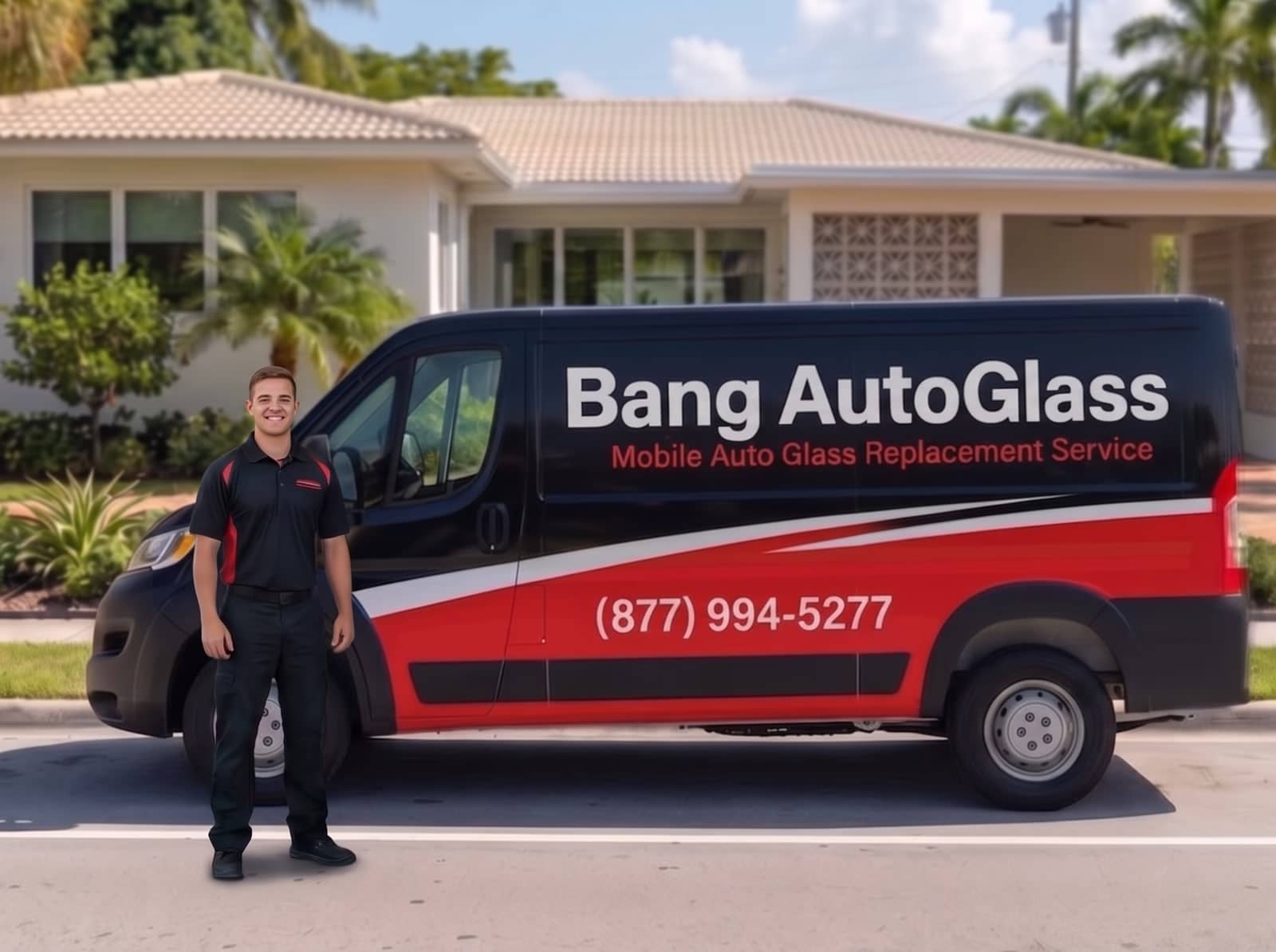
Bang AutoGlass is 100% mobile. There is no shop to drive to, which for an owner who would rather not hand the keys to a stranger is usually the whole point — we come to your home, garage, office or storage facility anywhere in our Arizona and Florida service areas, provided there is safe, level access. Company-wide we have completed more than 17,000 jobs and hold a 4.8-star rating across 350+ Google reviews. Every Aston Martin rear glass replacement is handled by experienced technicians, uses OEM-quality glass and premium adhesives, and carries our lifetime workmanship warranty: for as long as you own the car, if a leak, a wind noise or a defroster connection traces back to how we installed it, we come back and put it right at no charge. Use the form at the top of this page or call (877) 994-5277 to book, typically as soon as the next day.
Aston Martin Rear Glass Replacement — common questions
Can the rear glass on my Aston Martin be repaired instead of replaced?
No. Rear glass is almost always tempered, so it disintegrates into granules rather than cracking — there is no chip to fill and no crack to stop. Replacement is the only correct fix, and we are replacement-only.
Is the rear glass on a Vantage part of the tailgate?
On the Vantage coupe the rear pane is bonded into a lifting tailgate rather than fixed to the body, so it moves every time the car is opened. Bond quality and alignment are part of the job, not an afterthought.
Does the DBX need anything extra because of its rear wiper?
Yes. Where your DBX is equipped with one, the liftgate pane works with a rear wiper and washer plus a defroster grid, so the arm and spline, the washer feed and the heater tabs are all transferred and tested.
Will my defroster and radio reception still work afterward?
They should, and we test rather than assume. These rear panes often carry a printed heater grid and embedded antenna elements, so we remake the tabs and leads and confirm both circuits on site before finishing.
Where we do Aston-Martin auto glass
Bang AutoGlass is a mobile auto glass company serving Arizona and Florida. We don't have a shop you drive to — we come to your home, your job, or wherever the car is sitting, with next-day appointments in most areas. In Arizona that means the whole Valley — Phoenix, Mesa, Scottsdale, Chandler, Gilbert, Tempe, Glendale and out to Tucson and Prescott. In Florida we cover Tampa Bay, Orlando and Miami, from St. Petersburg and Clearwater across to Kissimmee, Winter Park and Fort Lauderdale.
Browse every city we serve in Arizona and Florida, or read how coverage works under Arizona's glass statutes and Florida's § 627.7288.
Mobile auto glass — cities we serve
4.8★ on Google · 350+ reviews from AZ & FL drivers
“I needed my windshield replaced and they made the entire process easy. Bang AutoGlass is the best!”
“Top-notch auto glass service. They handled my windshield replacement quickly and professionally.”
“Bang AutoGlass made my windshield replacement simple from start to finish.”
Need Aston Martin Rear Glass Replacement?
We come to you across Arizona and Florida — often $0 with insurance.
We reply within minutes during business hours.