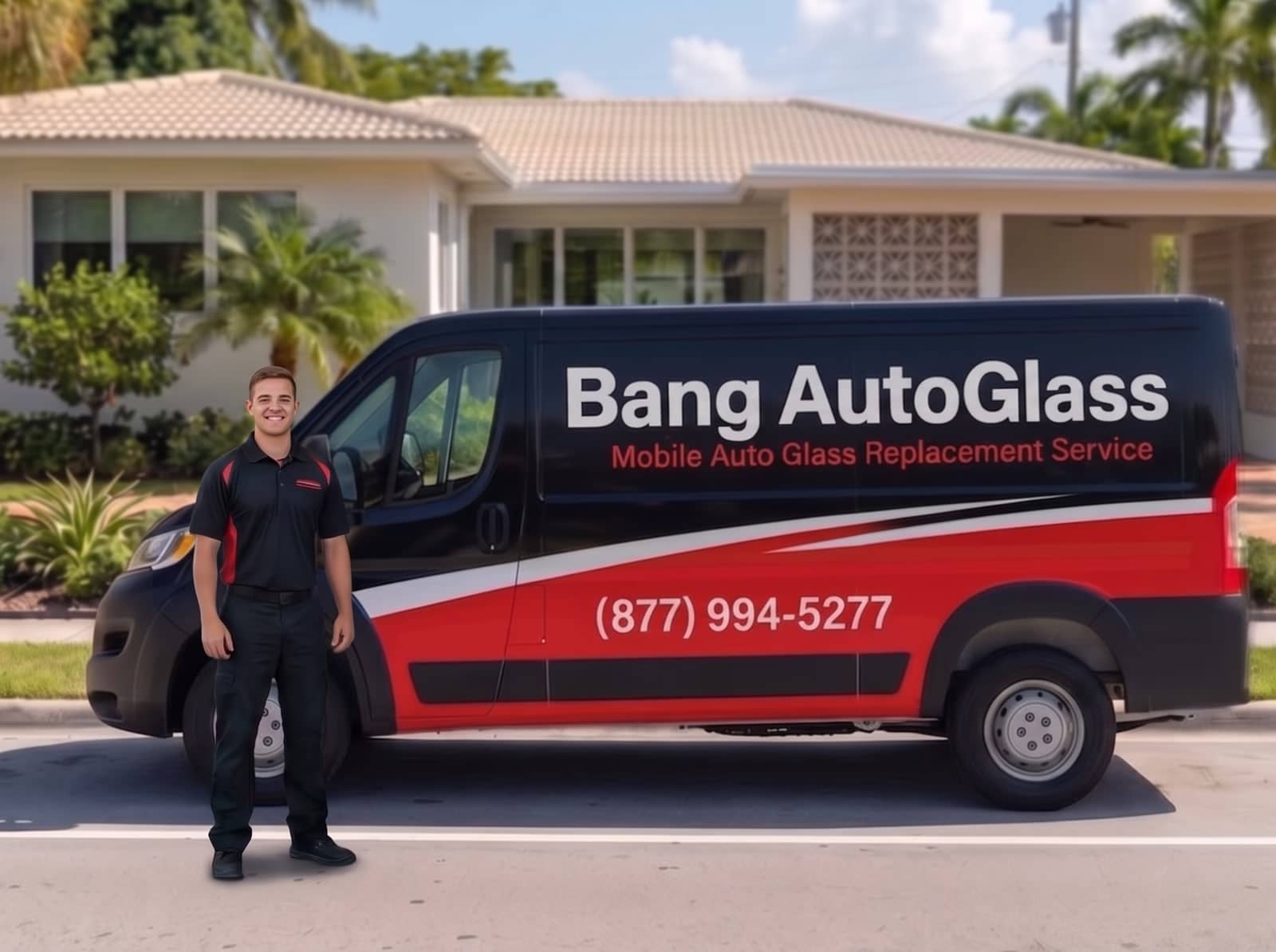
Ram Windshield Replacement
Bang AutoGlass installs Ram windshields on 1500, 2500, 3500, and ProMaster with OEM-spec laminated glass supporting forward camera, rain sensor, and HUD on 1500 TRX and Limited trims. Mobile service in Arizona and Florida includes urethane bonding, ADAS recalibration, and lifetime warranty.
Ram Windshield Replacement Services
When your Ram truck's windshield is cracked, chipped, or shattered, you need a replacement that's done right the first time. Bang AutoGlass specializes in Ram windshield replacement for the entire Ram lineup, from the half-ton Ram 1500 to the heavy-duty Ram 2500 and 3500, plus the Ram ProMaster and ProMaster City commercial vans. As a fully mobile auto glass service, we bring expert windshield replacement directly to your driveway, jobsite, or office, so you never have to interrupt your day or leave your truck sitting at a shop. With OEM-quality glass, a lifetime workmanship warranty, and next-day appointments available, we're built around getting Ram owners back on the road quickly and safely.
Why Ram Owners Choose Bang AutoGlass for Windshield Replacement
Ram trucks are workhorses, and the windshield is more than just a piece of glass. It's a structural component that supports the cab in a rollover, anchors the airbag deployment path, and on newer models, holds the camera that powers your truck's safety features. Choosing the right shop matters, and Ram drivers across our service area trust us because we combine experienced technicians, premium materials, and convenience that actually fits a working schedule.
Fully Mobile Ram Windshield Replacement
We come to you. Whether you're parked at home, at the shop, on a construction site, or at the office, our mobile auto glass team rolls up with everything needed to complete a full Ram windshield replacement on-site. There's no need to drop off your truck, arrange a ride, or burn a personal day. Most Ram windshield replacements take just 30 to 45 minutes of installation time, followed by a one-hour cure period for the urethane adhesive to set before the truck is safe to drive.
OEM-Quality Glass for Every Ram Model
Every Ram we service receives OEM-quality auto glass that meets the same DOT standards, optical clarity, and structural specifications as the original windshield from the factory. That means proper fit around the A-pillars, accurate curvature for ADAS camera alignment, correct shading at the top, and full compatibility with features like rain sensors, heated wiper park areas, acoustic interlayers, and Heads-Up Display projection where equipped.
Lifetime Workmanship Warranty
Every Ram windshield we install is backed by a lifetime workmanship warranty. If you ever experience a leak, a wind whistle, or any installation-related issue for as long as you own the truck, we'll make it right at no charge. We stand behind every job because we install every windshield like it's going on our own truck.
Next-Day Appointments Available
A cracked windshield doesn't wait, and neither should you. We offer next-day appointments for Ram windshield replacement, so a chip you noticed this morning can be a brand-new windshield tomorrow.
Ram Models We Replace Windshields For
The Ram lineup spans light-duty pickups, heavy-duty workhorses, and Class 2 and Class 3 commercial vans. Each model has its own windshield specifications, sensor layout, and replacement considerations, and our technicians are trained on the full range.
Ram 1500 Windshield Replacement
The Ram 1500 is the most common Ram windshield replacement we perform. Both the current DT-generation Ram 1500 (2019 and newer) and the Ram 1500 Classic (the carryover DS-generation truck still sold alongside the new model through 2024) use full-size windshields with model-year-specific features. The DT 1500 commonly comes equipped with a forward-facing camera mounted at the top center of the windshield for lane departure warning, lane keep assist, adaptive cruise control, and forward collision warning. Higher trims like Laramie, Longhorn, Limited, and Tungsten frequently add acoustic-laminated glass to reduce cabin noise, rain-sensing wipers, auto-dimming mirrors with HomeLink, and on select packages, a Heads-Up Display that requires HUD-compatible windshield glass.
Ram 2500 Windshield Replacement
The Ram 2500 Heavy Duty uses a larger windshield with a steeper rake and reinforced bonding surface to handle the additional cab mass and the loads associated with towing and hauling. Newer 2500s, particularly Power Wagon, Laramie, Longhorn, and Limited trims, often include the same forward-facing safety camera, surround-view camera integration, heated wiper park areas to keep your wipers from freezing to the glass in winter, and trailer-tow camera systems that interact with cab-mounted modules. Proper Ram 2500 windshield replacement requires correct OEM-quality glass, full urethane bead application, and ADAS recalibration when sensors are present.
Ram 3500 Windshield Replacement
The Ram 3500 dually and single-rear-wheel models share much of the windshield architecture with the 2500, but heavier configurations and the Aisin transmission packages can include additional sensors and tow-specific features. Whether you've got a work-spec Tradesman 3500 or a fully-loaded Limited Mega Cab pulling a fifth wheel, we install your replacement Ram 3500 windshield to factory spec with full warranty coverage.
Ram ProMaster Windshield Replacement
The Ram ProMaster is one of the most expansive windshields on the road, with a near-vertical rake and a one-piece curved design that requires careful handling and a precision install. ProMaster windshield replacement is a frequent job for delivery fleets, contractors, plumbers, electricians, and upfit van owners, and our mobile service is ideal for keeping commercial vehicles in service. We can replace ProMaster windshields on-site at your shop, depot, or yard so your van is ready for the next route.
Ram ProMaster City Windshield Replacement
The smaller Ram ProMaster City was sold through 2022 and is still a popular commercial vehicle on the road today. Its compact windshield is straightforward to replace, but we still apply the same OEM-quality glass standards, full urethane bonding procedure, and lifetime workmanship warranty to every job.
Common Causes of Ram Windshield Damage
Ram trucks see hard duty, and the windshield is the first thing to take the hit. Understanding how damage happens helps you decide whether to repair quickly or move straight to a full replacement.
Highway Rock Chips and Cracks
The most common cause of Ram windshield damage is a rock or piece of road debris kicked up by another vehicle. At highway speed, even a small pebble can chip the outer glass layer, and once a chip starts spreading, the crack can run across the entire windshield within days, especially with temperature swings.
Stress Cracks from Temperature Changes
Ram trucks parked outside in extreme heat, then hit with cold air conditioning or vice versa, can develop stress cracks that start at the edge of the windshield and travel inward without any visible impact point. These cracks almost always require full replacement.
Hail, Storms, and Falling Debris
Severe weather is brutal on truck windshields. Hail, falling tree limbs, and wind-driven debris can shatter or deeply pit a Ram windshield to the point that replacement is the only option.
Off-Road and Jobsite Damage
Ram 1500 Rebel, TRX, and Power Wagon owners who actually use their trucks off-road, along with contractors and tradespeople hauling loads to and from jobsites, often deal with damage from gravel, branches, and tools that simply can't be repaired.
Failed Prior Windshield Repairs
If a previous chip repair didn't hold, or if a low-quality install from another shop is leaking, whistling, or causing camera errors, we can replace the windshield correctly and back the work with our lifetime warranty.
Ram-Specific Windshield Features We Handle
Modern Ram trucks pack a surprising amount of technology into the windshield itself, and a proper replacement has to account for every feature your specific VIN was built with.
Acoustic Laminated Glass
Many Ram 1500 trims and most upper-tier Heavy Duty configurations come with acoustic windshields, which use a sound-dampening interlayer between the two glass layers to cut wind, road, and engine noise inside the cab. We match acoustic-equipped Rams with acoustic-spec replacement glass to preserve the quiet ride you paid for.
Forward-Facing Camera and ADAS
The forward camera mounted near the rearview mirror on Ram 1500, 2500, and 3500 trucks controls advanced driver assistance systems including lane departure warning, lane keep assist, adaptive cruise control, automatic emergency braking, and forward collision warning. After every windshield replacement on an ADAS-equipped Ram, we coordinate the required calibration to factory specifications.
Heated Wiper Park Area
Many Ram Heavy Duty trucks and select 1500 trims include a heated strip at the base of the windshield where the wipers rest, designed to melt ice and prevent the wipers from freezing to the glass. Replacement windshields must include this heating element and be properly connected during installation.
Rain-Sensing Wipers
Higher-trim Rams use a rain sensor mounted on the inside of the windshield that automatically activates the wipers when it detects moisture. The new windshield must be compatible with the sensor mount, and the sensor must be properly transferred and gel-pad reseated for full functionality.
Heads-Up Display Compatible Glass
Select Ram 1500 trims include a color Heads-Up Display that projects speed, navigation, and ADAS information onto the windshield. HUD-equipped trucks require HUD-specific windshield glass with the proper coating to display the projection clearly without ghosting.
Auto-Dimming Mirror with HomeLink
Most Ram trucks above the base trim include an auto-dimming rearview mirror, often with HomeLink garage door integration. We carefully transfer the mirror assembly during replacement and reseat it to the new windshield button.
ADAS Calibration After Ram Windshield Replacement
If your Ram is equipped with a forward-facing camera, ADAS recalibration is not optional after a windshield replacement. The camera lives behind the new glass, and even a fraction of a degree off can cause lane keep assist, adaptive cruise control, and automatic emergency braking to misread the road.
Why Calibration Is Critical
The factory calibration of your Ram's forward camera is set to the exact angle and curvature of the original windshield. Any new glass, even an identical OEM part, requires the camera to be re-aimed and the system re-trained so it reads the road accurately.
Static and Dynamic Calibration
Depending on your specific Ram model and year, calibration may be static (performed in a controlled space using factory targets), dynamic (performed during a test drive at specific speeds and conditions), or a combination of both. We handle the appropriate calibration type for your VIN.
What Happens If You Skip Calibration
Skipping ADAS recalibration after a Ram windshield replacement can cause warning lights, false alerts, system shutdowns, or worse, a system that fails to brake or steer when you need it most. We never deliver an ADAS-equipped Ram back to a customer without the calibration done.
Our Ram Windshield Replacement Process
Here's exactly what to expect when you book a mobile Ram windshield replacement with Bang AutoGlass:
- Schedule your next-day appointment by phone or through our online quick sign-up form, and let us know your Ram's year, model, trim, and any features like ADAS, HUD, or heated wiper park.
- We arrive at your location in our fully equipped mobile service vehicle, ready to complete the entire replacement on-site.
- Our technician removes the damaged windshield using cold-knife or wire-out methods that protect your paint, A-pillars, and dash.
- The pinch weld is cleaned, primed, and prepped to ensure a leak-free, factory-strength bond with the new glass.
- A continuous urethane bead is applied, and the new OEM-quality Ram windshield is set into position with precision alignment.
- The truck rests for one hour while the urethane cures to safe drive-away strength, and any required ADAS calibration is completed.
The total install takes roughly 30 to 45 minutes, plus the one-hour adhesive cure, and you're back on the road with a windshield that meets factory spec and is backed by our lifetime workmanship warranty.
How Much Does Ram Windshield Replacement Cost
The cost of Ram windshield replacement varies based on your specific model, the features built into your windshield, and whether ADAS calibration is required. A base Ram 1500 Tradesman or Classic with a simple windshield is significantly less than a fully-loaded Ram 1500 Limited with acoustic glass, HUD, rain sensor, and forward camera. Heavy Duty 2500 and 3500 trucks and ProMaster vans typically fall on the higher end due to glass size and sensor packages. We'll quote your exact Ram by VIN before we schedule, with no hidden fees and no upsells.
Insurance Claims Assistance for Ram Windshield Replacement
Most comprehensive auto insurance policies cover windshield replacement, often with little or no out-of-pocket cost depending on your deductible. If you haven't filed your claim yet, we'll walk you through the process and help you understand what to say, what information your insurer needs, and how to get the claim approved quickly. We help you with the insurance claim from start to finish and make the process as smooth as possible. Once the claim is open, we coordinate directly with your insurer for billing, so you don't have to chase paperwork.
Ram Windshield Repair Versus Replacement
Not every chip needs a full windshield. Small chips smaller than a quarter and short cracks under three inches that aren't in the driver's primary line of sight can often be repaired. However, many Ram windshield cracks, especially those near the edge or directly in front of the ADAS camera, require full replacement to maintain structural and sensor integrity. We'll give you an honest recommendation when you contact us.
Aftercare for Your New Ram Windshield
To get the longest life out of your new Ram windshield, follow these simple aftercare guidelines for the first 24 to 48 hours after installation:
- Leave at least one window cracked an inch for the first 24 hours to prevent pressure buildup inside the cab
- Avoid automatic car washes, especially high-pressure touchless washes, for the first 48 hours
- Don't remove the retention tape on the exterior moldings for at least 24 hours
- Skip slamming doors, since cabin pressure can disturb the fresh urethane seal
- Avoid off-roading or rough terrain for the first day so the bond can fully cure
- Keep the windshield clean using a microfiber cloth and standard automotive glass cleaner
Frequently Asked Questions About Ram Windshield Replacement
Can I Drive My Ram Right After the Windshield Is Replaced
Yes, after the one-hour urethane cure time, your Ram is safe to drive. We'll confirm the safe drive-away time at your appointment.
Do You Replace Windshields on Lifted Ram Trucks
Absolutely. Lift kits, leveling kits, off-road bumpers, and aftermarket accessories are no problem. Our mobile service is well-suited for trucks with custom builds since we work around your setup right at your location.
Will My Insurance Cover My Ram Windshield Replacement
In most cases yes, if you carry comprehensive coverage. In Florida, state law waives the comprehensive deductible entirely on windshield replacement, and Arizona insurers must offer optional zero-deductible glass coverage. We'll help you understand your options when you contact us.
What If My Ram Has Aftermarket Tint, a Dash Cam, or a Toll Transponder
We carefully transfer or relocate any items attached to your existing windshield, including dash cameras, toll tags, parking permits, and registration stickers, whenever possible.
Do You Service Older Dodge Ram Trucks
Yes. Even though the brand split from Dodge in 2010, we still service older Dodge Ram 1500, 2500, and 3500 trucks with the same level of care and the same lifetime workmanship warranty.
Schedule Your Ram Windshield Replacement Today
Don't let a cracked windshield turn into a bigger problem. Bang AutoGlass offers next-day mobile Ram windshield replacement, OEM-quality glass for every Ram model, full ADAS recalibration on equipped trucks, expert insurance claim assistance, and a lifetime workmanship warranty on every install. Call us or fill out the quick sign-up form at the top of this page, and we'll get your Ram back to factory clarity, factory strength, and factory safety, right in your driveway.
Ram Windshield Replacement — common questions
How long does a Ram windshield replacement take?
The replacement itself takes about 30-45 minutes, then time for the adhesive to set — about an hour is typical, and your technician confirms the exact safe drive-away time. Total visit time is roughly 1.5-2 hours.
Does my Ram windshield replacement come with a warranty?
Yes, every replacement is backed by a lifetime workmanship warranty, so you're covered for the life of your vehicle.
Will my Ram windshield replacement be covered by insurance?
With comprehensive coverage, many Ram owners pay nothing out of pocket due to Florida's deductible waiver or Arizona's optional no-deductible safety-glass coverage. We can help you start your claim.
What glass and materials do you use for Ram replacements?
We use OEM-quality glass and materials that meet your vehicle's original specifications, ensuring safety and durability.
Where we do Ram auto glass
Bang AutoGlass is a mobile auto glass company serving Arizona and Florida. We don't have a shop you drive to — we come to your home, your job, or wherever the car is sitting, with next-day appointments in most areas. In Arizona that means the whole Valley — Phoenix, Mesa, Scottsdale, Chandler, Gilbert, Tempe, Glendale and out to Tucson and Prescott. In Florida we cover Tampa Bay, Orlando and Miami, from St. Petersburg and Clearwater across to Kissimmee, Winter Park and Fort Lauderdale.
Browse every city we serve in Arizona and Florida, or read how coverage works under Arizona's glass statutes and Florida's § 627.7288.
Mobile auto glass — cities we serve
4.8★ on Google · 350+ reviews from AZ & FL drivers
“I needed my windshield replaced and they made the entire process easy. Bang AutoGlass is the best!”
“Top-notch auto glass service. They handled my windshield replacement quickly and professionally.”
“Bang AutoGlass made my windshield replacement simple from start to finish.”
Need Ram Windshield Replacement?
We come to you across Arizona and Florida — often $0 with insurance.
We reply within minutes during business hours.