BMW Rear Glass Replacement
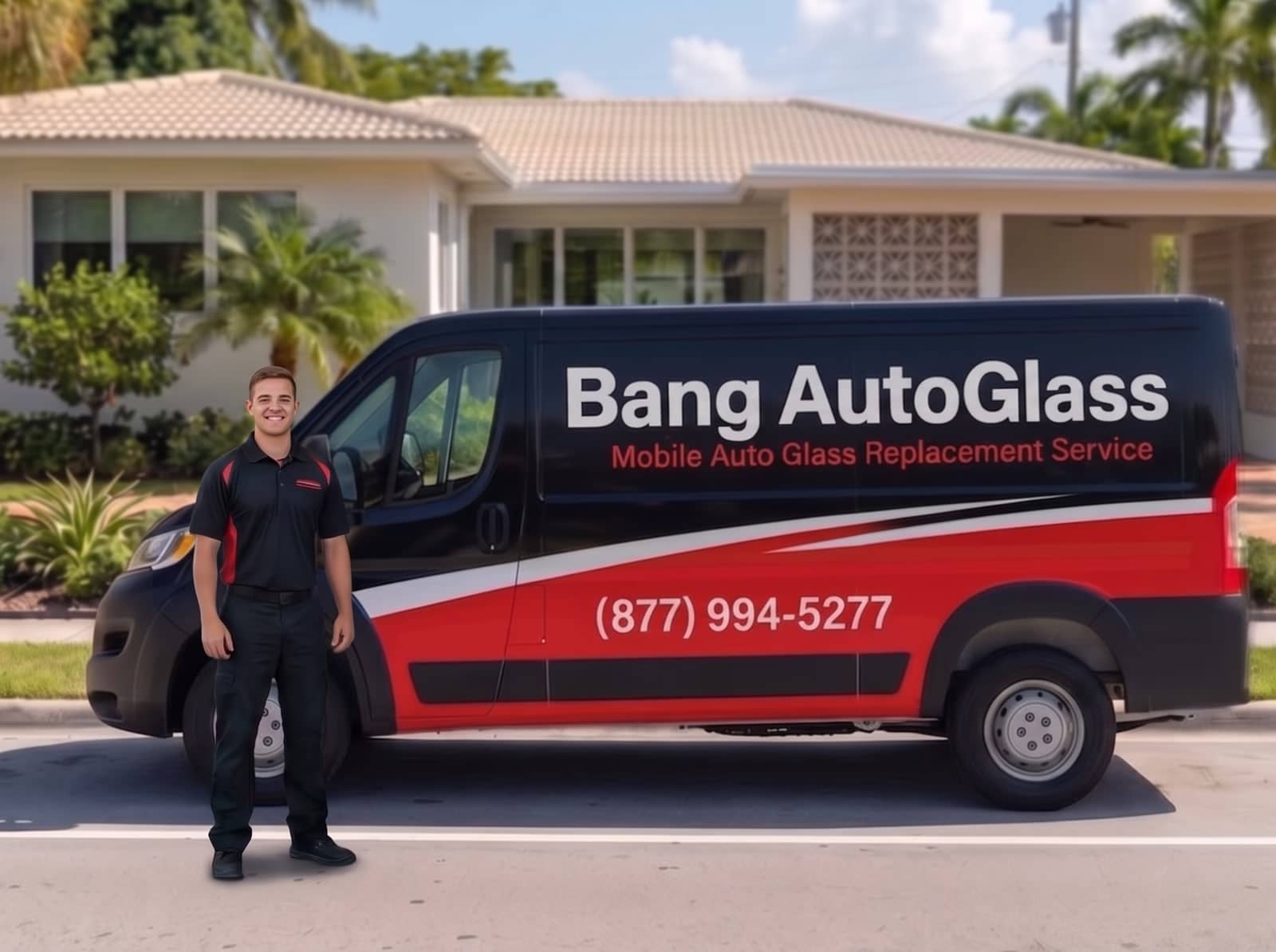
Bang AutoGlass replaces BMW rear glass wherever your car is parked in Arizona and Florida, from 3 Series and 7 Series backlights to i4 liftbacks, X3 and X7 tailgates, X6 fastback glazing, M4 coupes and Z4 roadsters. VIN-matched glass and a lifetime workmanship warranty on every install.
BMW Rear Glass Replacement: Fully Mobile in Arizona and Florida
A BMW rear window rarely fails politely. Because the pane behind you is almost always tempered, it relieves in one event and fills the parcel shelf, the sunshade cassette and the load floor with granular glass. Bang AutoGlass performs fully mobile BMW rear glass replacement across Arizona and Florida, with OEM-quality glass matched to your VIN and premium adhesive. Hands-on work runs about 30 to 45 minutes, plus roughly an hour of adhesive cure before the car is driven. Next-day appointments are typically available, and every replacement carries our lifetime workmanship warranty.
Tempered Glass Is Why There Is Nothing to Repair
Rear windows are normally tempered safety glass. Break the surface anywhere and the whole pane relieves into thousands of blunt granules rather than long shards. That is why rear window repair is not a real service: there is no chip to fill and no crack to arrest. Replacement is the only correct answer, which suits us — Bang AutoGlass is replacement-only.
Some BMW Builds Use Laminated Rear Glass
Not every rear position is tempered. Larger cars such as the 7 Series and i7, particularly those ordered with acoustic or enhanced glazing, can carry laminated glass at the back. Laminated glass holds together on its interlayer and sags rather than emptying into your cabin. We verify against your VIN rather than assuming from the model name.
BMW Builds No Pickup, But Nearly Every Other Rear End
Nothing in the range has a sliding rear window or a drop-down tailgate pane, because BMW does not sell a truck. What it does sell is an unusually wide spread of rear-end architecture: three-box sedans, frameless liftbacks styled as sedans, wagons whose rear glass opens on its own, tailgated Sports Activity Vehicles, steeply raked Sports Activity Coupes, coupes with bonded composite roofs, soft tops, and roadsters old enough that the rear window may not be glass.
Fixed Backlights: 3 Series, 5 Series, 7 Series, i5, i7
On a 3 Series, 5 Series, 7 Series, i5, i7, 2 Series Gran Coupe, M3, M5, M340i, M550i, M235i or ALPINA B7, the rear glass is a fixed pane bonded into the aperture behind the parcel shelf — no wiper, no hinge, no moving hardware. What the larger cars often do have is a powered rear sunshade whose roller and cassette sit directly under the lower edge of the glass. Granules pour straight down that sunshade slot and jam the shade weeks later.
Liftbacks That Look Like Sedans: i4 and 4 Series Gran Coupe
The i4 and 4 Series Gran Coupe are hatchbacks wearing sedan bodywork. Their rear glass is bonded into a gate that swings up on struts, so the pane moves every time the car is loaded and the loom feeding its heated grid and antenna elements flexes at the hinge. Alignment is judged against the closed position, and the gate is cycled before we call the work finished.
Sports Wagons: Rear Glass That Opens on Its Own
Where your 3 Series or 5 Series is a Sports Wagon body, the rear glass is hinged to open independently of the tailgate. The pane itself carries hinges, a latch, gas struts and a release, all of which transfer to the replacement and need adjusting, not just bolting back on. Glass that no longer closes flush becomes a wind-noise complaint at highway speed, so we cycle it and check the seal line before leaving.
Coupes and the Carbon Roof Panel
The 1 Series, 2 Series, 4 Series, 6 Series and 8 Series coupes, the M2, M4, M6, M8, M240i and M440i, and the Z3 Coupe body all use a fixed backlight in tight packaging. On M coupes ordered with the carbon-fibre roof panel, composite runs down toward the top edge of the aperture — not a surface to lever against, so the old bead is cut out with tooling chosen to respect it.
Sports Activity Vehicles: X1, X2, X3, X5, X7, iX
X1, X2, X3, X3 M, X5, X5 M, X7 and iX put the rear glass into a working tailgate. Where your vehicle carries a rear wiper, the spindle passes through or immediately alongside the pane, and the motor, seal and arm must go back correctly — a rear wiper that weeps after a glass job is almost always a seal reused when it should have been renewed. The high-mount stop lamp usually sits in the roof spoiler rather than on the pane.
The Two-Piece Tailgate on X5 and X7
X5, X5 M and X7 use a split tailgate: an upper section carrying the rear glass that lifts, and a lower section that folds down flat. Granules land in its hinge pockets and in the seal channel between the halves, where they grind against rubber every time the gate closes. We open both halves, clear that channel, and re-check latch engagement and strut travel.
Sports Activity Coupes: X4, X6 and XM
X4, X4 M, X6, X6 M and XM use the fastback roofline, giving them the most curved and most steeply raked rear glazing BMW sells. Compound curvature means the pane has to be genuinely right, because a close-enough substitute distorts visibly across that much sweep. A steep rake also throws every fragment forward and down, behind the rear seat backs and into the spare-wheel or subwoofer well.
Convertibles and Roadsters: 2 Series, 4 Series, 8 Series, Z4
Current soft tops on the 2 Series, 4 Series, 8 Series, M4, M8 and Z4 use a heated glass rear window bonded into the fabric top itself, so the glass belongs to a folding assembly that stows, flexes and must clear the roof mechanism through full travel. Retractable hardtop generations, including 3 Series and earlier 4 Series and Z4 variants, put the rear glass into a metal panel that folds into the trunk. On the oldest roadsters it may be flexible plastic rather than glass at all.
Carbon-Structured, Electric and Low-Volume BMWs
The i3 is built around a carbon-fibre passenger cell with high-voltage hardware beneath the load floor, so we work deliberately at the rear of that car. The i8, coupe and Roadster, is carbon-structured, low-production and out of production, so availability drives its timeline more than labour does. The Z8 is an aluminium-structured roadster built in small numbers. ALPINA B7 and ALPINA XB7 share most glazing with the 7 Series and X7 they are built from. For the rare cars we give you an honest read on sourcing before you plan a date around it.
What Is Printed, Bonded and Wired Into a BMW Backlight
The Defroster Grid
The heater grid is screen-printed onto the inner face of the glass and fed through tabs bonded near the edges. The replacement must be the heated variant with the correct grid layout and tab positions, and the circuit is confirmed on site. A defroster that reads dead afterwards is nearly always a connection never properly re-established.
Antenna and Telematics Elements
BMW has long routed radio reception through elements printed into the rear glass, feeding an antenna amplifier behind rear pillar or parcel-shelf trim. That pane may also carry elements tied to telematics or satellite reception. If reception was fine before the break and poor afterwards, the fault sits on the glass side, not in the head unit.
Rear Wipers, and the BMWs That Deliberately Have None
Most tailgated X models carry a rear wiper with a washer line run up the gate. The iX notably does not — BMW leaves the wiper off and leans on a water-repellent treatment on the glass instead. So the correct pane has no wiper bore and is a distinctly different part, and it should never meet abrasive pads or solvent that strips a factory coating.
Sun-Protection Glazing and Tint Density
BMW's privacy glazing, commonly specified on X models, darkens the rear side windows and the backlight from the factory. That tint lives in the glass rather than as a film over it, so the replacement must match density or the back of the vehicle reads as two different shades in Arizona or Florida sun.
Where the Glass Actually Ends Up in a BMW
A tempered pane does not break into pieces you pick up by hand — it becomes thousands of granules with momentum, and they travel. In BMWs we find them in the powered sunshade cassette on 7 Series and i7 sedans, in parcel-shelf speaker grilles, down the gap between rear seat backs and the load floor on X models, in the spare-wheel or subwoofer well under the cargo mat, in the seal channel of an X5 or X7 split tailgate, and folded into the stowage well of a convertible top, where they cut the headliner the next time the roof folds.
How We Handle the Job
- VIN and glass verification — grid layout, antenna elements, tint density, wiper bore or none, tempered or laminated, and which pane is broken.
- Mobile arrival and masking — our technician protects paint, trim, seats, load floor and exposed electronics first.
- Bulk extraction — loose granules come out of the cabin, parcel shelf, cargo bay, seal channels and top well before any cutting begins.
- Old pane and bead removal — remaining glass and the original bead are cut out without gouging the pinchweld, paint or adjacent composite.
- Hardware transfer — wiper motor and seal, hinges, latch and struts on separately opening wagon glass, mouldings and clips.
- Surface prep and glass set — the bonding flange is cleaned and primed, then OEM-quality glass is bedded into a fresh adhesive bead and supported while it takes.
- Electrical and function testing — defroster grid, antenna reception and, where fitted, wiper and washer operation.
- Deep clean and inspection — sunshade slot, speaker grilles, seat rails, cargo well, seal channels and top stowage.
How Long Does It Take?
Most rear glass replacements run about 30 to 45 minutes of hands-on installation. Because the pane is adhesive-set, plan on roughly an hour of cure before driving — a real difference from door and side glass, which is hardware-held. Separately opening wagon glass, split tailgates and a heavily contaminated cargo bay all add time.
OEM-Quality Glass and a Lifetime Workmanship Warranty
Every pane we fit is matched for thickness, curvature, optical clarity, tint density and the correct heated, antenna and wiper configuration. Every BMW rear glass replacement carries our lifetime workmanship warranty: for as long as you own the vehicle, if something traces back to how we installed it — a leak, wind noise, a defroster or antenna connection that did not hold, trim that was not reseated — we come back and put it right at no charge.
Mobile Service Across Arizona and Florida
Bang AutoGlass is fully mobile, with no shop to drive to. We come to your home, garage, office or workplace parking anywhere in our Arizona and Florida service areas, provided there is safe, level access. Company-wide we have completed more than 17,000 jobs and hold a 4.8-star rating across 350+ Google reviews. Next-day appointments are typically available, and we move quickly because an open rear aperture is exposed to weather and dust.
Insurance and Your BMW Rear Glass Claim
Rear glass damage is frequently covered under comprehensive coverage, particularly after a break-in, vandalism, road debris or a storm. Bang AutoGlass files the claim — give us your carrier and policy details and we file, document and coordinate approval.
Arizona
Arizona law (A.R.S. 20-264) requires insurers to offer optional no-deductible safety-glass coverage, and that definition reaches windshield, door and window glass. The operative word is optional: it is coverage a driver had to elect when the policy was written, and it is never automatic. If you elected it, your rear glass claim may carry no deductible. If you did not, ordinary comprehensive terms apply.
Florida
Florida law (Fla. Stat. 627.7288) requires the deductible to be waived for windshield replacement on a policy carrying comprehensive coverage. That statute is windshield-only — it does not apply to rear glass. A Florida rear window claim runs under your ordinary comprehensive terms and your normal deductible, and you should hear that plainly from us now rather than discover it afterwards.
After Your Replacement
- Allow roughly an hour of adhesive cure before driving.
- Skip automated car washes and high-pressure rinsing for 24 to 48 hours.
- Leave any retention tape or support tabs in place for a full 24 hours.
- Close doors and the tailgate normally for the first day — slamming a sealed cabin spikes pressure against a fresh bead.
- On convertibles, cycle the top gently at first and confirm the rear window clears the mechanism.
- On Sports Wagon bodies, open the separately hinged rear glass and check it settles flush.
- Watch for stray granules over the following week and tell us if you find any.
Book Your BMW Rear Glass Replacement
A BMW backlight carries a heated grid, antenna elements, factory tint density and, depending on the car, a wiper spindle or its own hinges. Our experienced technicians verify the specification against your VIN, install OEM-quality glass with premium adhesive, and test the circuits rather than assuming they work. Use the form at the top of this page or call (877) 994-5277 to book a mobile appointment, typically as soon as the next day.
BMW Rear Glass Replacement — common questions
Can the rear glass on my BMW be repaired instead of replaced?
No. BMW rear glass is normally tempered, so it collapses into granules rather than cracking and there is nothing left to fill or arrest. Replacement is the only correct fix, and we are replacement-only.
Will my defroster and radio still work after the rear glass is replaced?
Yes, when the job is done properly. BMW routes reception through elements printed into the pane, so we fit the correct heated and antenna specification for your VIN, re-make the tabs and test both on site.
Is rear glass on an X5 or X7 different because of the split tailgate?
Yes. The glass sits in the upper section that lifts while the lower half folds down, and granules collect in the seal channel between the two halves. We clear that channel and re-check latch and strut travel.
How do you know exactly which rear glass my BMW takes?
We verify against your VIN before ordering: heated grid layout, antenna elements, factory sun-protection tint density, whether there is a wiper bore, and whether your build uses tempered or laminated rear glass.
Where we do BMW auto glass
Bang AutoGlass is a mobile auto glass company serving Arizona and Florida. We don't have a shop you drive to — we come to your home, your job, or wherever the car is sitting, with next-day appointments in most areas. In Arizona that means the whole Valley — Phoenix, Mesa, Scottsdale, Chandler, Gilbert, Tempe, Glendale and out to Tucson and Prescott. In Florida we cover Tampa Bay, Orlando and Miami, from St. Petersburg and Clearwater across to Kissimmee, Winter Park and Fort Lauderdale.
Browse every city we serve in Arizona and Florida, or read how coverage works under Arizona's glass statutes and Florida's § 627.7288.
Mobile auto glass — cities we serve
4.8★ on Google · 350+ reviews from AZ & FL drivers
“I needed my windshield replaced and they made the entire process easy. Bang AutoGlass is the best!”
“Top-notch auto glass service. They handled my windshield replacement quickly and professionally.”
“Bang AutoGlass made my windshield replacement simple from start to finish.”
Need BMW Rear Glass Replacement?
We come to you across Arizona and Florida — often $0 with insurance.
We reply within minutes during business hours.