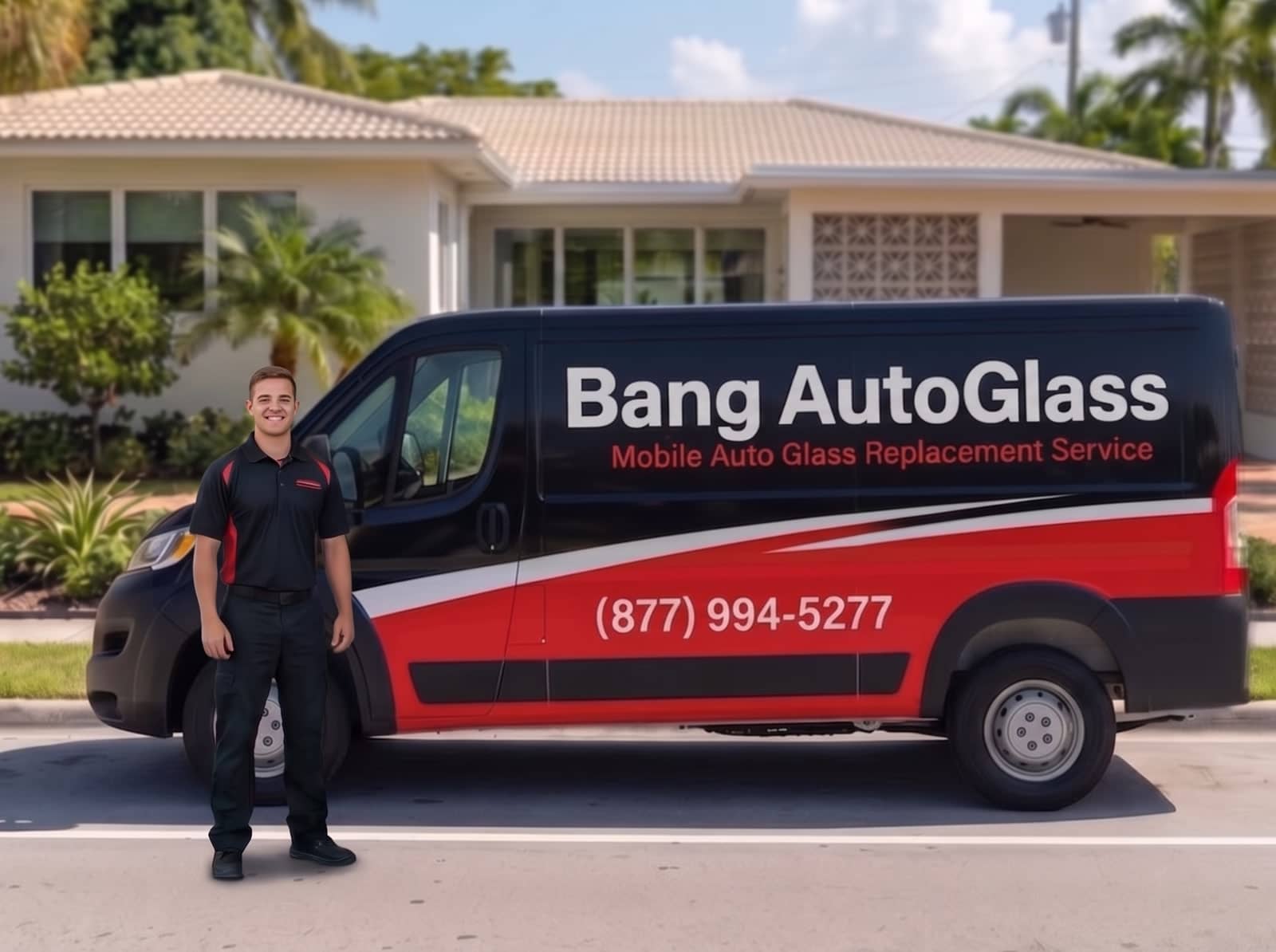
Fiat Windshield Replacement
Bang AutoGlass installs mobile Fiat windshields on 500, 500X, and 500e across Arizona and Florida with OEM-spec laminated glass supporting forward camera, rain sensor, and acoustic dampening. Every install includes urethane bonding, ADAS recalibration, and a lifetime workmanship warranty.
Fiat Windshield Replacement: Mobile Auto Glass Service Built for Italian Engineering
Owning a Fiat is about more than getting from one place to another. It's about driving something with personality, character, and a design language that stands out in a parking lot full of crossovers and sedans. So when a rock chips your windshield on the freeway or a sudden temperature swing turns a small crack into a long fracture across the driver's line of sight, you don't want just any auto glass shop touching your vehicle. You want a Fiat windshield replacement service that understands the specific quirks, sensors, and trim variations of your car. That's exactly what Bang AutoGlass delivers, and we bring it directly to your driveway, your office parking lot, or wherever your Fiat happens to be sitting. Our mobile Fiat windshield replacement service is designed around your schedule, not ours, and we back every installation with a lifetime workmanship warranty and OEM-quality materials so your Fiat looks, feels, and performs exactly the way it did the day you drove it off the lot.
Why Your Fiat Windshield Is More Than Just a Pane of Glass
Modern Fiat windshields are precision-engineered components that contribute to the structural integrity, safety, and comfort of the vehicle. Treating them like simple panes of glass is one of the biggest mistakes drivers and uncertified installers make. Your Fiat windshield is part of your roof crush protection system, it serves as the deployment surface for your passenger airbag, and on most newer Fiat models it houses or supports advanced driver assistance system (ADAS) cameras and sensors that need to see the road clearly to function correctly.
The Engineering Behind Modern Fiat Windshields
Fiat is part of the Stellantis family, which means Fiat vehicles share many of the same advanced safety platforms found in Chrysler, Jeep, Dodge, and Alfa Romeo models. That includes laminated safety glass construction with acoustic interlayers, integrated rain sensors, humidity sensors, lane departure warning cameras, and on certain trims, heated wiper park zones to keep your blades from freezing to the glass during cold mornings. Each of these features changes the way a windshield needs to be selected, installed, and calibrated. A Fiat 500e from 2024 has a completely different windshield specification than a 2014 Fiat 500 Pop, even though the cars look similar from the outside.
Common Fiat Models We Service
Bang AutoGlass services every Fiat model currently on the road in the United States. Whether you drive a peppy little city car, a turbocharged hot hatch, a family-friendly crossover, or a roadster built for weekend canyon runs, we have the experience and the OEM-quality glass to match.
Fiat 500 Windshield Replacement
The classic Fiat 500 is one of the most recognizable cars on the road, and its compact, curved windshield demands a precise fit. We replace windshields on every generation of the Fiat 500, including the Pop, Sport, Lounge, Abarth, and special editions. Most Fiat 500 windshields take about 30 to 45 minutes to install, and we always factor in the rain sensor location and any acoustic glass trim variations specific to your model year.
Fiat 500X Windshield Replacement
The Fiat 500X subcompact crossover has a noticeably larger windshield than the standard 500, which can mean a slightly higher glass cost but also a more complex installation when ADAS features are involved. Many 500X trims come equipped with lane keep assist, forward collision warning, and adaptive cruise control, all of which rely on a forward-facing camera that must be recalibrated after a windshield replacement.
Fiat 500L Windshield Replacement
The Fiat 500L is the family-friendly tall wagon variant, and its windshield is one of the larger pieces of glass in the Fiat lineup. We carry OEM-quality 500L windshields and handle the rain sensor reattachment and any forward camera recalibration required after replacement.
Fiat 500e Windshield Replacement
The all-electric Fiat 500e is the newest addition to the Fiat lineup and uses an acoustic-laminated windshield with integrated humidity sensors near the rearview mirror. These sensors help control the automatic climate system and defogging functions, and they require careful detachment, transfer, and reseating during the replacement process. We have the OEM-quality glass and the technical knowledge to handle 500e replacements without disturbing those electronic components.
Fiat 124 Spider Windshield Replacement
The Fiat 124 Spider was built on the Mazda MX-5 Miata platform and has a low, raked windshield that is particularly vulnerable to chips and cracks from highway debris. We have specialized installation techniques for convertible windshields like the 124 Spider's that ensure a perfect seal, no wind noise, and no leaks even when the top is down at speed.
Signs Your Fiat Needs a Windshield Replacement
Not every chip means a full replacement, but there are clear warning signs that should prompt you to schedule a Fiat windshield replacement appointment instead of trying to repair the damage. Knowing the difference can save you money and keep you safer on the road.
When Repair Isn't an Option
You should reach out for a full windshield replacement on your Fiat if you notice any of the following issues:
- A crack longer than three inches, especially one that reaches the edge of the glass where structural integrity is compromised
- Multiple chips clustered in the same area of the windshield that have weakened the surrounding glass
- Any damage that sits directly in the driver's line of sight, since repair resin can leave a visible blemish that distracts you while driving
- Damage that has penetrated both the outer and inner layers of the laminated glass, often visible as a deep pit with no clean surface
- A chip or crack that has been exposed to water, dirt, or temperature changes for several weeks and has begun to spread or discolor
How Cracks Spread on Fiat Windshields
Fiat vehicles, particularly the smaller 500 and 500e, have relatively flexible body structures compared to larger SUVs. That means even small bumps, potholes, or door slams can cause an existing chip to spread quickly. The temperature differential between your defroster and a cold windshield is another common culprit, especially during winter months. Once a crack starts traveling, it almost never stops on its own, which is why we recommend booking a next-day appointment with Bang AutoGlass at the first sign of significant damage.
ADAS Calibration and Your Fiat's Safety Systems
If your Fiat is a 2018 or newer model, there is a strong chance it relies on a forward-facing camera mounted near the rearview mirror to support its ADAS features. After a windshield replacement, that camera must be recalibrated to factory specifications or it will not see the road correctly.
What Is ADAS and Why Does Your Fiat Need It?
ADAS stands for Advanced Driver Assistance Systems, and on Fiat vehicles built under the Stellantis platform it can include adaptive cruise control, lane keep assist, lane departure warning, automatic emergency braking, traffic sign recognition, and forward collision warning. These features depend on a camera with a precise viewing angle through the windshield. Even a one-degree misalignment can cause the system to misread lane markings, brake unexpectedly, or fail to brake when it should.
Static vs. Dynamic Calibration for Fiat Vehicles
Fiat vehicles can require either static calibration, dynamic calibration, or both depending on the model and year. Static calibration involves placing precision targets at measured distances in front of the vehicle in a controlled environment, while dynamic calibration requires driving the car at specific speeds on well-marked roads so the camera can recalibrate itself against real-world references. Bang AutoGlass coordinates the appropriate calibration for your specific Fiat model so you drive away with every safety system functioning exactly the way Fiat engineers intended.
OEM-Quality Glass: The Standard for Every Fiat Replacement
We use OEM-quality glass on every Fiat windshield replacement we perform. This is one of the most important decisions you can make as a Fiat owner, because the wrong glass can affect everything from rain sensor accuracy to ADAS camera function to interior cabin noise.
Why Glass Quality Matters for Your Fiat
Cheaper, lower-grade glass often has subtle distortions that the human eye cannot detect at first glance but that can interfere with the optical sensors mounted to your windshield. It can also have inconsistent thickness, weaker laminate bonding, and acoustic properties that allow significantly more road and wind noise into the cabin. Our OEM-quality glass meets or exceeds the original Fiat factory specifications for clarity, thickness, acoustic dampening, and sensor compatibility.
Fiat-Specific Features We Account For
Every Fiat is built differently depending on trim, model year, and option packages. When we order glass for your replacement, we verify which of the following features your specific Fiat is equipped with so we install the correct windshield the first time.
Rain Sensors
Many Fiat 500X, 500L, and 500e trims come with optical rain sensors that automatically activate the wipers when moisture hits the windshield. These sensors mount to the inside of the glass behind the rearview mirror and require careful transfer and recalibration during replacement.
Acoustic Glass
The Fiat 500e and several higher trims of the 500X and 500L use acoustic glass, which incorporates a sound-dampening layer between the two panes of laminated safety glass.
How Acoustic Glass Improves Your Fiat Driving Experience
Acoustic glass cuts cabin noise from wind, traffic, and tire roar, which is especially noticeable in electric models like the 500e where there is no engine noise to mask outside sound. Replacing acoustic glass with standard glass saves a few dollars upfront but permanently changes the way your Fiat sounds and feels from the driver's seat. We never make that compromise.
Heated Wiper Park Areas
Some Fiat trims are equipped with heated wiper park zones at the base of the windshield to keep wiper blades from freezing in place during winter. Our OEM-quality replacement glass includes the proper heating elements and wiring connections.
Humidity Sensors
Fiat vehicles with automatic climate control often use a humidity sensor mounted near the rearview mirror to manage defogging and air conditioning behavior. We carefully detach, transfer, and reseat these sensors so your climate control system continues working without throwing dashboard warnings.
Our Mobile Fiat Windshield Replacement Process
Bang AutoGlass is a fully mobile auto glass service. That means we come to you, set up our equipment in your driveway, parking lot, or wherever your Fiat is parked, and complete the entire replacement on site.
How Mobile Service Works
Our mobile Fiat windshield replacement process is straightforward and designed to be as convenient as possible:
- Schedule your appointment, often as early as next day, by reaching out through our contact form or by calling our team directly.
- Confirm the make, model, year, and trim of your Fiat so we can order the correct OEM-quality glass and verify any sensor or ADAS features.
- Our certified mobile technician arrives at your location with the glass, urethane adhesive, primers, and tools needed to complete the job.
- We carefully remove the damaged windshield, prep the pinch weld, and install your new Fiat windshield in roughly 30 to 45 minutes.
- We allow approximately one hour for the urethane adhesive to fully cure before the vehicle can be safely driven.
- If your Fiat requires ADAS recalibration, we coordinate the appropriate static or dynamic calibration so every safety system is back to factory specifications.
Total Time Investment
From the moment we arrive to the moment your Fiat is safely back on the road, you are usually looking at about an hour and a half to two hours total when you account for the 30 to 45 minute installation and the one hour adhesive cure time. You can go about your day during the cure window. There is no need to drive somewhere, sit in a waiting room, or shuffle a rental car into the equation.
Next-Day Appointments for Fiat Owners
We know that a damaged windshield is not something most drivers want to live with for a week. Visibility issues, the constant worry of the crack spreading, the wind whistle from a poorly sealed chip, and even the legal complications of driving with obstructed vision all make fast service essential. That is why Bang AutoGlass offers next-day appointments for Fiat windshield replacement whenever possible. Reach out today and there is a strong chance we can have a technician at your location tomorrow.
Lifetime Workmanship Warranty on Every Fiat Replacement
Every Fiat windshield replacement we perform is backed by a lifetime workmanship warranty. That means if you ever experience a leak, a wind whistle, a trim issue, or any other problem related to the way we installed your windshield, we will come back out and make it right at no cost to you. We stand behind our work for as long as you own the vehicle because we believe a quality installation should not have an expiration date.
Filing an Insurance Claim for Your Fiat Windshield
Most comprehensive auto insurance policies cover windshield replacement, often with a low deductible or in some cases no deductible at all. If you have not yet contacted your insurance provider about your Fiat windshield damage, our team can walk you through what to expect.
How We Help You Through the Claims Process
We help you with the insurance claim from start to finish and make the process as smooth as possible. We will explain what information your insurance company will likely ask for, including your policy number, the date and circumstances of the damage, the make and model of your Fiat, and an estimate for the replacement. We can provide a written quote for your records, answer questions about OEM-quality glass requirements, and help you understand what your deductible means for the final out-of-pocket cost. Once the claim is filed and approved, we coordinate directly with your insurance company on billing so you are not left handling paperwork after the fact.
After Your Fiat Windshield Replacement: Aftercare Tips
Taking proper care of your Fiat in the first 24 to 48 hours after a windshield replacement protects the seal, the adhesive cure, and the long-term integrity of the installation. Avoid slamming your doors during the first day, since the pressure spike inside the cabin can disturb the still-curing urethane. Keep at least one window cracked slightly during the first few hours to let air pressure equalize naturally. Avoid car washes, especially high-pressure washes, for at least 48 hours. Leave the retention tape in place for the first 24 hours if your technician applied any. And avoid driving on rough or unpaved roads when possible during the first day, since heavy vibration can stress a fresh seal.
Schedule Your Fiat Windshield Replacement Today
Your Fiat deserves better than a one-size-fits-all repair shop. It deserves a mobile auto glass team that understands Italian engineering, respects the technology built into modern Stellantis platforms, and treats every installation like the safety-critical job that it is. Bang AutoGlass brings OEM-quality glass, certified mobile technicians, lifetime workmanship warranties, and next-day availability directly to your driveway. Reach out today using the contact form at the top of this page or give us a call to lock in your appointment, and let us get your Fiat back on the road looking, sounding, and driving the way it should.
Frequently asked questions
How long does Fiat windshield replacement take?
The replacement itself takes about 30–45 minutes, then the adhesive needs roughly 1 hour to set before you can drive. If your Fiat has a safety camera (typically 2018+), ADAS calibration adds about 15–30 minutes.
Will my Fiat windshield replacement be covered by insurance?
Most comprehensive insurance policies cover windshield damage. In Florida, comprehensive coverage typically waives the deductible entirely, so you pay nothing out of pocket. In Arizona, many drivers have optional no-deductible glass coverage. We can help you understand your policy and file a claim if needed.
Is the windshield glass OEM-quality and warranty protected?
Yes, every replacement uses OEM-quality glass and materials. Your windshield is backed by our lifetime workmanship warranty, protecting you against defects.
How does mobile windshield replacement work for my Fiat?
Our fully-equipped technicians come to your home, work, or roadside and complete the entire replacement on-site. The quality matches a traditional shop, with no need to visit a facility.
4.8★ on Google · 350+reviews from AZ & FL drivers
“I needed my windshield replaced and they made the entire process easy. Bang AutoGlass is the best!”
“Top-notch auto glass service. They handled my windshield replacement quickly and professionally.”
“Bang AutoGlass made my windshield replacement simple from start to finish.”
Need Fiat Windshield Replacement?
We come to you across Arizona and Florida — often $0 with insurance.
We reply within minutes during business hours.