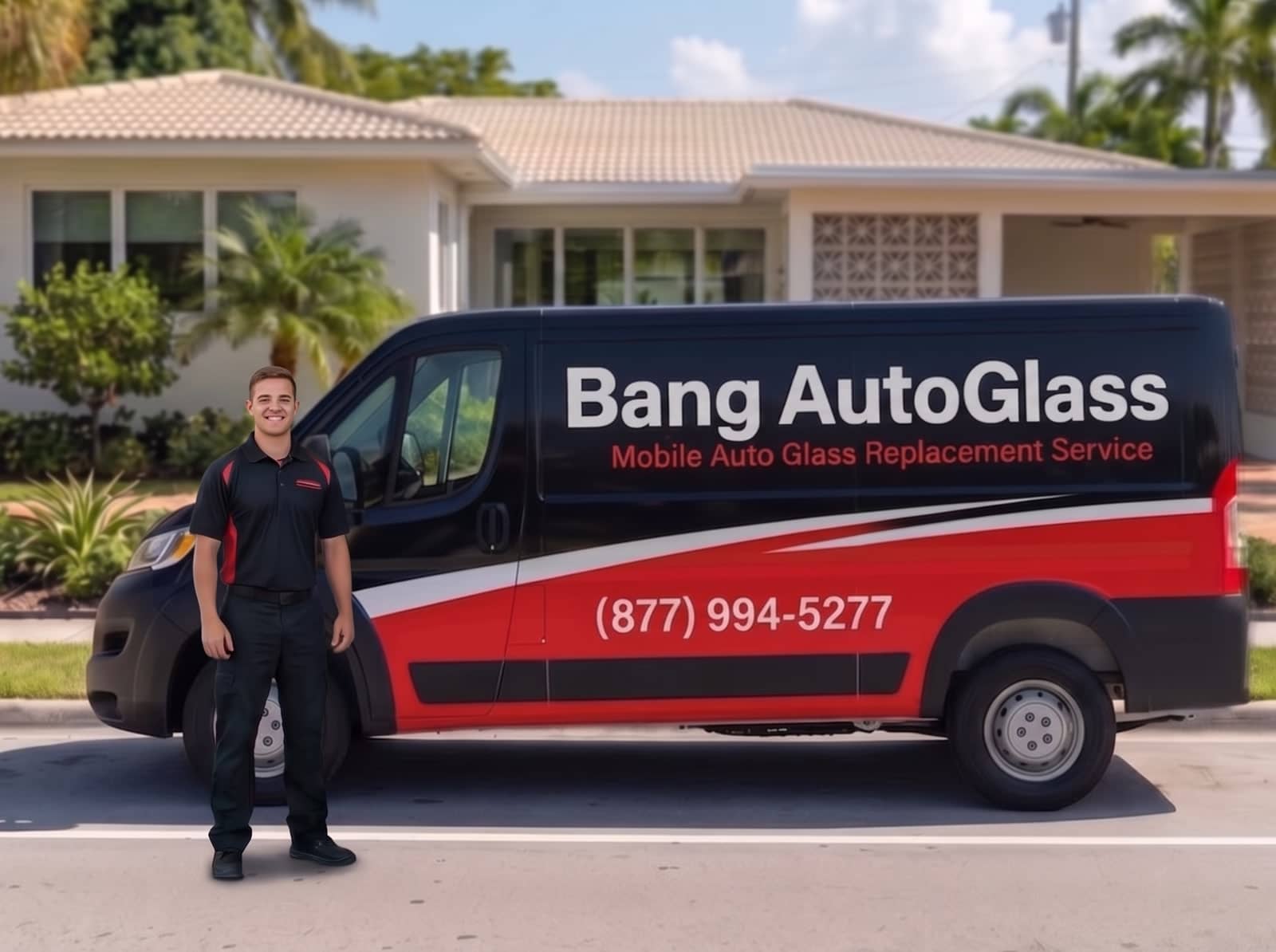
Ford Windshield Replacement
Bang AutoGlass installs Ford windshields on F-150, Explorer, Escape, Mustang, Bronco, and Mach-E with OEM-spec laminated glass supporting Co-Pilot360 camera, BlueCruise driver camera, HUD, and heated wiper park. Mobile service in Arizona and Florida includes ADAS recalibration and lifetime warranty.
Ford Windshield Replacement: Expert Mobile Service from Bang AutoGlass
When the windshield on your Ford truck, SUV, or sedan gets cracked, chipped, or shattered, you need a replacement done right the first time. Bang AutoGlass specializes in Ford windshield replacement, bringing professional, dealership-quality service directly to your driveway, workplace, or wherever your Ford happens to be parked. Whether you drive a Ford F-150, Explorer, Escape, Mustang, Bronco, or any other Ford in the lineup, our certified technicians have the tools, training, and OEM-quality materials to restore your vehicle to factory specifications quickly and safely.
Ford windshields are not what they used to be. Today's models feature advanced driver assistance systems (ADAS), acoustic laminated glass, heated wiper park areas, rain sensors, and even heads-up display projection technology. A modern Ford windshield is a critical structural and safety component, and improper installation can compromise everything from your airbag deployment timing to your lane-keeping assist accuracy. That's why choosing a trusted mobile auto glass specialist for your Ford windshield replacement matters more now than ever before.
Why Ford Drivers Choose Bang AutoGlass
Ford is one of America's most trusted vehicle brands for good reason: durability, performance, and constant innovation. Your auto glass service should match that same standard. At Bang AutoGlass, we pair OEM-quality glass with manufacturer-recommended urethane adhesives, deliver next-day appointments throughout our service area, and stand behind every installation with a lifetime workmanship warranty. Every replacement is completed in just 30 to 45 minutes, followed by a one-hour safe drive-away cure time, so most customers are back on the road the same morning we arrive.
Understanding Your Ford Windshield
The Engineering Behind Modern Ford Glass
A Ford windshield is far more than a sheet of glass. It is a laminated safety component made of two layers of automotive-grade glass bonded with a polyvinyl butyral (PVB) interlayer. This construction prevents shattering during impact and provides up to 45% of the vehicle's structural integrity during a rollover event. Ford engineers spec specific curvature, thickness, and acoustic dampening properties for every model and trim level, which is exactly why generic, one-size-fits-all glass simply will not do for your F-Series truck, Explorer SUV, or Mustang coupe.
Ford-Specific Features That Affect Replacement
Acoustic Laminated Glass
Most current Ford F-150, Edge, Explorer, and Expedition trims include acoustic laminated windshields with a sound-dampening interlayer. This technology reduces cabin noise on the highway by up to six decibels, and we always match acoustic glass for acoustic-equipped Ford vehicles so your ride feels exactly as quiet as it did the day you drove it off the lot.
Rain-Sensing Wipers
Found on higher trims of the Ford Explorer, Ford Edge, F-150 Lariat and above, and most Lincoln-badged Fords, rain-sensing wipers rely on an optical sensor bonded directly to the windshield. After replacement, the sensor must be properly reseated, gel-padded, and verified to function correctly before we leave your driveway.
Heated Wiper Park Area
Cold-weather Ford packages, especially on the F-150 and Super Duty trucks, include a heated wiper park area that melts ice off your wiper blades at the base of the windshield. This requires a heated-glass-compatible replacement and proper electrical reconnection at the harness, and we stock the correct heated windshield for every Ford trim that came with this feature.
Ford Heads-Up Display (HUD)
Available on the Mustang Mach-E, certain F-150 trims, Explorer ST and Platinum, and Edge ST, Ford's HUD projects speed, navigation prompts, and collision warnings onto the windshield itself. HUD-equipped vehicles require a specially polarized windshield. Installing a non-HUD windshield in a HUD-equipped Ford will cause a double-image, ghosted projection that ruins the feature.
ADAS Camera Mounts and Sensor Brackets
Ford Co-Pilot360 components — lane departure warning, pre-collision assist, intelligent adaptive cruise control, and BLIS Blind Spot Information System — all rely on forward-facing cameras mounted directly to the windshield. Replacement requires precise camera reinstallation and, in many cases, full dynamic or static recalibration before the vehicle leaves the service appointment.
Ford Models We Service
Ford F-Series Trucks
The Ford F-150 is the best-selling truck in America, and it is also the most common windshield replacement we perform. We service every generation from the 2009 twelfth-gen F-150 to the latest fourteenth-gen models, including hybrid PowerBoost and Lightning EV variants. We also handle Super Duty F-250, F-350, and F-450 XL, Lariat, King Ranch, Platinum, and Limited trims, which often include heated wiper park areas, panoramic windshields on some Limited trims, and extensive ADAS integration tied into the truck's safety suite.
Ford SUVs and Crossovers
From the compact Ford Escape and EcoSport to the mid-size Edge and Explorer, three-row Expedition, and the rugged Ford Bronco and Bronco Sport, our technicians know the unique trim, molding, and cowl requirements of every Ford SUV. Each model has its own urethane bead specification, A-pillar removal procedure, and rain sensor configuration. We follow Ford's published replacement procedures to the letter on each one.
Ford Cars, Vans, and EVs
We replace windshields on the Ford Mustang (including GT, Mach 1, Dark Horse, and Mach-E electric variants), Ford Maverick compact pickup, Ford Ranger mid-size truck, Ford Transit and Transit Connect cargo vans, and legacy models like the Focus, Fusion, Taurus, and Flex. Whether your Ford is from 2005 or 2026, we have access to the correct OEM-quality windshield for your VIN, body style, and option package.
Signs Your Ford Needs a Windshield Replacement
Not every Ford windshield issue requires a full replacement, but the following warning signs should prompt a call to Bang AutoGlass right away:
- A crack longer than six inches or any crack reaching the edge of the glass
- Multiple chips or any single chip larger than a quarter
- Damage directly in the driver's line of sight that compromises visibility
- A chip or crack overlapping the windshield's frit band, ADAS camera area, or rain sensor
- Internal delamination that appears as cloudy or bubbled areas between the glass layers
- Pitting from sand, road debris, or weather that causes glare at night
- A leak, whistle, or wind noise that indicates a previous installation has failed
If any of these describes your Ford, replacement is typically safer and more cost-effective than repeated repairs or living with degraded visibility.
The Ford Windshield Replacement Process
Assessment and Quote
We begin by verifying your Ford's VIN, year, trim, and ADAS package to ensure we bring the correct OEM-quality windshield and the right adhesive system. This step is critical because a 2023 Ford F-150 Lariat with FordPass Connect, Co-Pilot360 2.0, and a heated wiper park area requires a completely different windshield than a base XL trim from the same model year.
Old Windshield Removal
Our technician protects your Ford's paint, dashboard, and interior with covers, then carefully removes the cowl, A-pillar trim, and rearview mirror assembly. Using cold-knife or fiber-line cutting tools, we extract the old glass without scratching your pinch weld, damaging surrounding moldings, or disturbing your factory paint.
Pinch Weld and Frame Preparation
The pinch weld is cleaned of old urethane down to a thin, even layer, inspected for rust, and primed where needed. Any corrosion is treated before new glass goes in, because rust under a windshield is one of the most common causes of premature failure, leaks, and wind noise on older Fords.
OEM-Quality Installation
We apply a fresh bead of high-modulus, fast-cure urethane adhesive engineered to meet or exceed Ford Motor Company's FMVSS 212 safe drive-away standards. The new windshield is set with precision suction tools, properly indexed to your Ford's body lines, and seated for a perfect factory fit with no gaps, no twist, and no high spots.
Cure Time and Final Inspection
Total installation time is typically 30 to 45 minutes, after which the urethane needs one hour of cure time before your Ford is safe to drive. Our technician verifies all electronics, sensors, and trim are properly reconnected, performs a water test where appropriate, and walks you through aftercare instructions before leaving.
Ford ADAS Calibration After Windshield Replacement
What Is Ford Co-Pilot360?
Ford Co-Pilot360 is the suite of advanced driver assistance technologies built into nearly every new Ford since 2019. It includes Pre-Collision Assist with Automatic Emergency Braking, BLIS Blind Spot Information System, Lane-Keeping System, Auto High-Beam Headlamps, and the rearview camera. Most of these features rely on a windshield-mounted camera that reads lane markings, traffic signs, road curvature, and surrounding vehicles in real time.
Why Calibration Matters
When the windshield is replaced, that camera's angle changes by even a fraction of a degree, which can throw off lane-departure timing, automatic emergency braking distance, or adaptive cruise following gaps. Ford requires either a static calibration with targets in a controlled environment or a dynamic calibration performed at highway speeds, depending on the model year and feature set. Bang AutoGlass coordinates ADAS calibration as part of your Ford windshield replacement so your safety systems perform exactly as Ford engineered them to.
Mobile Ford Windshield Replacement
How Our Mobile Service Works
You don't need to take time off work or sit in a waiting room. Bang AutoGlass is a 100% mobile auto glass company, which means we bring the shop to you. Schedule your Ford windshield replacement online or by phone, choose a location — your home, office, gym, jobsite, or even a parking lot — and our technician arrives with a fully stocked service truck carrying the correct OEM-quality Ford windshield, all adhesives, primers, trim clips, and tools needed to complete the job onsite.
Next-Day Availability
Most Ford windshield replacements can be scheduled for the very next day. We understand that a cracked windshield is not a problem you want to live with for a week. Whether you drive a daily-driver Ford Escape or a hard-working F-250 Super Duty, our next-day mobile appointments keep your Ford on the road with minimal disruption to your schedule.
Insurance and Ford Windshield Replacement
How We Assist With Your Claim
If you carry comprehensive coverage on your Ford, your windshield replacement is often covered with little to no out-of-pocket cost. We help you with the insurance claim from start to finish and make the process as smooth as possible. Once your claim is open, we coordinate directly with your insurance company on invoicing and documentation so you don't have to play middleman.
Out-of-Pocket Pricing
For drivers who prefer to pay directly, or who don't carry comprehensive coverage, Bang AutoGlass offers transparent, upfront pricing on every Ford windshield replacement. We never tack on surprise charges for ADAS calibration, mobile service, or disposal — what you're quoted is what you pay.
Cost of Ford Windshield Replacement
Several factors influence the final price of a Ford windshield replacement:
- Vehicle model and year — a 2024 Ford F-150 Limited will cost more than a 2012 Ford Focus due to glass complexity and ADAS integration
- Glass features — acoustic laminated, heated wiper park, rain sensor, HUD, and solar coating all add to the cost
- ADAS calibration requirements — dynamic and static calibrations require specialized equipment and additional service time
- Trim and molding condition — if surrounding cowl, A-pillar, or moldings need replacement, that adds to the total
- Insurance coverage — comprehensive deductibles and zero-deductible glass waiver policies affect what you ultimately pay
We provide free quotes for every Ford windshield replacement and explain exactly which factors apply to your specific vehicle so there are no surprises.
Repair vs. Replace: Making the Right Call for Your Ford
When Windshield Repair Is an Option
Small chips — typically smaller than a quarter and away from the driver's line of sight — can sometimes be repaired with resin injection. Repair is faster and cheaper, but it has real limits, especially on newer Ford vehicles where damage near the camera array or rain sensor can interfere with safety system performance.
When Replacement Is the Only Safe Choice
For Ford models with ADAS cameras, HUD projection, or rain sensors, any damage near the sensor area should trigger a full replacement rather than a repair. Cracks longer than six inches, damage on both sides of the laminate, damage in the driver's primary viewing area, and any chip near the windshield edge all call for replacement to maintain your Ford's structural integrity and the proper function of its safety systems.
Caring for Your New Ford Windshield
The First 24 Hours
After your installation, keep the urethane cure window in mind. For the first hour, do not drive the vehicle. For the first 24 hours, avoid automatic car washes, slamming doors with the windows fully up, removing the retention tape, and parking on uneven surfaces that flex the body. Cracking a window slightly to equalize cabin pressure when closing doors is a smart habit during this window.
Long-Term Maintenance
Replace your wiper blades every six to twelve months to prevent micro-scratches on the new glass. Avoid ammonia-based cleaners that can damage tinted edges or sensor gel pads. Keep your defrost on a moderate setting in winter rather than blasting hot air onto frozen glass, which can cause thermal-stress cracks. Address any new chip immediately — early repair often saves a full replacement later.
Why Bang AutoGlass Is the Right Choice for Your Ford
Choosing the right auto glass company protects your Ford, your passengers, and your investment. Bang AutoGlass delivers Ford windshield replacement service built around three commitments: OEM-quality glass and adhesives that match factory specifications, a lifetime workmanship warranty that covers any installation-related issue for as long as you own your Ford, and a fully mobile service model designed around your schedule with next-day availability.
Whether you need a Ford F-150 windshield replacement after a highway rock strike, a Ford Explorer windshield replacement with rain sensor and lane-keep recalibration, or a Ford Mustang windshield replacement that preserves the acoustics and look of your sports car, we have the experience, the materials, and the commitment to do it right. Call Bang AutoGlass today to book your Ford windshield replacement and put a confident, crystal-clear view back on the road.
Frequently asked questions
How long does a Ford windshield replacement take?
The replacement typically takes about 30-45 minutes to complete, then about 1 hour for the adhesive to set before you can drive. For newer Ford models with safety cameras, ADAS calibration adds roughly 15-30 minutes to ensure your lane-keeping and braking features work correctly.
Do you use OEM-quality glass for Ford windshields?
Yes, every Ford windshield replacement uses OEM-quality glass and materials, backed by a lifetime workmanship warranty. Your new windshield will meet the same standards as the factory original.
Is my Ford windshield covered by insurance?
Many comprehensive auto insurance policies cover windshield damage with little or no out of pocket cost. In Florida, windshield coverage waives the deductible, so qualifying drivers pay nothing. We'll help you file or start your claim if needed.
How does your mobile Ford windshield service work?
Our fully-equipped technicians come to your home, workplace, or roadside and complete the entire replacement on-site with the same quality as a traditional shop, so you don't have to drive anywhere.
4.8★ on Google · 350+reviews from AZ & FL drivers
“I needed my windshield replaced and they made the entire process easy. Bang AutoGlass is the best!”
“Top-notch auto glass service. They handled my windshield replacement quickly and professionally.”
“Bang AutoGlass made my windshield replacement simple from start to finish.”
Need Ford Windshield Replacement?
We come to you across Arizona and Florida — often $0 with insurance.
We reply within minutes during business hours.