Land-Rover ADAS Calibration
Bang AutoGlass coordinates Land Rover ADAS calibration after windshield service so Adaptive Cruise Control, Emergency Braking, Lane Keep Assist, Blind Spot Assist, and ClearSight read targets correctly on Range Rover, Velar, Defender, and Discovery. Arizona and Florida mobile, warranty-backed.
Land Rover ADAS Calibration: Restoring Factory-Precise Safety After Windshield Replacement
Modern Land Rover vehicles are engineered with some of the most sophisticated Advanced Driver Assistance Systems on the road today. From the Range Rover's adaptive cruise with steering assist to the Defender's 360-degree camera array, every safety feature depends on a forward-facing camera that lives directly behind your windshield. The moment that windshield is removed, replaced, or even slightly disturbed, that camera loses its precise factory alignment. Land Rover ADAS calibration is the manufacturer-mandated process that brings those eyes back into perfect focus, ensuring your SUV's lane keep assist, autonomous emergency braking, traffic sign recognition, and adaptive cruise control all perform exactly as Solihull's engineers intended.
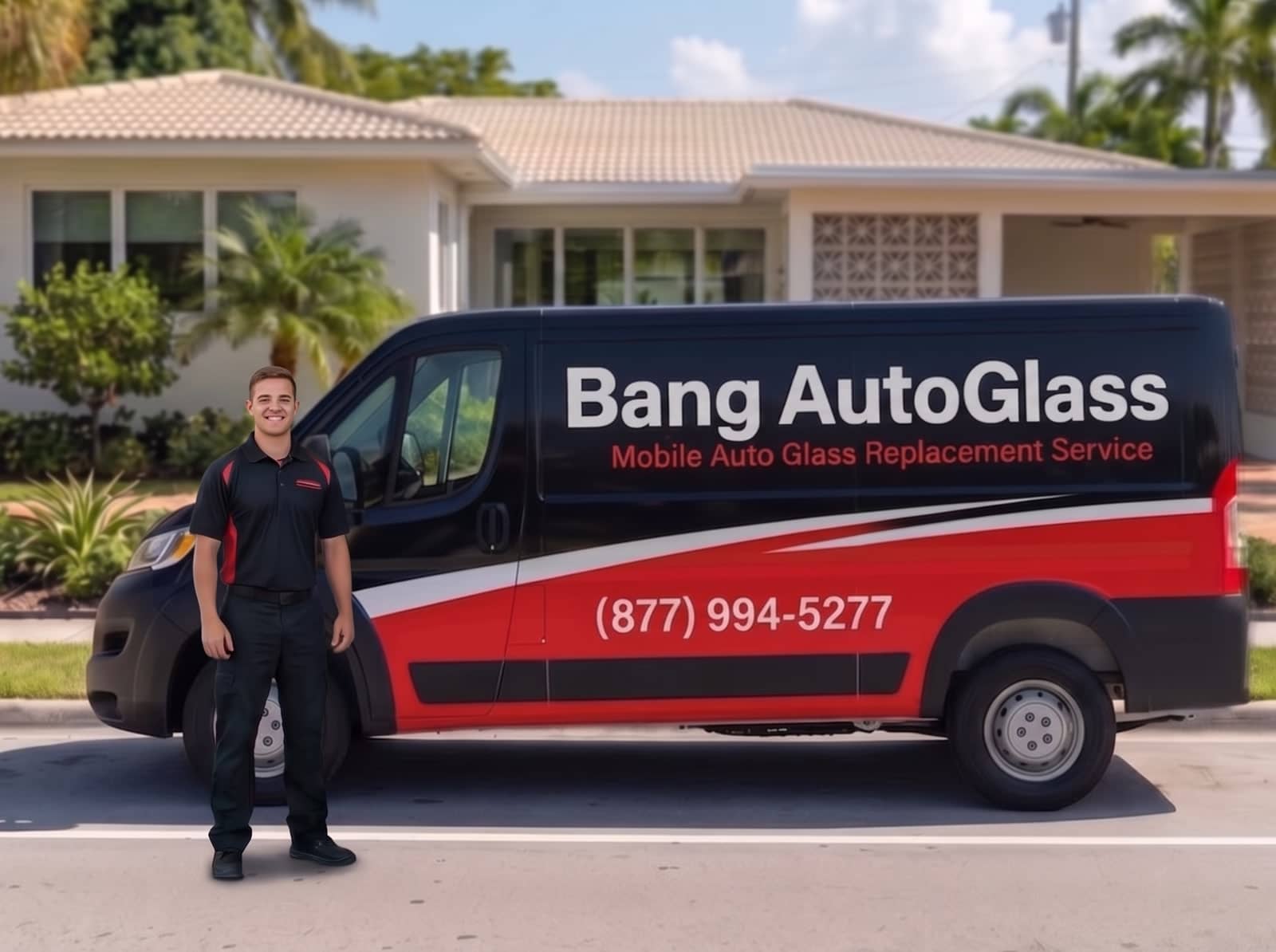
At Bang AutoGlass, we specialize in mobile Land Rover windshield replacement paired with full ADAS recalibration, all completed at your home, office, or jobsite. Our technicians understand that a Land Rover is more than transportation; it is a precision machine, and the calibration of its driver assistance suite is non-negotiable. Skipping this step does not just risk a dashboard warning light. It can cause emergency braking to trigger late, lane keep assist to drift, or adaptive cruise to misjudge following distance, every one of which is a serious safety concern.
What Land Rover ADAS Calibration Actually Does
ADAS calibration is the procedure of realigning your vehicle's onboard cameras and radar sensors so they accurately interpret the world around your Land Rover. The forward-facing camera, mounted at the top center of the windshield inside what Land Rover refers to as the Image Processing Module 'A' (IMPA) housing, processes lane markings, vehicles, pedestrians, cyclists, and posted speed limit signs in real time. Even a one-degree misalignment of that camera can translate into several feet of error several hundred feet down the road. Calibration uses precision targets, measured distances, level surfaces, and factory-specified procedures to bring the camera back into alignment within fractions of a degree.
Why Land Rover Specifically Requires Recalibration After Glass Replacement
Jaguar Land Rover has issued explicit position statements requiring ADAS recalibration any time the windshield is replaced on a vehicle equipped with the IMPA forward-facing camera. This applies across nearly every modern Land Rover and Range Rover model. The bracket that holds the camera is bonded to the windshield itself, so replacing the glass means replacing the camera's mounting reference. Without recalibration, the vehicle has no way to know whether the camera is pointing where it thinks it is, and the entire ADAS suite operates on guesswork.
Land Rover and Range Rover Models That Require ADAS Calibration
Virtually every Land Rover and Range Rover built since the late 2010s with a forward-facing camera will require recalibration after windshield replacement. Below are the most common models we service.
Range Rover and Range Rover Sport
The flagship Range Rover and Range Rover Sport feature an extensive ADAS suite, including Adaptive Cruise Control with Steering Assist, Lane Keep Assist, Emergency Braking, Blind Spot Assist with Vehicle Detection, and a four-camera 3D Surround Camera System. The forward-facing camera behind the windshield is the central nervous system for collision avoidance, lane discipline, and the Adaptive Speed Limiter that automatically adjusts vehicle speed based on detected speed limit signs.
Land Rover Discovery and Discovery Sport
The Discovery and Discovery Sport carry a similarly equipped ADAS package, with traffic sign recognition tied directly to the adaptive speed limiter, full-stop adaptive cruise control, lane departure warning, and rear traffic monitor. Calibration on these models is particularly sensitive because of how aggressively the autonomous emergency braking system intervenes when the camera detects a potential collision.
Land Rover Defender
The reborn Defender, including the Defender 90, 110, and 130 variants, features a four-camera 360-degree visibility system, ClearSight Ground View, Wade Sensing, and the same forward-facing camera-driven safety stack as its Range Rover siblings. Off-road capability does not exempt the Defender from on-road ADAS responsibilities, and recalibration is mandatory after any windshield service.
Range Rover Velar and Range Rover Evoque
Both the Velar and Evoque carry the IMPA camera and the full driver assistance suite, including Driver Condition Monitor, Lane Keep Assist, and Adaptive Cruise Control. The compact dimensions of the Evoque and the coupe-like roofline of the Velar mean precise camera angle is even more critical, as the field of view is tighter than on full-size Range Rovers.
ADAS Features on Your Land Rover That Depend on Proper Calibration
Every one of the following features routes through the forward-facing camera and must be recalibrated after windshield replacement.
Adaptive Cruise Control with Steering Assist
This system uses the windshield camera in combination with front radar to maintain a set distance from the vehicle ahead and gently steer to keep your Land Rover centered in its lane. A miscalibrated camera causes the system to misjudge lane center, leading to weaving or premature disengagement.
Lane Keep Assist and Lane Departure Warning
These features rely entirely on the camera reading lane markings. Even minor calibration errors cause the system to misinterpret lane position, triggering false warnings or, more dangerously, failing to warn at all when drift occurs.
Autonomous Emergency Braking and Forward Collision Warning
Land Rover's emergency braking can detect vehicles, pedestrians, and cyclists. The camera identifies the threat while radar measures distance and closing speed. Calibration determines exactly where the camera is looking, which directly affects whether the system intervenes in time.
Traffic Sign Recognition and Adaptive Speed Limiter
This feature reads posted speed limit signs and can automatically adjust your Land Rover's maximum speed to match. A misaligned camera can read signs intended for adjacent roads or miss signs entirely, leading to incorrect speed limiting.
Blind Spot Assist and Rear Traffic Monitor
While these features primarily use side and rear sensors, several Land Rover models cross-reference forward camera data for object classification, particularly when changing lanes at highway speeds.
When Your Land Rover Needs ADAS Calibration
Recalibration is required in any of the following situations:
- Windshield replacement on any Land Rover or Range Rover equipped with the forward-facing IMPA camera
- Removal and reinstallation of the camera bracket or camera module itself
- Front-end collision repair, even minor, that affects suspension geometry, ride height, or front bumper alignment
- Suspension work, including air suspension reprogramming, alignment changes, or wheel and tire size changes
- Replacement or reprogramming of the camera or any related ADAS module
- Any dashboard warning light related to the ADAS, lane assist, or cruise control systems
Static Versus Dynamic Calibration on Land Rover Vehicles
Land Rover supports both static and dynamic calibration depending on the model year, trim, and ADAS package installed. Most modern Land Rover and Range Rover vehicles require a combined approach.
Static Calibration
Static calibration takes place with the Land Rover stationary on a perfectly level surface, with manufacturer-specified targets placed at precise distances and angles in front of the vehicle. Our calibration equipment communicates with the vehicle's onboard ADAS module to align the camera against those targets to within fractions of a degree. This procedure is used for the lane departure system, forward collision warning camera alignment, and the adaptive cruise control camera reference point.
Dynamic Calibration
Dynamic calibration involves driving the Land Rover under specific conditions, typically on well-marked roads at sustained speeds between 30 and 50 miles per hour. The camera observes lane markings, traffic signs, and surrounding vehicles in real time, allowing the ADAS module to fine-tune itself based on real-world inputs. Many Land Rover models require dynamic calibration in addition to static calibration to fully complete the procedure.
Why Land Rover Often Requires Both
Jaguar Land Rover specifies a dual calibration procedure on most modern vehicles to verify that the camera performs correctly both in controlled conditions and in real-world driving. Skipping either step leaves part of the ADAS unverified, which is why we always perform the full manufacturer-specified procedure on every Land Rover we service.
Our Land Rover ADAS Calibration Process at Bang AutoGlass
Here is exactly what to expect when you schedule a Land Rover windshield replacement and ADAS calibration with us.
- Our technician arrives at your home, office, or jobsite at the scheduled time, typically a next-day appointment from when you book.
- The damaged windshield is carefully removed, the pinch weld is prepped, and a new OEM-quality windshield is installed using premium urethane adhesive. Most replacements take 30 to 45 minutes.
- The adhesive is given one full hour to cure to safe drive-away strength before any calibration begins.
- The forward-facing camera is reinstalled into the new windshield bracket and connected to our diagnostic equipment.
- Static calibration is performed using Land Rover-specified targets on a level surface with precise measurements verified.
- Dynamic calibration is completed on a nearby road meeting Land Rover's speed and lane marking requirements.
- A final diagnostic scan confirms zero stored fault codes and that all ADAS features report ready status before we hand the vehicle back to you.
Mobile Land Rover ADAS Calibration: Convenience Without Compromise
One of the questions we hear most often is whether mobile calibration can match the precision of a brick-and-mortar shop. The answer is absolutely yes, provided the technician arrives with the correct equipment, follows manufacturer procedures, and selects an appropriate workspace. Our mobile units carry full Land Rover-approved calibration targets, level reference equipment, OEM-grade scan tools, and the same diagnostic software a dealership uses. We assess the workspace on arrival, and if the surface is not level enough or the lighting is insufficient, we will reposition to ensure the calibration meets factory specification. Your time is valuable, and there is no reason to surrender your day to sit in a dealership waiting room when we can come to you.
Land Rover Insurance and ADAS Calibration Coverage
Most comprehensive auto insurance policies cover ADAS calibration as part of windshield replacement, often with no out-of-pocket cost beyond your standard glass deductible. Some policies in select states even waive the deductible entirely for windshield work. If you have not yet filed a claim, we are happy to walk you through the process, provide all necessary documentation including damage photos, VIN verification, and itemized calibration paperwork, and assist you in making the claim with your insurer. We help you with the insurance claim from start to finish and make the process as smooth as possible.
OEM-Quality Glass and Equipment for Every Land Rover
Land Rover windshields are not ordinary glass. They are engineered with acoustic interlayers for cabin quietness, integrated heating elements for de-icing, rain sensor brackets, humidity sensors, heads-up display reflective coatings on equipped models, and the precision camera bracket that mounts the IMPA module. We use OEM-quality glass that meets or exceeds Jaguar Land Rover's original specifications for every one of these features, ensuring your camera bracket sits exactly where it should, your rain sensor functions correctly, and your acoustic comfort is preserved. Combined with manufacturer-spec urethane adhesive and Land Rover-approved calibration equipment, every component of the job meets the standard your vehicle was built to.
Lifetime Workmanship Warranty on Every Land Rover Service
Every Land Rover windshield replacement and ADAS calibration we perform is backed by our lifetime workmanship warranty. If anything related to our installation or calibration ever causes an issue, we make it right at no cost to you, for as long as you own the vehicle. That includes leaks, wind noise, calibration drift caused by installation, or bracket alignment concerns. We stand behind our work because we know what goes into doing it correctly the first time.
Why Land Rover Owners Choose Bang AutoGlass
Choosing the right shop for Land Rover ADAS calibration matters. Many general auto glass shops do not own the calibration equipment Land Rover requires, which means they sublet the calibration to a third party, adding days to your repair and introducing uncertainty about whether the procedure was completed correctly. We perform the entire job in-house, on-site, and in a single visit. Our technicians are trained specifically on Jaguar Land Rover ADAS procedures, our equipment is updated with current Land Rover calibration software, and our process is built around the actual factory service procedure rather than a generic one-size-fits-all approach.
We also understand that Land Rover owners expect a different level of service. Our technicians treat every Range Rover, Discovery, Defender, Velar, and Evoque with the care it deserves, from protective interior coverings to careful handling of trim pieces and sensors. Your vehicle leaves our service in the same condition it arrived, only with a new windshield and a fully calibrated ADAS suite.
Schedule Your Land Rover ADAS Calibration Today
If your Land Rover or Range Rover needs windshield replacement, ADAS recalibration after collision repair, or any service that requires the forward-facing camera to be realigned, Bang AutoGlass is ready to help. Our mobile service brings factory-spec Land Rover ADAS calibration directly to your driveway, our next-day appointments fit your schedule, and our lifetime workmanship warranty means you never have to worry about the quality of the work. Contact us today using the form above or give us a call to book your appointment, and let us restore your Land Rover's safety systems to the precision they were built with.
Frequently asked questions
What is ADAS calibration and why does my Land Rover need it?
ADAS calibration re-aligns the safety cameras and sensors on your Land Rover so features like lane-keeping, collision warning, and adaptive cruise control work accurately. After windshield replacement, recalibration ensures these systems function as designed.
How long does Land Rover ADAS calibration take?
Calibration typically takes about 15–30 minutes and is performed during your windshield replacement appointment. The technician uses specialized equipment to verify and adjust camera alignment at your location.
Is ADAS calibration covered by insurance?
ADAS calibration is included as part of your windshield replacement service. If your comprehensive insurance covers the windshield, the calibration is covered as part of that job at no extra charge.
What Land Rover models need ADAS calibration?
Land Rovers equipped with driver-assist cameras—typically 2018 and newer models—require calibration after windshield replacement. We assess your vehicle's camera system during your appointment.
4.8★ on Google · 350+reviews from AZ & FL drivers
“I needed my windshield replaced and they made the entire process easy. Bang AutoGlass is the best!”
“Top-notch auto glass service. They handled my windshield replacement quickly and professionally.”
“Bang AutoGlass made my windshield replacement simple from start to finish.”
Need Land-Rover ADAS Calibration?
We come to you across Arizona and Florida — often $0 with insurance.
We reply within minutes during business hours.