BMW Windshield Replacement
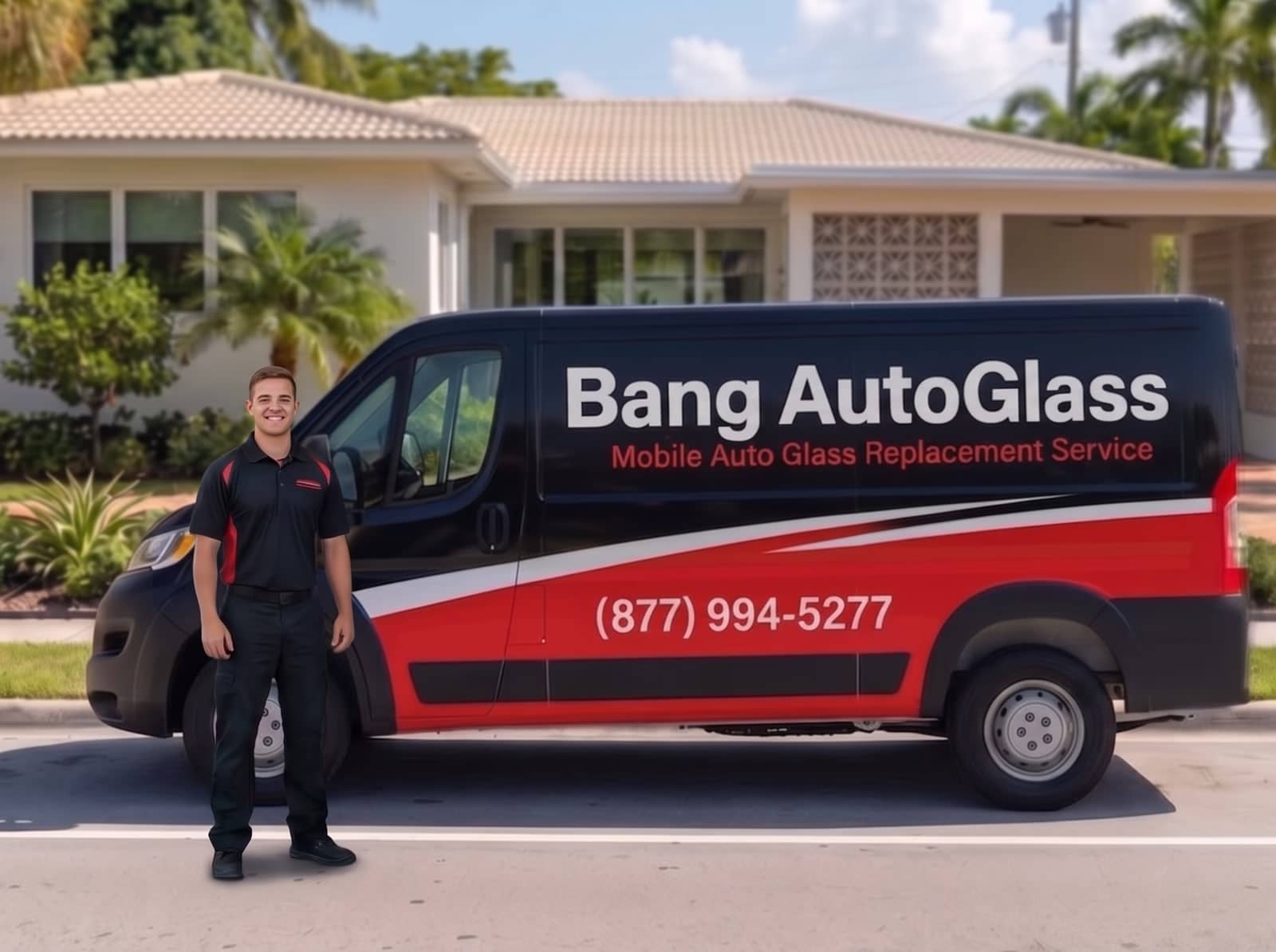
Bang AutoGlass installs BMW windshields on 3, 5, 7 Series, X3, X5, and iX with OEM-spec laminated acoustic glass supporting head-up display, rain sensor, and Driving Assistant camera. Mobile service in Arizona and Florida includes urethane bonding, ADAS recalibration, and lifetime warranty.
BMW Windshield Replacement
Owning a BMW means experiencing the perfect blend of luxury, performance, and cutting-edge automotive technology. From the precision-engineered handling to the integrated driver assistance systems, every component of your BMW is designed with intention — and that includes the windshield. When your BMW windshield becomes cracked, chipped, or compromised, replacing it isn't a one-size-fits-all job. BMW windshield replacement requires a specialized understanding of advanced features like ADAS sensors, heads-up display (HUD) projection, rain sensors, acoustic dampening glass, and lane departure cameras. At Bang AutoGlass, we deliver mobile BMW windshield replacement service backed by OEM-quality materials, a lifetime workmanship warranty, and next-day appointment availability — all without compromising the integrity that BMW engineering demands.
Why BMW Windshields Require Specialized Replacement
BMW windshields are not the same as standard auto glass found on entry-level vehicles. Bayerische Motoren Werke designs each windshield to support a sophisticated suite of safety, comfort, and convenience technologies. Improperly replacing a BMW windshield can disable critical safety systems, void warranties, distort visibility, or cause water leaks that lead to expensive interior damage. Understanding what makes BMW windshields unique is the first step toward ensuring your replacement is done correctly.
Advanced Driver Assistance Systems (ADAS)
Most modern BMW models — including the 3 Series, 5 Series, 7 Series, X1, X3, X5, X7, and the all-electric i4 and iX — come equipped with a forward-facing camera mounted to the windshield. This camera powers ADAS features such as Active Driving Assistant, Lane Departure Warning, Frontal Collision Warning, Traffic Sign Recognition, and Adaptive Cruise Control. When a BMW windshield is replaced, the ADAS camera must be precisely recalibrated to ensure these systems read the road accurately. A misaligned camera, even by a fraction of a degree, can result in delayed lane warnings, incorrect speed limit readings, or failure of automatic emergency braking. Proper BMW windshield replacement always accounts for these calibration requirements.
Heads-Up Display (HUD) Compatibility
Many BMW vehicles are equipped with a Heads-Up Display that projects speed, navigation directions, and driver assistance alerts directly onto the windshield. HUD-equipped BMW windshields contain a specialized polymer interlayer and reflective coating engineered to project a clear, ghost-free image into the driver's line of sight. Installing a non-HUD windshield in a HUD-equipped BMW will cause a doubled, blurry, or completely missing projection. When replacing a BMW windshield with HUD, it is essential to use glass that matches the original specifications exactly so the display performs as designed.
Acoustic and Solar Glass Technology
BMW prides itself on cabin refinement, and one of the ways the brand achieves whisper-quiet interiors is through acoustic glass — a laminated windshield with a sound-dampening film sandwiched between two glass layers. This reduces road noise, wind noise, and engine drone. Many BMW models also include solar-control infrared coatings that reflect heat away from the cabin, reducing the load on your climate system. A proper BMW windshield replacement matches the acoustic and solar features of your original glass so cabin comfort, fuel efficiency, and the BMW driving experience are fully preserved.
Rain and Light Sensors
BMW windshields typically house rain sensors, light sensors, and humidity sensors near the base of the rearview mirror. These sensors automate windshield wipers, control automatic headlights, and regulate cabin defrosting. During BMW windshield replacement, these sensors must be carefully transferred, properly bonded, and reconnected to the vehicle's electronic systems so all automatic features continue to operate seamlessly.
Common BMW Models We Service
Bang AutoGlass performs windshield replacement on the full range of BMW vehicles. Whether you drive a sport sedan, an SAV, an M-performance model, or one of BMW's all-electric offerings, our mobile technicians are equipped to handle the specific requirements of your vehicle. Some of the most common BMW windshield replacements we perform include the BMW 2 Series, 3 Series, 4 Series, 5 Series, 6 Series, 7 Series, 8 Series, X1, X2, X3, X4, X5, X6, X7, Z4, i3, i4, i5, i7, iX, and the high-performance M2, M3, M4, M5, and M8 variants. Every BMW model has unique windshield specifications, and we source the correct OEM-quality glass to match your trim and feature package.
The BMW Windshield Replacement Process
A correctly performed BMW windshield replacement is more than just removing old glass and installing new. It is a meticulous process that protects the structural integrity of your vehicle, restores all factory-equipped features, and ensures driver safety. At Bang AutoGlass, our mobile technicians follow a precise procedure refined specifically for BMW vehicles.
Step-by-Step Replacement
The replacement begins with a thorough inspection of your BMW's windshield, A-pillar trim, cowling, and any sensors or modules attached to the glass. Our technician carefully removes the wiper arms, cowling, and interior trim pieces to access the urethane bond around the windshield. Using cold-knife or wire-out techniques, the damaged BMW windshield is extracted without damaging the pinch weld or surrounding paint. The bonding surface is then cleaned, primed, and prepared for the new windshield. A fresh bead of high-modulus, BMW-approved urethane adhesive is applied, and the new OEM-quality windshield is set into place with precision alignment. Trim, sensors, mirror brackets, and the ADAS camera bracket are then reinstalled. The entire BMW windshield replacement typically takes 30 to 45 minutes from start to finish, followed by 1 hour of adhesive cure time before the vehicle is safe to drive.
ADAS Calibration After Replacement
For BMW models equipped with forward-facing cameras and driver assistance systems, ADAS calibration is a critical post-installation step. Depending on the model, calibration may be static (performed with targets in a controlled environment), dynamic (performed during a controlled road drive), or a combination of both. This recalibration ensures that lane keeping assist, automatic emergency braking, adaptive cruise control, and traffic sign recognition function exactly as BMW engineered them. Skipping or improperly performing ADAS calibration on a BMW after windshield replacement can put you and your passengers at serious risk.
OEM-Quality Glass for BMW Vehicles
At Bang AutoGlass, we use OEM-quality glass for every BMW windshield replacement we perform. OEM-quality glass is manufactured to meet or exceed the same specifications as the original windshield installed at the BMW factory. This means correct thickness, identical optical clarity, properly positioned sensor mounts, factory-matched acoustic dampening, accurate HUD coatings when applicable, and the precise curvature your BMW's body lines demand. Choosing OEM-quality glass protects the resale value of your BMW, preserves cabin quietness, and ensures every safety system operates flawlessly. Lower-grade replacement glass can lead to wind whistles, distorted vision, leaks, sensor malfunctions, and reduced structural strength during a collision.
Mobile BMW Windshield Replacement Service
One of the biggest advantages of choosing Bang AutoGlass for your BMW windshield replacement is our fully mobile service. We come to you — whether you're at home, at the office, or anywhere else that's convenient. There's no need to take time off work, arrange transportation, or sit in a shop waiting room. Our mobile BMW windshield replacement service brings professional-grade tools, OEM-quality glass, and experienced expertise directly to your driveway or parking space.
Next-Day Appointments
We understand that a cracked or shattered BMW windshield isn't something you want to live with. A small chip can spread into a full crack in days, and a damaged windshield compromises the structural support of your vehicle's roof during a rollover. That's why Bang AutoGlass offers next-day appointments for BMW windshield replacement. You won't be left waiting a week or more — we get your BMW back to factory-quality condition fast, with minimal disruption to your schedule.
Signs Your BMW Windshield Needs Replacement
Not every windshield blemish requires replacement, but there are clear warning signs that indicate your BMW windshield is beyond repair. Recognizing these signs early can save you money and prevent a small issue from becoming a major safety hazard.
- A crack longer than three inches, especially one that extends to the edge of the windshield
- Multiple chips or cracks in close proximity
- Damage directly in the driver's line of sight that cannot be safely repaired
- Damage that penetrates both layers of the laminated glass
- Pitting, sandblasting, or hazing that distorts night driving visibility
- Damage near or directly affecting the ADAS camera, rain sensor, or HUD projection area
- Leaks, wind noise, or interior moisture indicating a failed seal
If your BMW windshield shows any of these signs, scheduling a replacement promptly is the safest choice. Driving with compromised glass not only reduces visibility but also weakens the structural support BMW engineered into the vehicle's safety cage.
BMW Windshield Repair vs. Replacement
Some BMW windshield damage can be repaired rather than replaced. Small chips smaller than a quarter, short cracks under three inches, and damage outside the driver's primary viewing area are often candidates for resin injection repair. However, BMW windshields with ADAS sensors, HUD coatings, or acoustic interlayers often need replacement even for damage that would be repairable on a standard vehicle. This is because the integrity of these advanced features depends on the glass being free of structural compromise. Our technicians will inspect your BMW windshield damage during your appointment and provide an honest recommendation about whether repair or full BMW windshield replacement is the right call.
Cost of BMW Windshield Replacement
The cost of BMW windshield replacement varies based on several factors, including the specific model, year, trim level, and which advanced features your windshield supports. A BMW 3 Series with a basic windshield will cost considerably less than a 7 Series or X7 with HUD, acoustic glass, ADAS camera, rain sensors, and a heated wiper rest area. ADAS calibration also adds to the total cost when applicable. Generally, BMW windshield replacement falls into a higher price tier than standard vehicles because of the premium glass specifications and calibration requirements. However, the investment is worthwhile when you consider what's at stake: visibility, safety system functionality, cabin comfort, and the resale value of your luxury vehicle.
Insurance and BMW Windshield Claims
Many BMW owners carry comprehensive auto insurance that covers glass damage, often with a low deductible or no deductible at all depending on your state and policy. Bang AutoGlass works seamlessly with all major insurance carriers and can assist you in filing your BMW windshield replacement claim. We help you with the insurance claim from start to finish and make the process as smooth as possible. Many BMW owners are pleasantly surprised to learn that windshield replacement costs them little or nothing out of pocket when insurance is involved.
What Sets Bang AutoGlass Apart for BMW Windshield Replacement
Choosing the right shop for your BMW windshield replacement matters more than most drivers realize. The wrong installation can lead to leaks, wind noise, failed ADAS systems, voided warranties, or even compromised crash safety. At Bang AutoGlass, we've built our reputation on doing BMW windshield replacement the right way, every time.
Lifetime Workmanship Warranty
Every BMW windshield replacement we perform is backed by a lifetime workmanship warranty. As long as you own the vehicle, our installation is guaranteed against leaks, wind noise, adhesive failure, and any other issue resulting from workmanship. This warranty reflects our confidence in our technicians, our OEM-quality materials, and our commitment to standing behind every BMW we service. When you choose Bang AutoGlass, you're not just paying for a windshield — you're investing in long-term peace of mind.
experienced mobile technicians
Our mobile technicians are trained on the specific requirements of BMW windshield replacement, including proper urethane application, ADAS-related preparation, HUD-compatible glass handling, and sensor reattachment. We don't subcontract our installations or send out generalists who occasionally work on European vehicles. Every BMW that rolls through our service is handled by a technician who understands what makes the brand unique.
After Your BMW Windshield Replacement
A successful BMW windshield replacement doesn't end the moment the new glass is installed. Following the right after-care steps ensures your windshield bonds properly, your safety systems remain functional, and your BMW continues to perform as designed.
Safe Drive-Away Time
After your BMW windshield replacement, we recommend waiting one hour before driving the vehicle. This allows the urethane adhesive to reach its initial cure strength and securely bond the glass to the body of your BMW. Driving too soon can shift the windshield, compromise the seal, and lead to leaks or even ejection during an accident. Our technicians will confirm the exact safe drive-away time at the end of your appointment.
Care Tips for the First 48 Hours
For the first 48 hours after BMW windshield replacement, avoid slamming doors, washing the vehicle through high-pressure car washes, removing the retention tape too early if applied, parking on steep inclines, or driving on rough roads when possible. These simple precautions allow the adhesive to fully cure and protect your investment. Once the cure period is complete, your BMW is ready for normal driving, washing, and use without restriction.
Monitoring for Issues
While our lifetime workmanship warranty covers any installation-related issues, we encourage BMW owners to keep an eye out for water leaks during heavy rain, unusual wind noise at highway speeds, ADAS warning lights, or HUD display issues in the first weeks after replacement. If anything seems off, contact Bang AutoGlass immediately so we can resolve it under warranty.
Schedule Your BMW Windshield Replacement Today
Your BMW deserves better than a generic windshield replacement. With Bang AutoGlass, you get OEM-quality glass, precision installation, ADAS calibration when required, a lifetime workmanship warranty, and the convenience of fully mobile service that comes to you. Whether you drive a 3 Series sedan, an X5 SAV, an M-performance model, or one of BMW's flagship 7 Series or iX electric vehicles, our team is ready to restore your windshield to factory-quality condition. Next-day appointments are available, and most BMW windshield replacements are completed in just 30 to 45 minutes, followed by a 1-hour adhesive cure window. Contact Bang AutoGlass today to schedule your BMW windshield replacement and experience the difference that specialized expertise, premium materials, and dedicated craftsmanship can make.
BMW Windshield Replacement — common questions
How long does a BMW windshield replacement take?
The replacement itself takes about 30-45 minutes to complete. The adhesive then needs time to set — about an hour is typical, and your technician confirms the exact safe drive-away time. Total time at your location is typically 1.5-2 hours depending on ADAS calibration needs.
What is OEM-quality glass and why does it matter for my BMW?
OEM-quality glass meets the exact specifications of your BMW's original equipment, ensuring proper fit, safety, and performance of features like your defroster and ADAS safety systems. Every replacement is backed by a lifetime workmanship warranty.
Will my BMW windshield replacement be covered by insurance?
If you have comprehensive coverage, it's often fully covered with nothing out of pocket. Florida waives the deductible for windshield replacement, and Arizona allows optional no-deductible coverage. We'll help you file or start your claim.
Does my BMW need ADAS calibration after windshield replacement?
Most BMWs from 2018 onward have a safety camera mounted on the windshield that requires recalibration after replacement to keep features like lane-keeping assist and automatic braking accurate. Calibration adds about 15-30 minutes to your appointment.
Where we do BMW auto glass
Bang AutoGlass is a mobile auto glass company serving Arizona and Florida. We don't have a shop you drive to — we come to your home, your job, or wherever the car is sitting, with next-day appointments in most areas. In Arizona that means the whole Valley — Phoenix, Mesa, Scottsdale, Chandler, Gilbert, Tempe, Glendale and out to Tucson and Prescott. In Florida we cover Tampa Bay, Orlando and Miami, from St. Petersburg and Clearwater across to Kissimmee, Winter Park and Fort Lauderdale.
Browse every city we serve in Arizona and Florida, or read how coverage works under Arizona's glass statutes and Florida's § 627.7288.
Mobile auto glass — cities we serve
4.8★ on Google · 350+ reviews from AZ & FL drivers
“I needed my windshield replaced and they made the entire process easy. Bang AutoGlass is the best!”
“Top-notch auto glass service. They handled my windshield replacement quickly and professionally.”
“Bang AutoGlass made my windshield replacement simple from start to finish.”
Need BMW Windshield Replacement?
We come to you across Arizona and Florida — often $0 with insurance.
We reply within minutes during business hours.