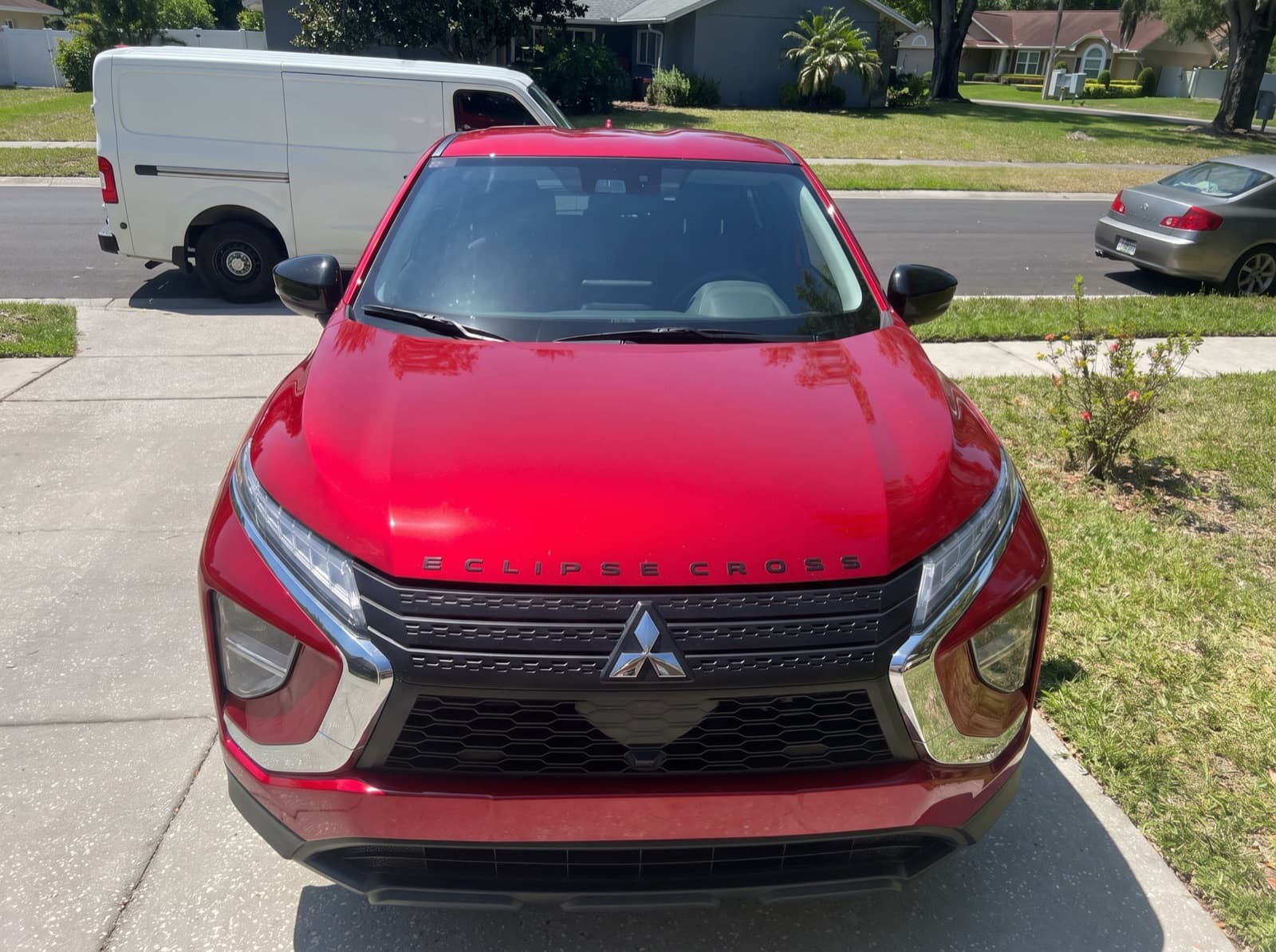
Mitsubishi Rear Glass Replacement
Rear glass on a Mitsubishi is tempered, so it does not crack and wait for you - it lets go all at once. We replace liftgate and backlight glass on the Outlander, Eclipse Cross, Mirage, Lancer, Montero and Raider at your door, with a lifetime workmanship warranty behind every install.
Mitsubishi Rear Glass Replacement: Mobile Service With a Lifetime Workmanship Warranty
A broken rear window on a Mitsubishi rarely announces itself as a crack. Rear glass is tempered, so it holds its tension until the surface is compromised and then relieves the whole pane at once, leaving an empty aperture and pounds of granular glass through the cargo bay. Bang AutoGlass performs fully mobile Mitsubishi rear glass replacement across Arizona and Florida. Installations run roughly 30 to 45 minutes of hands-on work plus about an hour of adhesive cure, and next-day appointments are typically available.
Tempered Glass Cannot Be Repaired, and That Is by Design
Rear windows are heat-treated so the outer surfaces sit in compression and the core in tension. Break the surface anywhere and that stored energy releases across the whole pane, which is why you get thousands of blunt pebbles rather than long shards. That ends any conversation about repair: there is no chip to fill and no crack to stop, because there is no crack. Replacement is the only correct answer, which suits us, because Bang AutoGlass is replacement-only. A minority of applications use laminated rear glass, so we verify against your VIN.
Mitsubishi Sells Liftgates, and Liftgate Glass Is the Busiest Pane on a Car
Look at what Mitsubishi sells in North America and the pattern is obvious. Outlander, Outlander PHEV, Outlander Sport, Eclipse Cross and Mirage are all crossovers or hatchbacks; only the Mirage G4 puts a trunk behind the rear seat. So the typical Mitsubishi rear glass job is a liftgate pane, and liftgate glass is the most heavily equipped position on any vehicle. It moves, it carries electrical elements, and hardware passes straight through it.
The Wiper Spindle Passes Through the Pane
Where your Mitsubishi carries a rear wiper, the motor mounts to the liftgate structure and the pivot shaft passes through a bored hole in the glass on a seal. The new pane must be the wiper-drilled variant, because a blank pane cannot accept the arm. That spindle seal is a leak path if reassembled carelessly, and the arm has to be re-indexed so it parks where it should.
Defroster Grids and the Tabs That Feed Them
Mitsubishi prints a defroster grid across the rear glass on virtually the entire range, fed by solder tabs bonded near the edges. The replacement pane must be the heated variant with the grid your vehicle expects, and the tabs re-made cleanly. A defroster that reads dead after a glass job is almost always a connection nobody tested. We test it on site.
Stop Lamps, Antennas and Privacy Tint
On older Mitsubishi sedans the radio antenna is printed into the backlight rather than mounted on the roof; newer models moved to a roof fin, so this is a per-vehicle question. If reception was fine before the break and poor after, that is a glass-side connection, not a head unit fault. Mitsubishi also darkens the glass from the B-pillar back on upper trims, so a clear pane on a privacy-tinted car is an obvious mismatch.
The Eclipse Cross Has Two Rear Windows
The Eclipse Cross launched with its rear glazing divided into two panes, an upper and a lower screen split by a horizontal bar carrying the high-mount stop lamp, so the driver looked out through the gap between them. Mitsubishi dropped that arrangement in the later restyle for a single conventional window. What matters is this: on a split-glass Eclipse Cross there are two rear panes, they are different parts, and you can break one and not the other. Tell us which screen went.
Mitsubishi Models We Service, Grouped by How the Rear Glazing Differs
Crossovers and SUVs With a Liftgate
Outlander, Outlander PHEV, Outlander Sport, Eclipse Cross and Endeavor all put a bonded pane in a top-hinged liftgate, usually with a wiper, a defroster grid and privacy tint. The Outlander is unusual among compact crossovers in offering a third row, and that changes the cleanup: glass lands on folded third-row seat backs and drops into their latch mechanisms and floor wells rather than onto a flat cargo floor. Outlander Sport was offered with a panoramic glass roof, so tell us if the break is overhead rather than at the tail.
Hatchback and Sedan Twins: Mirage and Mirage G4
These two share a nameplate and almost nothing about their rear glass. The Mirage hatchback carries a steeply raked liftgate pane with a wiper, opening as part of the hatch. The Mirage G4 is a booted sedan with a fixed backlight and a conventional trunk lid below it. Same badge, two different parts, so confirm which one you drive.
Sport Coupes and Liftbacks: Eclipse and 3000GT
Both are liftbacks: the rear glass is the hatch itself, roof-hinged, large, steeply raked and heavily curved, with a defroster grid and often an in-glass antenna. These cars are decades old, so the hinges, gas struts and trim clips are brittle and tired struts may no longer hold the pane. The convertibles are a separate conversation: the Eclipse Spyder carries a heated glass rear window bonded into a folding fabric roof, so the work is as much a soft-top job as a glass job, while the 3000GT Spyder sets its glass into a power-retractable steel hardtop, where the roof mechanism governs the job, and we will tell you honestly whether it is something mobile glass service should touch.
Sedans With a Fixed Backlight: Galant, Diamante, Lancer and Lancer Evolution
Sedan rear glass is bonded into a fixed aperture between the C-pillars with a parcel shelf directly beneath it, and that shelf is the specific problem. Fragments pour onto it, then filter through the speaker grilles into the trunk and rear quarter cavities. The Lancer Evolution adds a wrinkle: the last generation used an aluminium roof panel to save weight, so the metal around the aperture is not all one material, and a gouge invites corrosion that will not show for a year.
Body-on-Frame SUVs: Montero and Montero Sport
The Montero is the outlier here. Its tailgate is side-hinged rather than top-hinged and carries the spare wheel on its outer face, so the glass rides in a heavy swinging door that meets a latch every time it closes. Where your Montero uses a rear window that retracts into the tailgate on a regulator instead of a fixed bonded pane, the job changes shape entirely: it becomes a hardware-held pane, and the regulator, channels and drain path must be cleared of fragments first. The Montero Sport uses a conventional top-hinged liftgate.
The Pickup: Raider
The Raider is Mitsubishi’s only recent North American pickup and a genuine outlier, built in Michigan on the bones of the Dodge Dakota it was derived from. The cab backlight is a small, near-vertical pane rather than a sprawling curved screen. Where the truck was ordered with a sliding rear window it is a multi-piece assembly with tracks, a latch and a moving centre pane, and those tracks trap fragments beautifully. Glass also drops into the gap behind the seat back, the least reachable place in any pickup cab. The sourcing upside is real: because the Raider shares its cab with the Dakota of the same years, the pool of usable glass is wider than the badge suggests.
Sourcing Glass for a Lineup With a Long Back Catalogue
Mitsubishi’s North American range narrowed considerably over two decades, which is a practical fact rather than a criticism. Many of the Mitsubishis we are called out to left production years ago: 3000GT, Diamante, Montero, Montero Sport, Raider, Endeavor, Eclipse, Galant and Lancer. Availability splits along volume lines: high-volume cars are still well supplied, and on low-volume models lead time becomes the variable rather than labour. There are shortcuts. The early Eclipse was built in Normal, Illinois at the Diamond-Star plant alongside Chrysler-badged twins that shared its body, which widens the search when Mitsubishi-numbered stock has dried up. The Raider and Dakota work the same way. The 3000GT and Diamante are hardest, the Spyder versions harder still. Call and we will tell you what we can actually source rather than quote a date we cannot hold.
Outlander PHEV: Working Around High-Voltage Hardware
The Outlander PHEV puts a high-voltage battery beneath the cabin floor and drive hardware under the rear of the vehicle, which is precisely where a shattered liftgate pane empties itself. That is a reason to be deliberate, not to avoid the job. Our technicians do not improvise around high-voltage components, and we clear the cargo well and load floor edges properly rather than lifting the mat and shaking it out.
Cleanup Is Most of the Real Work
Owners underestimate this part, and it is where a competent rear glass job separates itself from a fast one. A tempered pane becomes thousands of pebbles with momentum behind them, and they travel further than seems reasonable. On a Mitsubishi crossover they end up in the cargo tie-down tracks, under the load floor, inside the spare well, in third-row latch mechanisms and along the seat rails. On a sedan they go through the parcel shelf into the trunk. On a Raider they wedge behind the bench, and glass left in a seat rail surfaces weeks later.
How the Job Runs
- VIN and specification check — Body style, then the exact glass: heated grid, wiper hole, antenna, tint shade, and on an Eclipse Cross which pane.
- Mobile arrival — Our technician comes to you and masks paint, trim and cargo surfaces.
- Bulk extraction first — Loose fragments come out of the cabin, cargo area and tailgate channels before cutting starts.
- Old bead removal — Glass and adhesive are cut out without gouging the pinchweld; wiper arms, stop lamps and trim are removed rather than forced.
- Surface prep — The flange is cleaned and primed, and defroster tabs and antenna leads prepared.
- Glass set — The new pane goes in on a fresh adhesive bead, aligned to factory position.
- Reconnect and test — Defroster and antenna circuits are tested, the wiper cycled to its park position, the liftgate checked for seal.
- Deep cleanup — Seat rails, tie-down tracks, spare well and trim gaps are worked over for fragments.
How Long It Takes
Most rear glass replacements take about 30 to 45 minutes of hands-on installation, then roughly an hour of adhesive cure before driving. Split-glass Eclipse Cross panes, Raider sliders and heavy contamination all add time.
OEM-Quality Glass and a Lifetime Workmanship Warranty
Every Mitsubishi rear glass replacement uses OEM-quality glass and premium adhesives matched for thickness, curvature, tint shade, wiper provision and the correct heated and antenna configuration, and the work is backed by our lifetime workmanship warranty. For as long as you own the vehicle, if a fault traces back to how we installed it, whether a leak, wind noise or a defroster tab that did not hold, we put it right at no charge.
Mobile Service Across Arizona and Florida
Bang AutoGlass is fully mobile. There is no shop to drive to, which matters here, because an open rear aperture means road grit and rain straight into the cabin, and on a hatchback or crossover no bulkhead slows it down. We come to your home, workplace or storage facility anywhere in Arizona and Florida, given safe, level access. Company-wide we have completed more than 17,000 jobs and hold a 4.8-star rating across 350+ Google reviews. Next-day appointments are typically available.
Insurance and Your Mitsubishi Rear Glass Claim
Rear glass damage is frequently covered under comprehensive coverage, particularly after a break-in, vandalism or a storm. We file the claim, document it and coordinate approval with your carrier so your appointment is not held up by paperwork.
Arizona
Arizona law, A.R.S. 20-264, requires insurers to offer optional no-deductible safety-glass coverage, and that definition reaches windshield, door and window glass. The operative word is optional. It is coverage the driver must have elected when the policy was written, and it is never automatic. If you elected it, your rear glass claim may carry no deductible. If you did not, ordinary comprehensive terms and your normal deductible apply. We can help you check which is the case.
Florida
Florida law, Fla. Stat. 627.7288, requires the deductible to be waived for windshield replacement on a policy carrying comprehensive coverage. That statute is windshield-only and it does not apply to rear glass. A Florida rear window claim on your Mitsubishi runs under ordinary comprehensive terms and your normal deductible, and we would rather you hear that from us up front than discover it afterward.
After Your Replacement
- Allow roughly one hour of adhesive cure before driving.
- Avoid automated car washes for 24 to 48 hours.
- Leave any retention tape in place for the full 24 hours.
- Close doors and the liftgate gently for the first day; pressure spikes push against a fresh bead.
- On a Raider slider or a Montero with a retracting pane, operate it gently at first and confirm smooth travel.
- Expect the occasional stray fragment for weeks afterward and tell us if you find one.
Book Your Mitsubishi Rear Glass Replacement
Whether it is an Outlander with a third row full of glass, an Eclipse Cross where one of two panes broke, a Mirage hatchback, a Lancer backlight or a Raider cab window sourced through its Dakota twin, our experienced technicians verify the spec against your VIN, install OEM-quality glass, test the defroster and refit the wiper. Use the form at the top of this page or call (877) 994-5277 to book a mobile appointment, typically as soon as the next day.
Mitsubishi Rear Glass Replacement — common questions
Can a broken rear window on my Mitsubishi be repaired instead of replaced?
No. Rear glass is tempered, so it disintegrates into granular pieces rather than cracking, leaving nothing to fill or stop. Replacement is the only correct fix, and Bang AutoGlass is replacement-only.
My Eclipse Cross has two rear windows. Which one do you replace?
Split-glass Eclipse Cross models carry an upper and a lower rear pane divided by the stop-lamp bar, and they are separate parts. Tell us which screen broke, or if both did, and we order accordingly.
Will my rear defroster and rear wiper still work afterward?
Yes. We match the replacement pane to your Mitsubishi's heated grid and wiper-hole specification, re-make and test the defroster tabs on site, then refit the wiper and cycle it to its correct park position.
Can you still get rear glass for a 3000GT, Diamante, Montero or Raider?
Usually, though lead time varies. Eclipse, Lancer and Outlander glass is readily supplied; low-volume discontinued models take longer. The Raider shares cab glass with the Dakota, which widens the search.
Where we do Mitsubishi auto glass
Bang AutoGlass is a mobile auto glass company serving Arizona and Florida. We don't have a shop you drive to — we come to your home, your job, or wherever the car is sitting, with next-day appointments in most areas. In Arizona that means the whole Valley — Phoenix, Mesa, Scottsdale, Chandler, Gilbert, Tempe, Glendale and out to Tucson and Prescott. In Florida we cover Tampa Bay, Orlando and Miami, from St. Petersburg and Clearwater across to Kissimmee, Winter Park and Fort Lauderdale.
Browse every city we serve in Arizona and Florida, or read how coverage works under Arizona's glass statutes and Florida's § 627.7288.
Mobile auto glass — cities we serve
4.8★ on Google · 350+ reviews from AZ & FL drivers
“I needed my windshield replaced and they made the entire process easy. Bang AutoGlass is the best!”
“Top-notch auto glass service. They handled my windshield replacement quickly and professionally.”
“Bang AutoGlass made my windshield replacement simple from start to finish.”
Need Mitsubishi Rear Glass Replacement?
We come to you across Arizona and Florida — often $0 with insurance.
We reply within minutes during business hours.