Jaguar ADAS Calibration
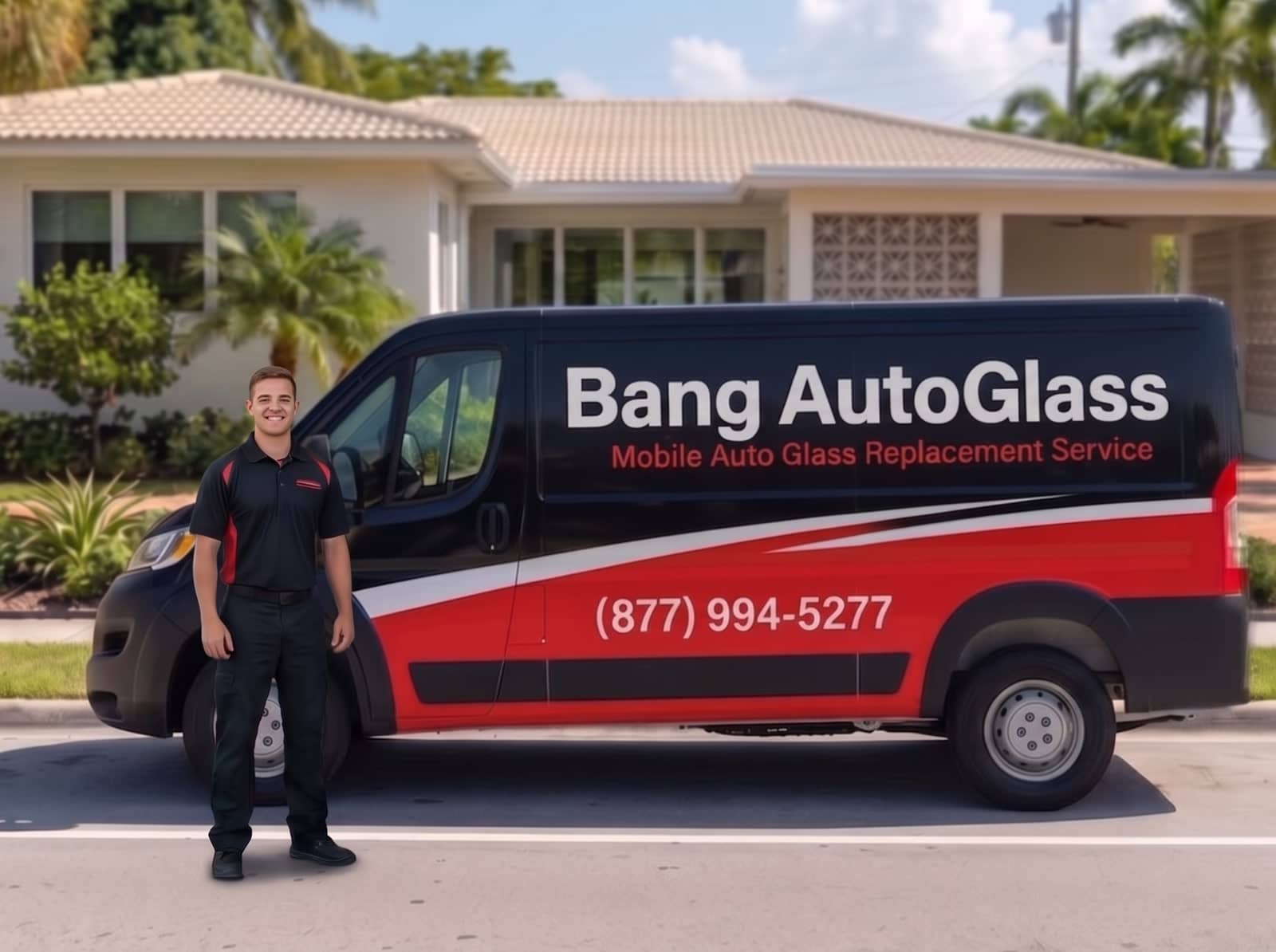
Bang AutoGlass coordinates Jaguar InControl ADAS calibration after windshield service so Adaptive Cruise Control, Emergency Braking, Lane Keep Assist, and Blind Spot Monitor read targets correctly on F-Type, F-Pace, E-Pace, I-Pace, and XF. Arizona and Florida mobile, warranty-backed.
Jaguar ADAS Calibration: Restoring Precision Safety After Windshield Replacement
When you drive a Jaguar, you're behind the wheel of a vehicle engineered with some of the most sophisticated driver-assistance technology on the road. Jaguar ADAS Calibration is the critical service that ensures every camera, sensor, and safety feature in your luxury vehicle continues to operate exactly the way Jaguar's engineers designed it to. Whether you drive an F-Pace, XF, XE, I-Pace, E-Pace, F-Type, or XJ, the Advanced Driver Assistance Systems built into your Jaguar rely on a forward-facing camera mounted at the top of your windshield, and any time that windshield is replaced, repositioned, or disturbed, that camera must be precisely recalibrated. Skipping this step can compromise lane departure warnings, emergency braking response times, traffic sign recognition, and adaptive cruise control, which is why Jaguar ADAS recalibration after windshield replacement is not optional, it's essential.
What Is Jaguar ADAS Calibration?
Jaguar ADAS Calibration is the process of realigning the forward-facing camera and associated sensors mounted to your windshield so that every Jaguar InControl driver assistance feature reads the road accurately. The camera built into your Jaguar's windshield is responsible for monitoring the lanes, traffic signs, vehicles, pedestrians, and cyclists in front of you, and even a few millimeters of misalignment can throw off the entire system. After any windshield replacement, the camera's angle, height, and field of vision shift slightly from the original factory position. Recalibration restores those exact angles using either a static target board, a dynamic driving procedure, or a combination of both, depending on your specific Jaguar model and year.
This process is performed using Jaguar-approved diagnostic equipment that communicates directly with your vehicle's onboard computer through the OBD-II port. The technician uploads the calibration parameters, aligns the camera to manufacturer specifications, and verifies that every ADAS feature is functioning within Jaguar's tolerance ranges. Without this step, your Jaguar's safety suite is, at best, unreliable and, at worst, completely inoperative.
Why Jaguar Vehicles Require ADAS Calibration After Windshield Replacement
Almost every modern Jaguar built since 2016 ships with the Jaguar InControl driver-assistance suite, and that suite depends entirely on a camera that lives behind your rearview mirror. When we replace a Jaguar windshield, even with an OEM-quality glass that meets factory specifications, the camera's positioning will not perfectly mirror the original installation down to the millimeter. The bracket, the curvature of the glass, and the angle of the windshield rake all influence how the camera "sees" the road. Jaguar's official position, supported by I-CAR repair guidelines, is that windshield replacement requires ADAS recalibration on all camera-equipped vehicles.
There's also a legal and safety dimension here. If your Jaguar's automatic emergency braking fails to activate because the camera is reading the road inaccurately, that's not just a malfunction, it's a liability. Insurance providers, dealerships, and Jaguar themselves all recognize ADAS recalibration as a mandatory step following any windshield replacement on a vehicle with camera-based driver assistance.
Jaguar InControl Driver Assistance Features That Rely on Calibration
The Jaguar InControl ADAS suite is one of the most comprehensive in the luxury segment, and every feature listed below depends on a properly calibrated windshield camera to function as designed.
Lane Keep Assist and Lane Departure Warning
Your Jaguar's Lane Keep Assist uses the forward-facing camera to detect lane markings and apply gentle corrective steering torque when the vehicle drifts without a turn signal. After Jaguar windshield replacement, an uncalibrated camera may misread lane positions, causing the system to either fail to engage or, worse, apply steering input when it shouldn't.
Adaptive Cruise Control with Stop and Go
Adaptive Cruise Control on Jaguar vehicles uses radar in combination with the windshield camera to maintain a safe following distance and adjust your speed automatically. Proper Jaguar ADAS calibration ensures the camera correctly identifies vehicles ahead, brake lights, and the distance gap selected by the driver.
Autonomous Emergency Braking
The Emergency Braking feature in your Jaguar can help mitigate or even prevent collisions with vehicles, pedestrians, and cyclists. It does this by analyzing the road ahead through the windshield camera and applying the brakes automatically if the driver doesn't react in time. A miscalibrated camera can delay this response by critical milliseconds.
Traffic Sign Recognition and Adaptive Speed Limiter
Jaguar's Traffic Sign Recognition displays current speed limits and no-passing signs on your instrument cluster and optional Head-Up Display. Pair this with the Adaptive Speed Limiter and your Jaguar can adjust speed automatically based on what the camera sees. If the camera is even slightly off, you may receive incorrect speed limit readings.
Blind Spot Assist and Rear Traffic Monitor
While the windshield camera isn't the only sensor involved in blind spot detection, it does cross-reference data with the side and rear sensors. A properly calibrated front camera ensures the entire 360-degree awareness system works in harmony.
Driver Condition Monitor
This Jaguar feature analyzes steering inputs and lane position to detect signs of driver fatigue. An uncalibrated camera can trigger false fatigue alerts or, conversely, fail to warn a driver who genuinely needs a break.
Types of Jaguar ADAS Calibration
Not every Jaguar requires the same calibration approach, and the procedure varies based on the model, year, and specific systems installed.
Static Calibration
Static Jaguar ADAS calibration is performed while the vehicle is parked on a perfectly level surface. We position specialized Jaguar-approved target boards at precise distances and angles in front of the vehicle, and the diagnostic equipment uses these targets to teach the camera its new reference points. Static calibration is common for older F-Pace, XE, XF, and XJ models.
Dynamic Calibration
Dynamic Jaguar ADAS calibration requires driving the vehicle under specific road conditions at certain speeds while the diagnostic tool monitors the camera's learning process. The technician must drive on well-marked roads, typically at speeds between 30 and 50 mph, until the system confirms a successful calibration. Many Jaguar I-Pace and newer F-Pace models use dynamic calibration procedures.
Dual or Combined Calibration
Some Jaguar models, particularly newer Jaguar F-Pace, I-Pace, and E-Pace vehicles, require both static and dynamic calibration to complete the ADAS recalibration process. This dual approach ensures every layer of the system, from camera angle to real-world performance, is verified before the vehicle leaves our care.
Jaguar Models That Require ADAS Calibration After Windshield Replacement
Bang AutoGlass performs Jaguar ADAS calibration on virtually every modern Jaguar equipped with InControl driver assistance technology, including:
- Jaguar F-Pace (2017 and newer, including SVR trims)
- Jaguar E-Pace (all model years from 2018 onward)
- Jaguar I-Pace (all electric SUV model years)
- Jaguar XE sedan (2017 and newer)
- Jaguar XF sedan and Sportbrake (2016 and newer)
- Jaguar XJ flagship sedan (2016 through 2019)
- Jaguar F-Type coupe and convertible (camera-equipped trims)
If your Jaguar has a camera behind the rearview mirror, lane keep assist, adaptive cruise control, or emergency braking, your vehicle will require ADAS calibration after any windshield replacement.
Our Jaguar ADAS Calibration Process at Bang AutoGlass
At Bang AutoGlass, we've built our Jaguar ADAS calibration process around precision, convenience, and Jaguar's exact manufacturer specifications. Here's how we handle every Jaguar windshield replacement and ADAS recalibration appointment:
- We schedule your Jaguar service as a mobile appointment, typically as a next-day appointment, at your home, office, or any location convenient to you.
- Our technician arrives with OEM-quality glass specifically manufactured to Jaguar's optical and dimensional specifications, ensuring the windshield rake, curvature, and frit pattern match the original.
- We remove your existing Jaguar windshield and inspect the camera bracket, rain sensor, humidity sensor, and any auto-dimming or heated wiper park elements that need to be transferred to the new glass.
- The new Jaguar windshield is installed using urethane adhesive that meets or exceeds Jaguar's OEM bonding standards, with the replacement typically completed in 30 to 45 minutes.
- We require approximately one hour of cure time for the adhesive to set safely before the vehicle can be driven.
- Once cured, we connect Jaguar-approved diagnostic equipment to perform the static, dynamic, or dual ADAS calibration procedure required for your specific model.
- We verify every InControl feature using diagnostic readouts, clear any fault codes, and confirm that your Jaguar's safety systems are operating exactly as Jaguar designed them.
How Long Does Jaguar ADAS Calibration Take?
Most Jaguar windshield replacements at Bang AutoGlass take 30 to 45 minutes to complete the physical install, followed by one hour of adhesive cure time. The ADAS calibration itself varies depending on the model and calibration type. Static calibration on a Jaguar F-Pace or XF typically adds about 15 to 30 minutes to the appointment, and dynamic calibration on a Jaguar I-Pace falls in the same range depending on traffic and road conditions in your area. Models requiring both static and dynamic procedures may take a bit longer, but we plan for it so your entire Jaguar service is handled in a single appointment whenever possible.
Because we're a mobile service, you don't sit in a waiting room. You can work, relax at home, or get on with your day while we restore your Jaguar to factory safety standards.
Insurance and Jaguar ADAS Calibration Claims
Most major insurance providers recognize Jaguar ADAS calibration as a required component of windshield replacement on camera-equipped vehicles, and the calibration is typically covered under your comprehensive glass coverage when the windshield itself is covered. If you have full glass coverage, your Jaguar windshield replacement and ADAS calibration may be completed at no out-of-pocket cost beyond your deductible, if any applies.
If you haven't yet filed a claim with your insurance, Bang AutoGlass is happy to assist you with the claim process. We help you with the insurance claim from start to finish and make the process as smooth as possible. We can provide documentation, calibration reports, and any supporting paperwork your insurance company requires to process your claim smoothly.
Why Choose Bang AutoGlass for Your Jaguar ADAS Calibration
When it comes to a luxury vehicle like a Jaguar, the shop you trust matters. Here's what sets Bang AutoGlass apart for Jaguar owners.
Mobile Service That Comes to You
We're a fully mobile auto glass service, which means you never have to drop off your Jaguar at a shop or arrange a ride home. We bring our tools, our OEM-quality glass, and our calibration equipment directly to your driveway, your office parking lot, or wherever your Jaguar is parked.
OEM-Quality Materials Built for Jaguar Specifications
Every Jaguar windshield we install meets OEM-quality standards, with the correct frit pattern, acoustic interlayer, solar tinting, camera mount geometry, and optical clarity your Jaguar's ADAS system was designed to work with. Cheap or generic glass can throw off calibration even after a perfect technical install, which is why we never compromise on materials.
Lifetime Workmanship Warranty
Every Jaguar windshield replacement and ADAS calibration we perform comes with a lifetime workmanship warranty. If anything related to our install or calibration ever fails, we make it right at no cost to you, for as long as you own the Jaguar.
Next-Day Appointments and Fast Turnaround
You shouldn't have to wait a week to get your Jaguar back to factory safety standards. We offer next-day appointments in most cases, and our streamlined process means your Jaguar windshield replacement and ADAS calibration can typically be completed in a single visit.
What Happens If You Skip Jaguar ADAS Calibration?
Skipping ADAS calibration after a Jaguar windshield replacement is one of the most expensive mistakes a Jaguar owner can make. At best, you'll see persistent dashboard warning lights, deactivated lane keep assist, and a non-functional adaptive cruise control. At worst, you'll have a vehicle whose emergency braking system either fails to engage when it should or engages when it shouldn't, both of which create serious safety risks. Insurance providers may also deny coverage on subsequent claims if they determine the vehicle's safety systems weren't properly restored after a previous repair.
There's also resale value to consider. Future buyers and Jaguar dealerships will pull diagnostic reports during a pre-purchase inspection, and any uncalibrated ADAS module will show up immediately, lowering the value of your Jaguar and potentially killing a sale.
Schedule Your Jaguar ADAS Calibration With Bang AutoGlass
If you've cracked a Jaguar windshield, suffered a rock chip that's spread into your camera's field of view, or recently had a windshield replaced elsewhere and need professional Jaguar ADAS calibration, Bang AutoGlass is ready to help. We bring decades of experience with luxury European vehicles, Jaguar-approved diagnostic equipment, OEM-quality glass, and the patience to do every job right the first time. Reach out today using the contact form above, and we'll schedule your next-day Jaguar ADAS calibration appointment at the location that works best for you.
Jaguar ADAS Calibration — common questions
What is ADAS calibration for a Jaguar?
ADAS calibration realigns the safety cameras and sensors in your Jaguar after windshield replacement or repair to ensure features like lane-keeping and automatic braking work accurately.
Why does my Jaguar need ADAS calibration after windshield replacement?
Jaguar windshields hold the forward-facing camera that powers ADAS features. Replacing the windshield slightly shifts the camera's angle, so recalibration restores these safety systems to factory precision.
How long does Jaguar ADAS calibration take?
ADAS calibration typically adds about 15–30 minutes to your windshield replacement appointment. Our technicians use precision equipment to align your camera and test all safety features before completing the job.
Is ADAS calibration covered by insurance?
Yes, ADAS calibration is included in comprehensive windshield coverage at no extra charge. If your windshield replacement is fully covered by insurance, so is the recalibration.
Where we do Jaguar auto glass
Bang AutoGlass is a mobile auto glass company serving Arizona and Florida. We don't have a shop you drive to — we come to your home, your job, or wherever the car is sitting, with next-day appointments in most areas. In Arizona that means the whole Valley — Phoenix, Mesa, Scottsdale, Chandler, Gilbert, Tempe, Glendale and out to Tucson and Prescott. In Florida we cover Tampa Bay, Orlando and Miami, from St. Petersburg and Clearwater across to Kissimmee, Winter Park and Fort Lauderdale.
Browse every city we serve in Arizona and Florida, or read how coverage works under Arizona's glass statutes and Florida's § 627.7288.
Mobile auto glass — cities we serve
4.8★ on Google · 350+ reviews from AZ & FL drivers
“I needed my windshield replaced and they made the entire process easy. Bang AutoGlass is the best!”
“Top-notch auto glass service. They handled my windshield replacement quickly and professionally.”
“Bang AutoGlass made my windshield replacement simple from start to finish.”
Need Jaguar ADAS Calibration?
We come to you across Arizona and Florida — often $0 with insurance.
We reply within minutes during business hours.