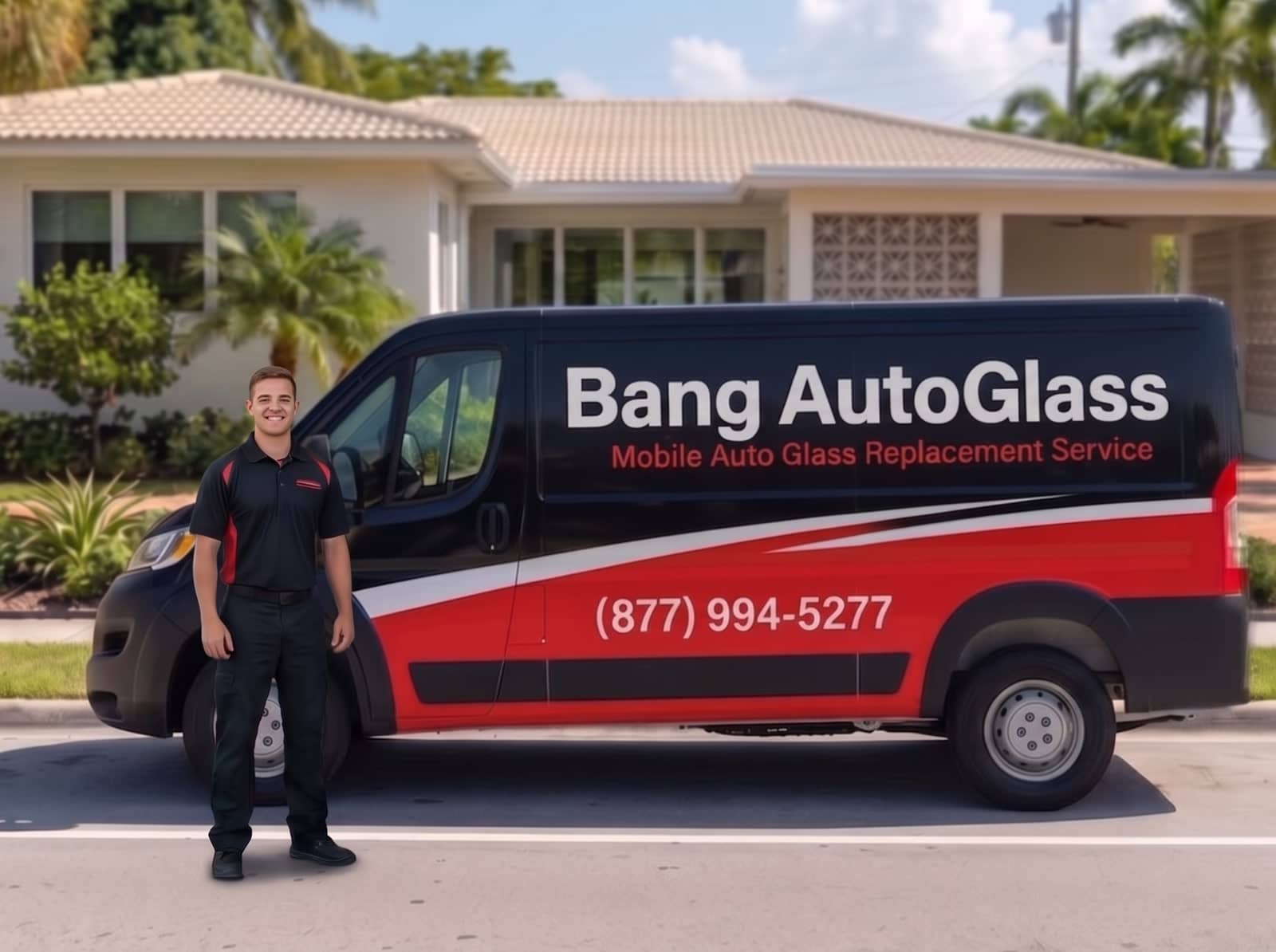
Porsche Rear Glass Replacement
Rear glass is tempered, so it cannot be repaired, only replaced. Bang AutoGlass replaces rear screens, hatches and liftgate glass on the 911, 718 Cayman, Boxster, Cayenne, Macan, Panamera and Taycan at your home or garage anywhere in Arizona and Florida. Next-day appointments are typical.
Porsche Rear Glass Replacement, Done at Your Home or Garage
Porsche is one of the few marques where "rear glass" means half a dozen genuinely different parts. On a 911 the pane sits above a flat-six. On a Cayman it is a hatch over a mid-mounted engine. On a Boxster it is bonded into a fabric roof. On a Cayenne it carries a wiper motor. Bang AutoGlass performs fully mobile Porsche rear glass replacement across Arizona and Florida, arriving with OEM-quality glass, premium urethane and the extraction equipment this job requires. Installation runs about 30 to 45 minutes hands-on plus roughly an hour of adhesive cure. Next-day appointments are typically available, and every install carries our lifetime workmanship warranty.
One Badge, Six Very Different Rear Windows
Most specialist marques build one body style and glaze it one way. Porsche does not: the range spans rear-engine coupes, mid-engine roadsters and hatch coupes, two SUVs, a liftback, two wagons and a pair of carbon-tub limited-production cars. Grouping them by how the glazing behaves is the only accurate way to discuss this job.
911 and 911 Turbo
The 911 is rear-engined, which makes its backlight unusual: the glass behind your head looks down onto an engine rather than out at the road, with the engine lid immediately below the base of the pane. Coupes use a fixed bonded backlight. Cabriolets carry a rear window set into the folding fabric roof, which on modern cars is heated glass rather than plastic. Targas are the most involved version of this job: on generations where the rear screen forms part of the powered roof assembly, the glass is not a static panel but a large curved dome that travels during roof operation. Say so when you call — it changes the part and the checks afterwards. The 911 Turbo shares the same architecture with wider bodywork.
Cayman and 718 Cayman
These are mid-engine coupes with a glazed rear hatch rather than a fixed backlight. The pane is large, strongly curved, hinged and adhesive-set into a lifting panel sitting above both a luggage compartment and the engine bay. When it lets go you are cleaning the parcel space, the hatch seal channel and the engine cover. A hatch pane also has to close, seal and latch afterwards, so we check shut lines and seal contact.
Boxster and 718 Boxster
Both are mid-engine roadsters, so the rear window lives in the folding fabric top. Where your car carries a glass rear window bonded into the soft top, that pane is heated and forms part of a structure that folds, stacks and stows — not interchangeable with a body-mounted backlight. Roof specification varied across generations, so we confirm what your car has before ordering.
Cayenne, Cayenne Coupe, Macan and Macan EV
The utility models carry the busiest rear glass in the range: a liftgate pane with a wiper spindle passing through it, a high-mount stop lamp at the top edge, a defroster grid, and privacy tint where the vehicle was ordered with darkened rear glazing. The Cayenne Coupe is deliberately different from the standard Cayenne — a more steeply raked, shallower rear window with its own roof spoiler above it — so the two are not the same part and cannot be substituted. The Macan EV puts a battery-electric drivetrain into the same body concept. On all four, a broken pane leaves an open tailgate aperture with a wiper arm attached to nothing, and we handle that hardware as part of the job.
Panamera, Panamera Sport Turismo, Taycan and Taycan Cross Turismo
People call the Panamera a sedan, but the glass at the back of it is not sedan glass. It is a large glazed liftback panel that opens with the tailgate, closer to a hatch than a fixed backlight, and it empties into the load bay when it breaks. The Panamera Sport Turismo goes further with a taller, more upright wagon tailgate. The Taycan is Porsche's electric four-door, and where it uses a conventional boot lid its rear window is a fixed bonded backlight rather than part of the opening panel — simpler to set, no easier to clean up after. The Taycan Cross Turismo returns to the wagon layout with a near-vertical tailgate pane. Deployable spoilers are common here, and they sit exactly where broken glass lands.
Carrera GT and 918 Spyder
The Carrera GT and 918 Spyder are limited-production, carbon-monocoque, mid-engine cars, and rear glass work on either is a sourcing exercise first and a labour exercise second. Both have a screen behind the occupants with serious hardware directly behind it, and the 918 Spyder adds a high-voltage hybrid system. Call us and we will tell you honestly what can be sourced and what the lead time looks like.
Tempered Glass: Nothing to Fill, Nothing to Stop
Rear windows are typically tempered safety glass. Tempering holds the surface in compression, so when the pane is breached anywhere the stored energy releases across the whole panel at once and it collapses into small granular pieces rather than long blades. That is deliberate and a real safety benefit. It also means there is no chip to fill and no crack to arrest, so repair is not a lesser option on rear glass — it is not an option at all. Replacement is the only correct answer, which suits us, because Bang AutoGlass is replacement-only. Some applications use laminated rear glass, so we verify the specification against your VIN rather than assuming from the model name.
What Sits Directly Behind the Pane
An Engine, on Most of the Sports Cars
On a 911, Cayman, Boxster, Carrera GT or 918 Spyder the rear glass separates the cabin from a powertrain, not from the road. The seal works in a warmer environment than a windshield does, so bonding has to be right rather than merely acceptable. Broken glass falls into engine covers, intake openings and the slatted engine lid grille, dropping through the slats onto components a household vacuum will never reach.
A Spoiler That Rises Out of the Deck
Deployable rear spoilers are a Porsche signature, and on the 911 the wing rises out of the engine lid immediately below the base of the rear glass. Other models use extending or fixed roof spoilers at the top edge of the pane. Either way, a mechanism with a channel and a travel path sits directly in the fall line of the broken window. Fragments that settle there work loose at speed and surface weeks later as a noise the owner cannot place. We clear those channels and cycle the spoiler.
High-Voltage Hardware on the Electric Cars
On the Taycan, Taycan Cross Turismo and Macan EV there is no combustion heat behind the glass, which removes one problem and introduces another: the rear structure carries high-voltage cabling and power electronics behind trim not meant to be poked at. Our technicians work to the body structure and load bay, not into high-voltage assemblies.
The Hardware Printed Into or Bolted Through the Glass
Heated Grids
The defroster grid is printed onto the glass and fed through tabs bonded near the edges. The replacement must be the heated variant, the tabs re-made cleanly, and the circuit tested before the technician packs up. A rear heater that reads dead after a glass job is almost always a connection that was never properly restored.
Antenna and Telematics Elements
Porsche has long routed radio reception — and on many cars telematics or satellite functions — through elements laid into the rear glass rather than an external mast. If reception was fine before the break and poor afterwards, that is a glass-side connection, not a head unit at fault.
Wipers, Stop Lamps and Privacy Glass
On the Cayenne, Cayenne Coupe, Macan and Macan EV, and on the wagon-bodied Panamera Sport Turismo and Taycan Cross Turismo, the pane may be drilled for a wiper spindle and carry a high-mount stop lamp. Both have to come off the old glass and onto the new one correctly, with the spindle seal restored so the tailgate does not develop a slow leak. Where privacy glazing was ordered, the replacement must match the tint shade rather than approximate it.
Where the Glass Actually Ends Up
A tempered pane does not break into a handful of pieces you sweep up — it becomes thousands of small pebbles with real momentum that scatter as the panel collapses. On a 911 or Cayman they go into the rear seat area, the engine lid grille and the engine bay. On a Cayenne, Macan or Sport Turismo they fill the load floor, the seat rails and the wiper spindle recess. On a Panamera or Taycan they get under the parcel shelf and into the spoiler channel. We treat extraction as a core part of the job, not a courtesy at the end.
The Job, Step by Step
- VIN and specification check — Year, model, body style and exact glass specification: heated grid, antenna elements, tint shade, wiper provision, and whether the pane is a fixed backlight, a hatch, a liftgate or part of a roof assembly.
- Mobile arrival and masking — Our technician comes to you and protects paint, trim, seats and surrounding bodywork first.
- Bulk glass extraction — Loose fragments come out of the cabin, load bay, engine bay and spoiler channel before any cutting begins.
- Old pane and bead removal — Remaining glass and the original urethane bead are cut out without gouging the pinchweld or paint.
- Hardware transfer and prep — Wiper seals, stop lamps, defroster tabs and antenna leads are transferred, and the bonding surface cleaned and primed.
- OEM-quality glass set — The new pane goes in on a fresh adhesive bead, positioned to factory alignment and supported while it takes.
- Reconnection and testing — Defroster and antenna circuits are re-made and tested, wipers cycled, and hatches, roofs and deployable spoilers run through full travel.
- Deep cleanup and inspection — Seat rails, seal channels, vents, load floor and engine bay are cleared of fragments, and the install inspected for fit and seal.
Time On Site and Cure Time
Most rear glass replacements take roughly 30 to 45 minutes of hands-on installation, plus about an hour of adhesive cure before driving — unlike door and side glass, which is hardware-held and has no cure wait. Larger panels add time: a Panamera Sport Turismo or Cayenne tailgate is a heavier pane than a 911 backlight. So do moving assemblies such as a Targa roof, and so does heavy engine-bay contamination.
Glass, Adhesive and the Lifetime Workmanship Warranty
We fit OEM-quality rear glass and premium adhesives on every Porsche we service, matched for thickness, curvature, optical clarity, tint shade and the correct heated, antenna and wiper configuration. Every Porsche rear glass replacement is backed by our lifetime workmanship warranty: for as long as you own the vehicle, if a problem traces back to how we installed it — a leak, wind noise, a connection that did not hold, trim that was not reseated — we come back and put it right at no charge.
Insurance and a Porsche Rear Glass Claim
Rear glass damage is frequently covered under comprehensive coverage, particularly after a break-in, vandalism or a storm. Give us your carrier and policy details and we file the claim, document the loss and coordinate approval. The rules differ by state.
Arizona
Arizona law (A.R.S. 20-264) requires insurers to offer optional no-deductible safety-glass coverage, and that definition reaches windshield, door and window glass. The important word is optional: it is coverage a driver must have elected when the policy was written, and it is never automatic. If you elected it, your rear glass claim may carry no deductible. If you did not, ordinary comprehensive terms apply.
Florida
Florida law (Fla. Stat. 627.7288) requires the deductible to be waived for windshield replacement on a policy carrying comprehensive coverage. That statute is windshield-only. It does not apply to rear glass. A Florida rear window claim runs under your ordinary comprehensive terms and your normal deductible, and we would rather you hear that from us up front.
Fully Mobile Across Arizona and Florida
Bang AutoGlass is entirely mobile. There is no shop to drive to, which matters more than usual when the car is a Porsche its owner would rather not hand to a stranger and a flatbed. We come to your home, garage, office or storage facility anywhere in our Arizona and Florida service areas, given safe, level access. Company-wide we have completed more than 17,000 jobs and hold a 4.8-star rating across 350+ Google reviews. Next-day appointments are typically available, and we prioritise these — an open rear aperture leaves the car exposed to weather and dust.
The First Two Days After Installation
- Allow roughly one hour of cure before driving, and take it gently for the rest of that first day.
- Skip automated car washes and high-pressure rinsing for 24 to 48 hours.
- Leave any retention tape or support tabs in place for a full 24 hours.
- Close doors, hatch and engine lid normally rather than slamming them — pressure spikes in a sealed cabin push against a fresh bead.
- On Cabriolet, Targa and Boxster models, cycle the roof gently the first few times.
- Where the car has a deployable spoiler, raise and lower it once and listen for anything grinding in the channel.
Book Your Porsche Rear Glass Appointment
Rear glass on a rear-engine coupe, a mid-engine hatch, a folding fabric roof or an electric wagon is not a job for whoever answers the phone first. Our experienced technicians verify the specification against your VIN, fit OEM-quality glass with premium adhesives, transfer wipers and stop lamps properly, and test defroster and antenna circuits instead of assuming they work. Use the form at the top of this page or call (877) 994-5277 to book a mobile appointment, typically as soon as the next day.
Porsche Rear Glass Replacement — common questions
Can a cracked rear window on my Porsche be repaired instead of replaced?
No. Porsche rear glass is normally tempered, so it collapses into granular pieces rather than cracking. There is nothing to fill or stop, and replacement is the only correct fix. We are replacement-only.
My 911 is rear-engined. Does broken glass get into the engine bay?
Usually yes. Fragments drop through the engine lid grille and settle on covers and intake openings. We extract loose glass from the engine bay and spoiler channel before any cutting starts.
Is the rear glass on a Cayenne Coupe the same part as a standard Cayenne?
No. The Coupe uses a far more steeply raked, shallower rear window with its own spoiler arrangement above it. The two are not interchangeable, so we confirm body style against your VIN before ordering.
Will my defroster and radio still work after the new glass goes in?
They should. The heater grid is printed on the pane and antenna elements are often laid into it, so we transfer and re-make those connections, then test the defroster and reception on site before leaving.
Where we do Porsche auto glass
Bang AutoGlass is a mobile auto glass company serving Arizona and Florida. We don't have a shop you drive to — we come to your home, your job, or wherever the car is sitting, with next-day appointments in most areas. In Arizona that means the whole Valley — Phoenix, Mesa, Scottsdale, Chandler, Gilbert, Tempe, Glendale and out to Tucson and Prescott. In Florida we cover Tampa Bay, Orlando and Miami, from St. Petersburg and Clearwater across to Kissimmee, Winter Park and Fort Lauderdale.
Browse every city we serve in Arizona and Florida, or read how coverage works under Arizona's glass statutes and Florida's § 627.7288.
Mobile auto glass — cities we serve
4.8★ on Google · 350+ reviews from AZ & FL drivers
“I needed my windshield replaced and they made the entire process easy. Bang AutoGlass is the best!”
“Top-notch auto glass service. They handled my windshield replacement quickly and professionally.”
“Bang AutoGlass made my windshield replacement simple from start to finish.”
Need Porsche Rear Glass Replacement?
We come to you across Arizona and Florida — often $0 with insurance.
We reply within minutes during business hours.