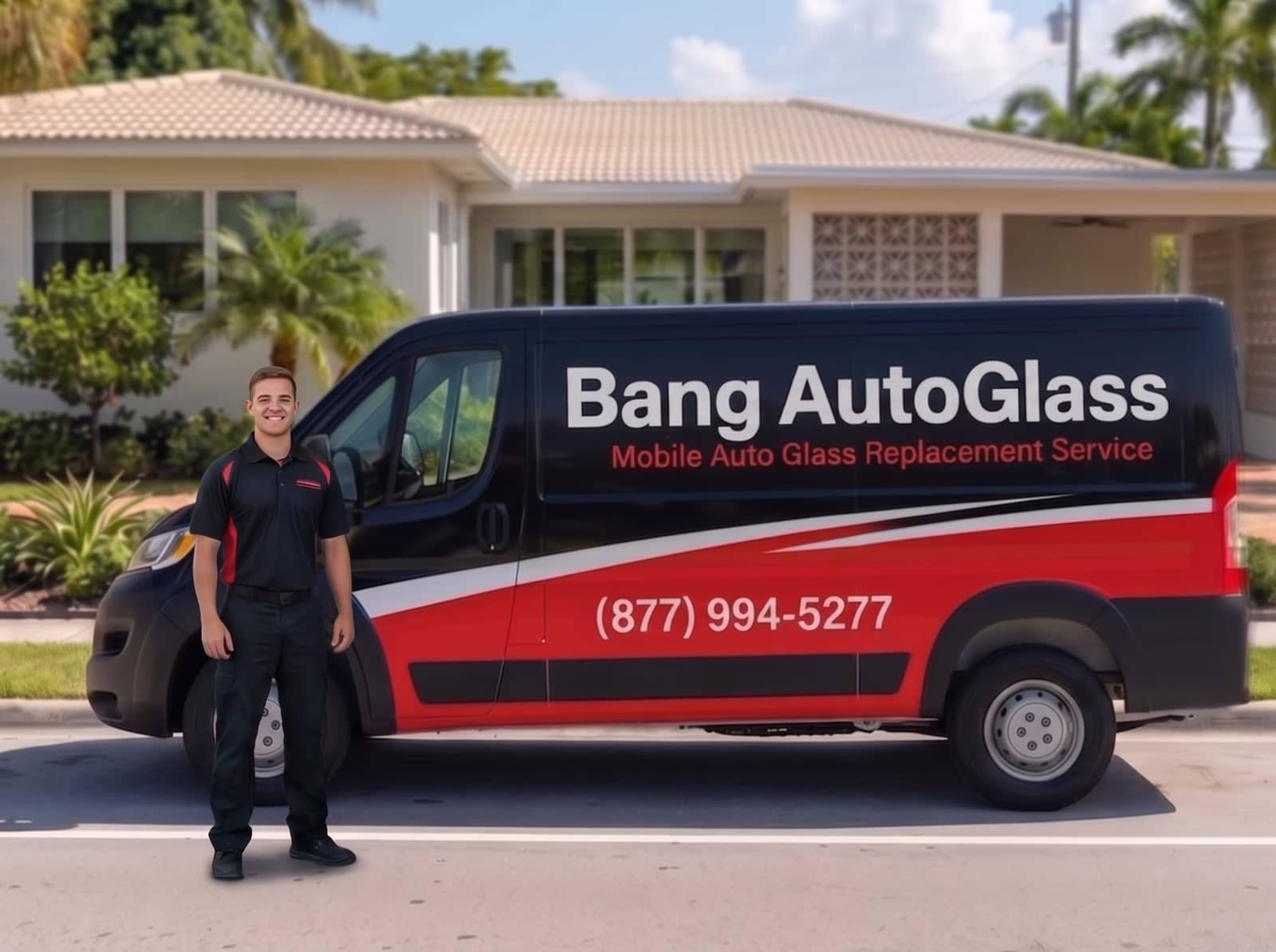
Toyota Rear Glass Replacement
Rear glass on a Toyota is rarely a plain bonded pane. A 4Runner or Sequoia tailgate window drops down into the body, a Tacoma or Tundra carries a slider, a Prius splits its glazing in two, a Sienna spans a whole liftgate. We replace all of it, fully mobile across Arizona and Florida.
Toyota Rear Glass Replacement: Fully Mobile Across Arizona and Florida
A broken rear window on a Toyota rarely stays in one piece long enough to plan around. Rear glass is usually tempered, so the moment the pane is compromised it releases all at once into thousands of blunt granules — across a Highlander cargo floor, down inside a 4Runner tailgate shell, behind the rear seat of a Tacoma. Bang AutoGlass performs fully mobile Toyota rear glass replacement across Arizona and Florida, arriving with OEM-quality glass, the correct adhesive and the extraction equipment this job requires. Installation runs about 30 to 45 minutes hands-on, plus roughly an hour of adhesive cure. Next-day appointments are typically available, and every replacement carries our lifetime workmanship warranty.
Tempered Glass Is Not Repairable
Rear windows are typically tempered safety glass, heat-treated so that when the surface tension is broken anywhere, the whole pane relieves itself into granular pieces rather than long shards. That is a genuine safety feature, and it is also why repairing rear glass does not exist — no chip to fill, no crack to stop, no intact pane left. Replacement is the only correct outcome, which suits us: Bang AutoGlass is replacement-only. A minority of applications use laminated rear glass, so we confirm against your VIN rather than the model name.
Toyota Puts More Moving Glass at the Back Than Most Brands
Plenty of manufacturers give you a bonded backlight and stop there. Toyota builds rear panes that slide, drop and flip, and each mechanism changes the part, the failure mode and the cleanup.
The Power Drop-Down Tailgate Window
The 4Runner is the signature example. Its tailgate glass is not bonded into an aperture at all — it retracts down into the tailgate on a regulator, operated from the dash or the tailgate itself, like an oversized door window. The Sequoia has offered the same. The glass is therefore hardware-held rather than adhesive-set, and when it breaks most of the debris never reaches the cargo area: it pours down inside the hollow tailgate, onto the regulator, motor and drain slots. A tailgate packed with granules binds or grinds long after the new glass is in, so emptying it is part of the job.
Sliding Rear Windows on Tacoma and Tundra
The pickups take a different route. Depending on how your truck was built, the back of the cab may carry a fixed pane, a manual three-piece slider whose centre section moves on tracks, or a power rear window — and on Tundra CrewMax bodies Toyota has offered a power vertical slider that drops the centre pane into the cab wall instead of sliding it sideways. A slider is fitted as a complete assembly — glass, frame, tracks and latch — and that assembly is bonded into the cab opening, so adhesive cure still applies even though the moving pane is hardware-held. Manual and power versions are not interchangeable, so we verify yours before ordering.
Flip-Up Hatches and Split Tailgates
The FJ Cruiser uses a side-hinged rear door with a separate flip-up glass hatch above it, so it has its own hinges, struts and latch. Several Land Cruiser generations use a split tailgate whose upper glass section opens on its own while the lower gate folds down. Where your Highlander, Grand Highlander or Sequoia has a separately opening liftgate window, the same holds: it is a hinged panel with its own seal and alignment, and it must latch cleanly against the gasket when we are done.
What Else Is Built Into a Toyota Rear Pane
Defroster Grids and Wiper Spindles
Nearly every bonded Toyota backlight and liftgate pane carries a printed defroster grid fed by tabs near the edges. The replacement must be the heated variant with the matching grid, and the circuit is tested before our technician leaves. A defroster that reads dead afterwards is almost always a connection nobody finished. On liftgate and hatch glass — RAV4, Highlander, Sienna, Corolla Hatchback, C-HR, Matrix, Prius — the rear wiper drives a spindle through a hole in the pane itself. Glass without that hole, or with it in the wrong position, is the wrong part, and the seal has to be reset properly because that hole is a water path into the liftgate. Some vehicles were built with no rear wiper at all, so we confirm from the VIN, not the body style.
Antennas, Stop Lamps and Privacy Glass
Many Toyota sedans route radio reception through antenna elements printed into the rear glass rather than a mast or roof fin. If reception was fine before the break and poor afterwards, that is a glass-side connection, not a head-unit fault. Where the high-mount stop lamp is bonded to the pane rather than the spoiler, it has to come across and light correctly. Toyota also fits factory privacy glass behind the B-pillar on most SUVs, trucks and vans, so tint shade is a matching requirement, not a preference.
Toyota Models We Service, Grouped by How the Rear Glazing Works
Pickups: Tacoma and Tundra
Fixed panes, manual sliders and power rear windows all appear across Tacoma and Tundra model years and cab configurations. Granules from a cab-back break land behind and under the rear seat, in seat-track channels, in under-seat storage, and out into the bed.
Body-on-Frame SUVs: 4Runner, Sequoia, Sequoia Hybrid, Land Cruiser, FJ Cruiser
This is where the moving rear glass lives — the 4Runner and Sequoia drop-down tailgate window, the Land Cruiser split tailgate, the FJ Cruiser's flip-up hatch. These are also the Toyotas most likely to have spent time on gravel, where rear glass takes stones thrown up by other vehicles.
Crossovers and Wagons: RAV4, RAV4 Prime, Highlander, Highlander Hybrid, Grand Highlander, Venza, C-HR, Crown Signia
Unibody vehicles with a bonded liftgate pane, usually heated, drilled for a wiper and privacy-tinted. The RAV4 changed rear-door architecture between generations — some open as a liftgate, others on a side hinge — so year and VIN matter more than the badge. Highlander and Grand Highlander add a long cargo bay and folding third row, exactly the geometry that hides glass.
Hatchbacks: Corolla Hatchback, Corolla iM, GR Corolla, Matrix, Yaris, Prius c
Steeply raked liftgate glass, a wiper through the pane, a spoiler across the top edge and a load floor with trays underneath. On the GR Corolla that glass sits behind a wide-body hatch owners drive hard, so a merely adequate seal announces itself as wind noise at speed.
The Prius Family: Prius, Prius Prime, Prius v, Prius c
Several Prius generations use the distinctive split rear glazing — an upper backlight plus a second, more vertical pane below the spoiler — so the car effectively has two rear windows and you must tell us which one broke. Certain Prius Prime years use a lightweight composite hatch carrying a shaped double-bubble pane that is not the standard car's part. The Prius v is a longer wagon; the Prius c a small hatch.
Sedans: Camry, Camry Hybrid, Corolla, Corolla Hybrid, Avalon, Avalon Hybrid, Crown, Echo, Mirai
Fixed bonded backlights, heated, frequently carrying printed antenna elements, set behind a parcel shelf. Avalon and upper Camry trims have offered a power rear sunshade sitting immediately behind the glass — a mechanism that catches granules and jams weeks later if nobody empties it. The Mirai is a hydrogen fuel cell sedan with high-pressure tank hardware behind the rear seat, a reason to work deliberately, not to decline the job.
Coupes and Convertibles: GR86, 86, GR Supra, Supra, Solara, Camry Solara
The 86 and GR86 use a fixed coupe backlight in a short, steeply angled aperture with very little room behind the rear seats. The GR Supra carries a large curved glass hatch rather than a conventional backlight, as earlier Supra generations did — and on older Supra glass it is sourcing rather than labour that sets the timeline. The Solara convertible is different again: a heated glass rear window bonded into a folding soft top, so afterwards we cycle the roof through full travel and check stack clearance.
Sienna, and the Electrified Range
The Sienna has a long, heated, wiper-drilled liftgate pane above the deepest cargo well Toyota sells, and its granules reach third-row footwells, the spare tyre area and folding seat mechanisms — the longest cleanup in the range. The bZ4X is a battery-electric crossover with a bonded liftgate pane, and the RAV4 EV was built in very small numbers, so sourcing there is genuinely VIN-driven. Across the hybrids and plug-ins — Camry Hybrid, Highlander Hybrid, Sequoia Hybrid, Crown, Crown Signia, RAV4 Prime, Prius Prime — battery hardware and its cooling intakes sit at the rear of the cabin, and granules find air intakes.
What Cleanup Actually Looks Like on a Toyota
A tempered pane does not break into a handful of pieces you can lift out — it becomes thousands of pebbles with momentum, and they travel. On a Toyota that means a 4Runner tailgate cavity, Tacoma seat rails and under-seat bins, Sienna third-row wells, Prius load-floor trays, sedan parcel shelves, sunshade cassettes and hybrid battery cooling vents. Glass left in a vent rattles loose months later. Extraction is core work, not a courtesy at the end.
Our Toyota Rear Glass Replacement Process
- VIN and glass verification — Year, model, defroster grid, antenna, wiper hole, tint shade, and whether the pane is a backlight, liftgate window, slider assembly or drop-down tailgate glass.
- Mobile arrival and protection — We mask off paint, trim, seats and cargo liners before touching the aperture.
- Bulk glass extraction — Loose granules come out of the cabin, cargo bay, tailgate shell and slider tracks before cutting starts.
- Old glass and adhesive removal — The original bead is cut out without gouging the pinchweld; on hardware-held glass the run channels and regulator are cleared.
- Electrical transfer and surface prep — Defroster tabs, antenna leads and any bonded stop lamp are prepared, and the bonding surface primed.
- OEM-quality glass installation — The new pane is set with a fresh bead to factory alignment, or fitted into its regulator and channels where the glass moves.
- Reconnection and function testing — Defroster, antenna and stop lamp circuits are tested, the wiper seal checked, and moving glass cycled through full travel.
- Deep cleanup and final inspection — Cargo areas, seat tracks, tailgate cavities and drain paths are cleared of fragments.
How Long Does It Take?
Most rear glass replacements take roughly 30 to 45 minutes of hands-on installation. Where the pane is adhesive-set — a Camry backlight, a RAV4 liftgate window, a Tacoma slider bonded into the cab — plan on about an hour of cure before driving. Hardware-held glass such as a 4Runner tailgate window is a different situation, and your technician will tell you on site what applies.
OEM-Quality Glass and a Lifetime Workmanship Warranty
We install OEM-quality rear glass and premium adhesives on every Toyota we service, matched for thickness, curvature, optical clarity, privacy tint shade, defroster grid pattern, wiper hole position and antenna configuration. Every Toyota rear glass replacement carries our lifetime workmanship warranty: for as long as you own the vehicle, if something traces back to how we installed it — a leak, wind noise, a defroster connection that failed, a slider that binds — we come back and put it right at no charge.
Mobile Service Across Arizona and Florida
Bang AutoGlass is 100% mobile, which matters here: driving a Toyota with an open rear aperture means a cabin full of dust in Arizona, or a soaked interior after a Florida afternoon storm. We come to your home, workplace or storage lot anywhere in our service areas, given safe, level access. Company-wide we have completed more than 17,000 jobs and hold a 4.8-star rating across 350+ Google reviews.
Insurance and Toyota Rear Glass
Rear glass damage is frequently covered under comprehensive coverage — break-ins, vandalism, road debris and storm damage are the causes we see most. Bang AutoGlass files the claim and handles the paperwork so your appointment is not held up.
Arizona
Arizona law (A.R.S. 20-264) requires insurers to offer optional no-deductible safety-glass coverage, and that definition reaches windshield, door and window glass. The word that matters is optional. It is coverage a driver has to have elected when the policy was written, and it is never automatic. If you elected it, your rear glass claim may carry no deductible. If you did not, ordinary comprehensive terms apply.
Florida
Florida law (Fla. Stat. 627.7288) requires the deductible to be waived for windshield replacement on a policy carrying comprehensive coverage. That statute is windshield-only, and it does not apply to rear glass. A Florida rear window claim on your Camry, RAV4 or Tacoma runs under ordinary comprehensive terms and your normal deductible, and we would rather you hear that plainly from us now.
After Your Replacement
- Allow roughly an hour of cure before driving where the pane was adhesive-set.
- Skip automated car washes and high-pressure rinsing for 24 to 48 hours, and leave any retention tape in place for the full 24 hours.
- Close doors and the tailgate normally rather than firmly for the first day — pressure spikes in a sealed cabin push against a fresh bead.
- On a 4Runner, Sequoia, Tacoma or Tundra, cycle the moving rear glass gently at first and confirm smooth, quiet travel.
- Watch for stray granules over the following days and tell us if you find any.
Schedule Your Toyota Rear Glass Replacement
Whether it is a fixed backlight on a Corolla, a drop-down tailgate window on a 4Runner, a slider on a Tundra or split glazing on a Prius, the work is the same in principle and completely different in execution. Our experienced technicians verify the spec against your VIN, install OEM-quality glass, test the defroster, antenna and wiper rather than assuming they survived, and clear debris from where it goes. Use the form at the top of this page or call (877) 994-5277 to book, typically as soon as the next day.
Toyota Rear Glass Replacement — common questions
Can a broken Toyota rear window be repaired instead of replaced?
No. Rear glass is normally tempered, so it disintegrates into granules rather than cracking, leaving nothing to repair. Replacement is the only correct fix, and Bang AutoGlass is a replacement-only company.
My 4Runner's rear window rolls down. Is that glass different?
Very. 4Runner and Sequoia tailgate glass rides on a regulator like a door window rather than being bonded in, and when it breaks the granules pour down inside the tailgate onto the motor and tracks.
Does a Tacoma or Tundra sliding rear window come as one piece?
Sliders are fitted as a complete assembly with tracks, seals and latch, and that assembly is bonded into the cab opening. Manual and power versions differ, so we verify yours against the VIN first.
Will the defroster, wiper and antenna work after the new glass?
They should, because we transfer and test them. Defroster tabs, any printed antenna, a bonded stop lamp and the wiper spindle seal are all reconnected and checked on site before we leave.
Where we do Toyota auto glass
Bang AutoGlass is a mobile auto glass company serving Arizona and Florida. We don't have a shop you drive to — we come to your home, your job, or wherever the car is sitting, with next-day appointments in most areas. In Arizona that means the whole Valley — Phoenix, Mesa, Scottsdale, Chandler, Gilbert, Tempe, Glendale and out to Tucson and Prescott. In Florida we cover Tampa Bay, Orlando and Miami, from St. Petersburg and Clearwater across to Kissimmee, Winter Park and Fort Lauderdale.
Browse every city we serve in Arizona and Florida, or read how coverage works under Arizona's glass statutes and Florida's § 627.7288.
Mobile auto glass — cities we serve
4.8★ on Google · 350+ reviews from AZ & FL drivers
“I needed my windshield replaced and they made the entire process easy. Bang AutoGlass is the best!”
“Top-notch auto glass service. They handled my windshield replacement quickly and professionally.”
“Bang AutoGlass made my windshield replacement simple from start to finish.”
Need Toyota Rear Glass Replacement?
We come to you across Arizona and Florida — often $0 with insurance.
We reply within minutes during business hours.