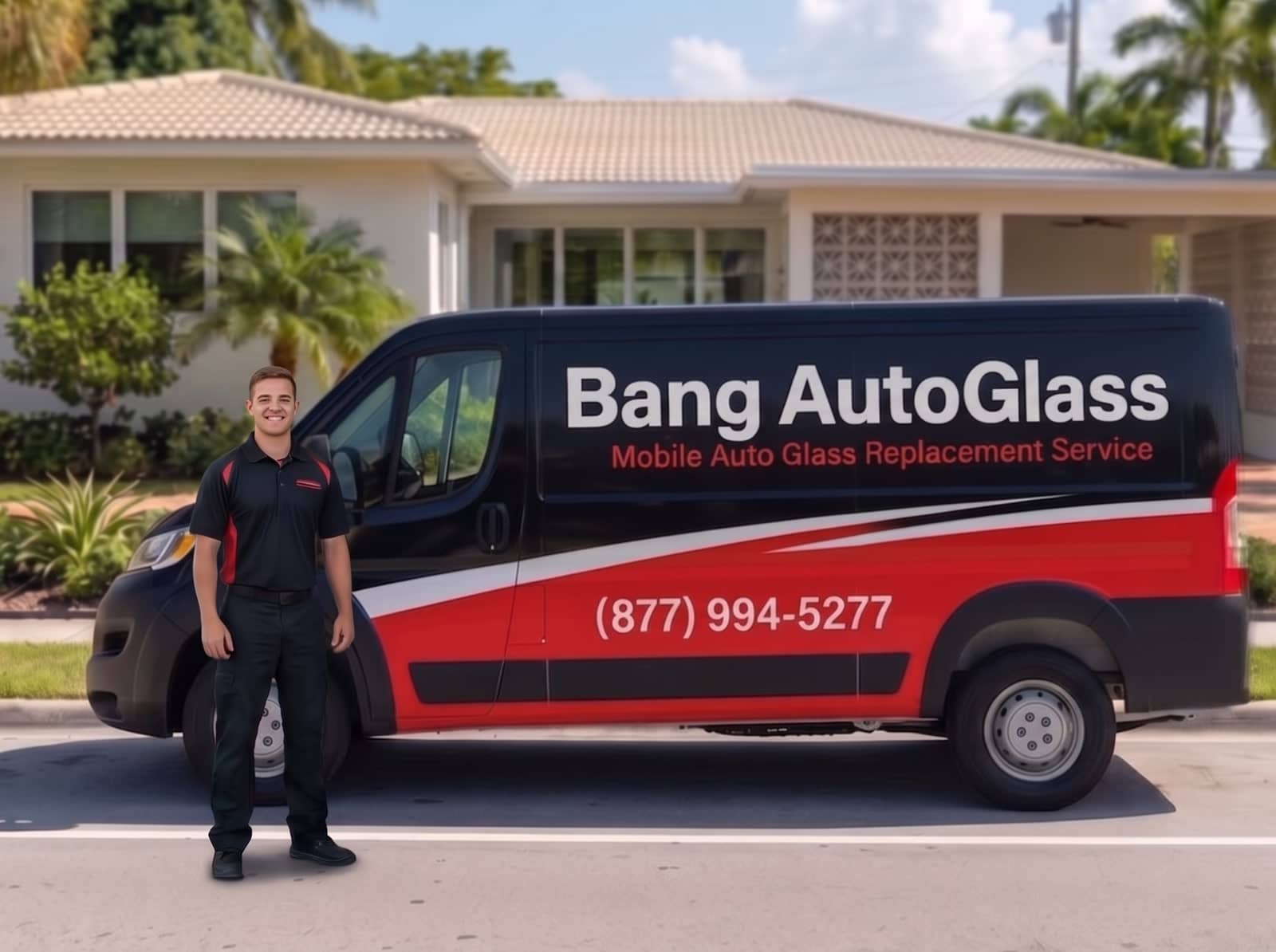
BMW ADAS Calibration
Bang AutoGlass coordinates BMW Driving Assistant ADAS calibration after windshield service so Lane Keeping Assistant, Frontal Collision Warning, Adaptive Cruise Control, and Blind Spot Detection read targets correctly across 3, 5, 7, X, and i-series. Arizona and Florida mobile, warranty-backed.
BMW ADAS Calibration
What Is BMW ADAS Calibration?
BMW ADAS calibration is the precise alignment and reprogramming of your BMW's Advanced Driver Assistance Systems following any service that disturbs the position, angle, or sightline of the forward-facing camera, radar sensors, or related modules mounted to your windshield or vehicle body. Modern BMWs are engineered with some of the most sophisticated driver assistance technology on the road, and even a fraction of a degree off-axis can cause the entire system to misread the road ahead. Whenever a BMW windshield is replaced, the camera that lives behind the rearview mirror must be re-taught where the road, lane lines, vehicles, and pedestrians actually are in physical space relative to the new glass. Without proper calibration, lane keeping, automatic emergency braking, adaptive cruise control, and pedestrian detection can give false readings, fail to engage when needed, or trigger unexpectedly while driving.
Understanding ADAS Technology in BMW Vehicles
BMW packages its driver assistance suite under several trim names depending on model year and equipment, including Driving Assistant, Driving Assistant Plus, and Driving Assistant Professional. These suites pull data from multiple sensors working together, but the windshield-mounted forward camera is the visual anchor for nearly every system. That camera reads lane markings, identifies traffic signs, tracks the vehicle in front of you, and feeds information to the radar and ultrasonic sensors that complete the picture. When the windshield comes out and a new one goes in, that camera's relationship with the world changes, which is exactly why BMW requires recalibration as part of factory-approved repair procedures.
Why Calibration Matters After Windshield Replacement
Even a windshield that is replaced perfectly straight will sit in a slightly different position than the one that came out. Glass thickness, frit pattern alignment, urethane bead height, and bracket clip tolerances can all shift the camera's pointing angle by enough to throw the system out of specification. BMW publishes tight tolerances for camera aim, and the only way to bring a car back into spec is through a documented calibration procedure performed with manufacturer-level scan tools and target setups. This is not optional and it is not something a glass technician can skip without compromising your safety and the resale value of your BMW.
BMW's Advanced Driver Assistance Systems Explained
BMW's ADAS suite has expanded dramatically over the last decade, and most models from 2016 forward carry at least one camera-dependent safety system that requires calibration after windshield work. Understanding what your BMW has under the hood helps explain why the calibration step is so important.
Driving Assistant Professional
Driving Assistant Professional is BMW's flagship semi-autonomous package, found on most current 3 Series, 5 Series, 7 Series, X3, X5, X7, and i-badged electric models. It bundles Steering and Lane Control Assistant, Lane Keeping Assistant with Active Side Collision Protection, Traffic Jam Assistant, Emergency Stop Assistant, and Active Navigation. Every one of these features depends on the front camera reading the road accurately, which means a windshield replacement on any BMW with this package absolutely requires a full ADAS recalibration before the vehicle is returned to the road.
Active Cruise Control with Stop & Go
Active Cruise Control uses the forward camera together with the front radar to maintain a set distance from the vehicle ahead, slow your BMW to a complete stop in traffic, and resume cruising automatically. If the camera angle is off after a windshield replacement, the system can misjudge following distance, brake too late, or fail to recognize a stopped vehicle in your lane. Calibration restores the precise geometry the system needs to function safely.
Lane Departure Warning and Lane Keeping Assistant
Lane Departure Warning vibrates the steering wheel when your BMW drifts toward a lane line without a turn signal, and Lane Keeping Assistant gently steers you back into your lane. Both systems read painted lines through the windshield camera. An uncalibrated camera may interpret your lane as being shifted left or right, which causes the car to nudge you into the wrong position or fail to warn you at all when you actually do drift.
Forward Collision Warning and Automatic Emergency Braking
This is arguably the most safety-critical ADAS feature on any BMW. The camera and radar work together to identify vehicles, pedestrians, and cyclists in your path, warn you of an impending collision, and apply the brakes if you do not react in time. A miscalibrated camera can delay or prevent that braking event, which is why BMW and the Insurance Institute for Highway Safety both treat post-replacement calibration as mandatory.
Other ADAS Features
Beyond the core suite, your BMW may also carry several other systems that touch the windshield camera or interact with calibration. These include:
- Speed Limit Information and No-Passing Information that read posted signs
- Traffic Jam Assistant for hands-on assisted driving in congestion
- High Beam Assistant that automatically dims your headlights for oncoming traffic
- Pedestrian Warning with City Braking Function
- Crossing Traffic Warning Front
- Active Side Collision Protection
- Evasion Aid that helps steer around obstacles
- Night Vision with Pedestrian Detection on select 7 Series and X7 models
When Does a BMW Need ADAS Calibration?
The most common trigger is a windshield replacement, which is what brings most of our customers to us. However, BMW specifies recalibration any time the camera or its mounting bracket is disturbed, the vehicle suspension is altered, certain body repairs are performed, or the vehicle has been in a collision that affects ride height or sensor positioning. If you have just had your windshield replaced anywhere, even at a dealership, and you notice your lane keeping pulling oddly, your adaptive cruise behaving inconsistently, or warning lights on the iDrive cluster, your camera is almost certainly out of calibration and needs immediate attention.
Static vs. Dynamic Calibration for BMW
Not every BMW calibrates the same way. Some models require a static calibration, some require a dynamic calibration, and many newer models require both procedures performed in sequence. Knowing the difference matters because it determines how long your appointment will take and what conditions need to be met for the calibration to succeed.
Static Calibration
Static calibration is performed with the BMW parked on a level surface in a controlled environment. Specific targets, often featuring black-and-white checkerboard or geometric patterns, are placed at exact distances and angles in front of the vehicle according to BMW factory specifications. The scan tool then walks the camera through a learning procedure, teaching it to recognize the targets and calculate its own position relative to them. Static calibration typically adds about 15 to 30 minutes to the appointment and requires precise floor flatness, accurate target placement, and consistent lighting.
Dynamic Calibration
Dynamic calibration, sometimes called mobile or drive calibration, requires the BMW to be driven at specific speeds on roads with clearly visible lane markings. The scan tool stays connected throughout the drive, and the camera learns by watching the road in real time. Dynamic procedures typically require speeds between 30 and 50 miles per hour for a sustained period, good weather, and well-painted roads. Most dynamic calibrations add about 15 to 30 minutes to the appointment, including the drive, setup, and verification time.
Which One Does Your BMW Need?
Many newer BMW models, particularly those built on the CLAR platform like the G20 3 Series, G30 5 Series, and G05 X5, require both a static calibration in a controlled setting and a dynamic calibration on the road. We confirm the exact procedure for your specific VIN before beginning work so you know what to expect and how long the appointment will take.
Our BMW ADAS Calibration Process
Bang AutoGlass follows a structured, manufacturer-aligned process for every BMW we calibrate. We treat ADAS calibration as a precision service, not a checkbox at the end of a glass install, and our process reflects that.
- We confirm your BMW's exact ADAS configuration by VIN before the appointment so we arrive with the correct targets, mounts, and software ready
- We replace your windshield using OEM-quality glass that matches the optical clarity, frit pattern, and bracket positioning your camera was originally designed around
- We allow the urethane adhesive a full one-hour safe drive-away cure window before any calibration work begins
- We perform a pre-scan to identify any existing trouble codes in the ADAS modules
- We perform or coordinate the static calibration when required, using BMW-specified targets at factory-mandated distances
- We complete the dynamic calibration drive on a pre-mapped route with appropriate speeds and lane markings if required
- We perform a post-scan to confirm all modules report a successful calibration with no stored fault codes
- We provide you with documentation showing the calibration was completed to specification
BMW Models We Service
We calibrate ADAS systems on essentially every BMW model that left the factory with a forward-facing camera, including but not limited to current and recent generation 2 Series, 3 Series, 4 Series, 5 Series, 7 Series, 8 Series, X1, X2, X3, X4, X5, X6, X7, Z4, M2, M3, M4, M5, M8, i4, iX, i5, and i7. Older E and F chassis BMWs with optional driver assistance packages are also fully supported, including F30 3 Series, F10 5 Series, F15 X5, F25 X3, and many others. If you drive a BMW and you are unsure whether your vehicle has ADAS, simply share the VIN with us and we will tell you exactly what your car requires before we ever schedule the appointment.
Why Choose Bang AutoGlass for Your BMW
Choosing the right shop for BMW ADAS calibration matters more than choosing the right shop for almost any other automotive service. The decisions we make affect how your BMW protects you and your family on every drive afterward.
Mobile Convenience
Bang AutoGlass is a fully mobile service, which means we come to your home, your office, or wherever your BMW is parked. You do not need to take time off work, sit in a waiting room, or coordinate a ride. Our mobile units carry everything required to perform a complete BMW windshield replacement and the dynamic portion of ADAS calibration on site, and we coordinate the static calibration component when your specific BMW model requires it.
OEM-Quality Materials
We install OEM-quality glass that meets or exceeds the specifications of the windshield BMW originally fitted to your car. That includes proper bracket geometry for the camera mount, correct frit pattern, accurate optical properties to avoid distortion in the camera's field of view, and matching acoustic and solar properties where applicable. The wrong glass can prevent calibration from completing at all, and we will not put you in that position.
Lifetime Workmanship Warranty
Every BMW windshield replacement and ADAS calibration we perform is backed by a lifetime workmanship warranty. If anything we did is responsible for a leak, wind noise, or calibration drift, we make it right at no cost to you for as long as you own the vehicle. We can stand behind that warranty because our process is built around doing the job right the first time.
Next-Day Appointments
We understand that nobody plans to need a windshield. When you call us, we work to get your BMW on the calendar as quickly as possible, and most customers are scheduled for a next-day appointment. The actual replacement portion of the visit takes 30 to 45 minutes, followed by a one-hour adhesive cure time before any calibration begins, which keeps your total downtime minimal.
How Long Does BMW ADAS Calibration Take?
The total time from start to finish depends on your specific BMW and which calibration procedures it requires. The windshield replacement itself takes 30 to 45 minutes. The urethane adhesive then needs one hour to cure to safe drive-away strength. Static calibration, when required, adds another 60 to 90 minutes. Dynamic calibration, when required, adds 20 to 40 minutes of road time plus setup and post-scan verification. Most BMW ADAS calibration appointments wrap up within three to four hours total, and you leave with a vehicle that drives, brakes, and steers exactly as BMW intended.
BMW ADAS Calibration and Insurance
Most comprehensive auto insurance policies cover windshield replacement and the associated ADAS calibration in full or with a small deductible, and many states require insurers to waive the deductible entirely for glass claims. ADAS calibration is no longer a gray area for insurance carriers because it is documented as a required step in the BMW factory repair procedure, which means insurers cannot refuse to pay for the calibration when they pay for the glass.
Filing a Claim
If you have not already filed a claim with your insurance company, we are happy to walk you through the process and assist you in making the claim yourself. We can tell you exactly what to say, what to ask for, and what information your carrier will need from us, but the claim itself is filed by you as the policyholder. Once the claim is open and we have your claim number, we coordinate directly with your insurer for billing so you do not have to manage paperwork in the middle of your day.
Coverage Considerations
If you carry full glass coverage, your out-of-pocket cost for a BMW windshield replacement and ADAS calibration is typically zero. If you carry a glass deductible, you pay only that deductible and we bill the rest to your carrier. If you are paying out of pocket, we provide a clear, itemized estimate up front so there are no surprises.
Risks of Driving With Uncalibrated ADAS
Driving a BMW with an uncalibrated camera is a real safety risk that should not be taken lightly. Lane keeping can pull you in the wrong direction, automatic emergency braking can fail to engage when a child or cyclist enters the road, adaptive cruise can misjudge distances on the highway, and your BMW may show persistent warning messages that desensitize you to other genuine alerts over time. Insurance complications can also arise if you are involved in a collision and the system was known to be out of calibration. The fix is straightforward and we make it easy, so there is no reason to delay.
Schedule Your BMW ADAS Calibration Today
If your BMW needs a windshield replacement, has already had one done elsewhere, or is showing any symptoms of an out-of-calibration camera, contact Bang AutoGlass today. We bring the shop to you, we use OEM-quality materials, we calibrate to BMW factory specifications, and we back every job with a lifetime workmanship warranty. Most appointments are available next day, and most replacements are completed in 30 to 45 minutes plus a one-hour cure time before calibration. Call us, send us your VIN, and let us get your BMW back to driving exactly the way BMW engineered it to drive.
BMW ADAS Calibration — common questions
What is ADAS calibration and why does my BMW need it?
ADAS (Advanced Driver Assistance Systems) calibration realigns safety cameras and sensors on your BMW so features like lane-keeping assist, collision warning, and automatic braking work accurately. We calibrate after windshield replacement or repairs to these systems.
How long does BMW ADAS calibration take?
ADAS calibration typically takes about 15-30 minutes once the windshield adhesive has fully set. If you're also getting a windshield replacement, plan for roughly 30-45 minutes for the glass plus 1 hour for adhesive to cure, then calibration.
Do I need ADAS calibration after a windshield replacement?
If your BMW has a forward-facing safety camera on the windshield (most models from 2018 onward do), calibration ensures that camera-dependent features stay accurate and reliable. We assess your vehicle during the appointment.
Is ADAS calibration covered by insurance?
ADAS calibration is typically included in comprehensive glass coverage when paired with windshield replacement. If you have comprehensive coverage, your insurer usually covers the full job with nothing out of pocket, and we help you file the claim.
Where we do BMW auto glass
Bang AutoGlass is a mobile auto glass company serving Arizona and Florida. We don't have a shop you drive to — we come to your home, your job, or wherever the car is sitting, with next-day appointments in most areas. In Arizona that means the whole Valley — Phoenix, Mesa, Scottsdale, Chandler, Gilbert, Tempe, Glendale and out to Tucson and Prescott. In Florida we cover Tampa Bay, Orlando and Miami, from St. Petersburg and Clearwater across to Kissimmee, Winter Park and Fort Lauderdale.
Browse every city we serve in Arizona and Florida, or read how coverage works under Arizona's glass statutes and Florida's § 627.7288.
Mobile auto glass — cities we serve
4.8★ on Google · 350+ reviews from AZ & FL drivers
“I needed my windshield replaced and they made the entire process easy. Bang AutoGlass is the best!”
“Top-notch auto glass service. They handled my windshield replacement quickly and professionally.”
“Bang AutoGlass made my windshield replacement simple from start to finish.”
Need BMW ADAS Calibration?
We come to you across Arizona and Florida — often $0 with insurance.
We reply within minutes during business hours.