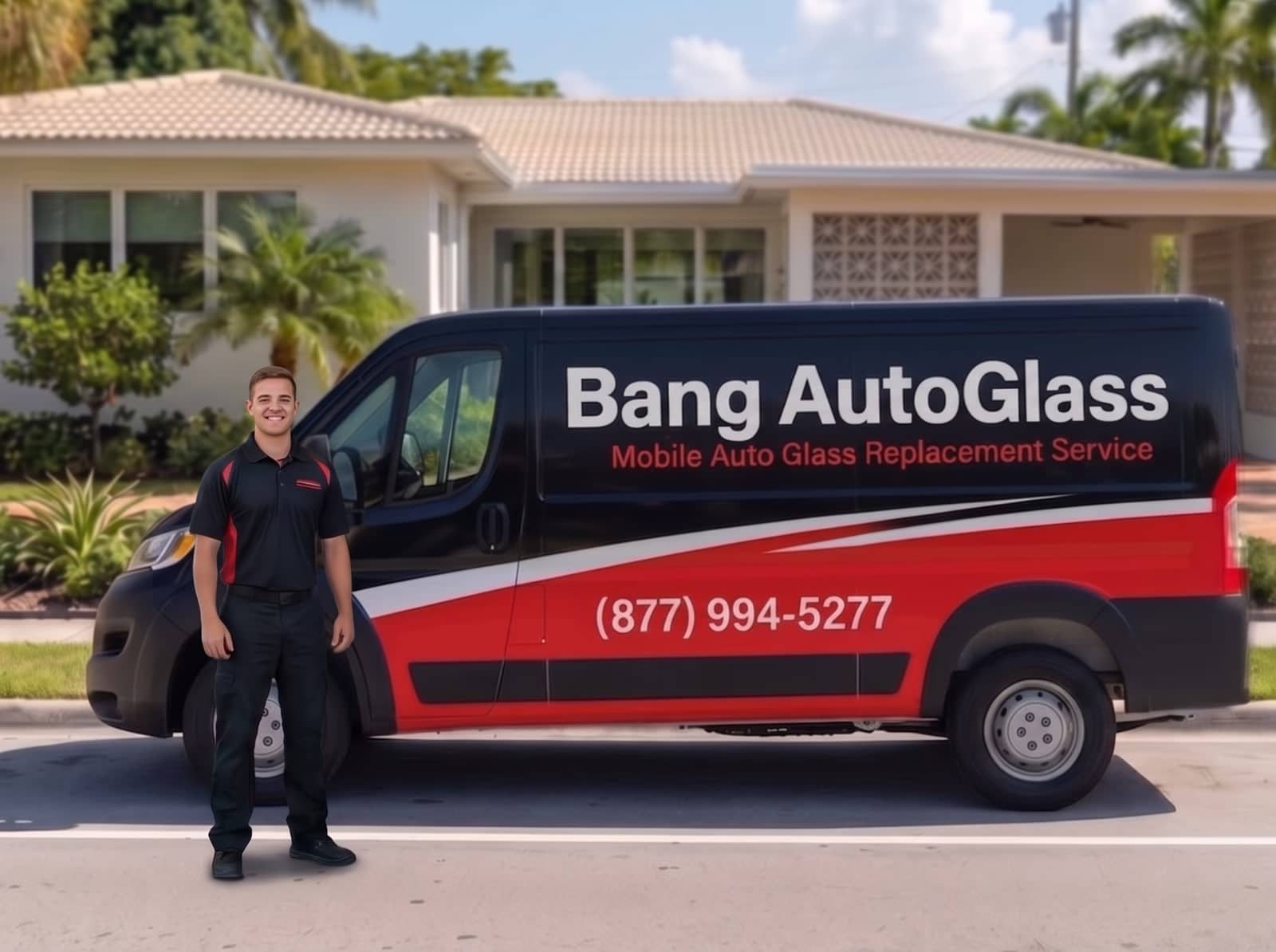
Volvo Rear Glass Replacement
Bang AutoGlass replaces rear glass on Volvos across Arizona and Florida, fully mobile: XC90, XC60, XC40, V60, V90 Cross Country, S60, S90, C30, C70, EX30 and EX90. Tempered rear panes cannot be repaired, so we fit OEM-quality glass, test the defroster grid, and warranty the workmanship.
Volvo Rear Glass Replacement: Mobile Service Across Arizona and Florida
When a rear window lets go on a Volvo, the damage is rarely confined to the glass. On a wagon or SUV the pane sits above an open load bay and the debris travels the length of the cargo floor. On an S90 it drops through the parcel shelf into the trunk. On a C70 it falls into the well where the folding roof lives. Bang AutoGlass performs fully mobile Volvo rear glass replacement across Arizona and Florida with OEM-quality glass, the correct urethane and the extraction equipment this job needs. Installation runs about 30 to 45 minutes hands-on, plus roughly an hour of adhesive cure. Next-day appointments are typically available, and every replacement carries our lifetime workmanship warranty.
Why a Volvo Rear Window Cannot Be Repaired
Rear glass on nearly every Volvo is tempered safety glass, heat-treated so that when surface tension breaks anywhere the whole pane relieves itself into small granular pieces rather than long shards. That is a genuine safety feature, and it is why there is nothing to repair: no chip to fill, no crack to arrest, no resin that brings a shattered pane back. Replacement is the only correct answer, which suits us, because Bang AutoGlass is replacement-only. A minority of applications use laminated rear glass, so we verify the specification against your VIN rather than assuming from the badge on the tailgate.
Volvo Models We Service, Grouped by How the Rear Glazing Differs
Volvo does not build a pickup, so the sliding rear windows and drop-down tailgate glass that dominate truck work never come up. What Volvo builds instead is an unusually wide spread of wagons, plus SUVs, sedans, a glass-backed hatchback, a convertible and a growing electric range.
Wagons: V50, V60, V70, V90, V60 Cross Country, V90 Cross Country and XC70
The wagon is the shape Volvo is known for, and its rear glass is a large, near-upright pane set into a liftgate — a different part from a sedan backlight even when the two cars share a platform. Nearly all carry a rear wiper whose spindle passes through a drilled hole in the pane, so the replacement must be the drilled variant and that seal has to be right, or water tracks down inside the tailgate. Volvo has mounted the wiper differently across the range: on some cars the arm parks at the base of the glass, on others it sits under the roof spoiler and sweeps down. The high-mount stop lamp usually lives in that spoiler rather than bonded to the pane. Older V70 and XC70 cars were offered with a rear-facing third-row seat folded into the load floor, and where one is fitted it is a fragment trap.
SUVs: XC40, XC60 and XC90
Volvo's SUVs use a liftgate pane raked further back than a wagon's, which changes the cleanup more than the installation. A sloped screen throws glass forward into the cargo area and down between folded seat backs instead of onto the load floor. Expect a wiper spindle through the pane, a printed defroster grid, and privacy tint from the B-pillar back on most cars. The XC90 carries a third row, and when those seats are stowed the wells beneath them fill with granules that will not lift out from above. Where your XC90 has a two-piece tailgate, we check the hinge line and the seal between the panels too.
Sedans: S40, S60, S80 and S90
Sedan backlights are fixed, adhesive-bonded panes with no wiper and no hinge: the most straightforward installation in the Volvo range and the most irritating cleanup. Everything lands on the parcel shelf, which is perforated for the rear speakers and, on S80 and S90 cars with a powered rear sunblind, houses a roller assembly directly beneath the glass. Fragments drop through the speaker grilles into the trunk and into the sunblind cassette, where they rattle for months if nobody lifts the shelf out. We lift it out.
C30: the Glass Tailgate
The C30 earns its own paragraph. Its rear hatch is dominated by a large, deeply curved frameless glass panel that forms most of the visible tailgate, a deliberate callback to Volvo's own glass-backed hatchbacks from decades earlier. That makes it one of the more demanding panes in the range: big, double-curved, adhesive-set, with hardware bonded to it, and it has to sit flush or the car looks wrong from across a parking lot. A break also leaves an unusually large open aperture.
C70: a Rear Window That Lives Inside the Roof
The C70 was built as a soft-top convertible and later as a retractable hardtop, and in both cases the rear window belongs to a roof assembly that moves. Where your car carries the heated glass rear window, it is bonded into that assembly rather than into the body shell, so the pane is set to the roof's tolerances and the roof then cycled through full travel to confirm it stows and latches. On the hardtop cars the roof folds into the trunk, which is exactly where broken glass ends up. Clearing that mechanism before anything is cycled is not optional — granules in the roof rails are how a top gets scratched or jammed.
Electric Volvos: EX30, EX90 and C40
Volvo's electric cars change the conversation in two ways. The first is shape: the C40 uses a fastback roofline sweeping into a steeply raked rear screen, and where a car was built without a rear wiper it relies on airflow off the spoiler to keep the pane clear. That removes the spindle hole as a sealing point but leaves a larger, more sharply curved piece of glass to align. The second is the heater grid. On an EV the rear defroster is a resistive load drawing from the same system that governs range, and it is often the quickest way to clear a screen without running cabin heat. A grid left dead after a replacement on an EX30 or EX90 is not a cosmetic complaint. We test the circuit, and we work deliberately rather than improvising near high-voltage hardware.
What Is Printed, Drilled and Bonded Into a Volvo Rear Pane
A rear window is rarely just glass, and the parts of it that are not glass are the parts that get skipped.
- Defroster grid — printed onto the inner face and fed through tabs bonded near the edges. The replacement must be the heated variant with matching grid layout and terminal positions. Almost every dead rear defroster we inspect on somebody else's work traces to a tab pushed on rather than seated.
- Antenna elements — Volvo has routed radio reception through the rear glass on a great many cars, sometimes alongside a roof fin handling telematics. Reception that was fine before the break and poor after is a glass fault, not a head unit.
- Wiper spindle — a sealing point and a stress point at once. The pane must be drilled to the right diameter and position, the grommet tightened rather than crushed, and the arm re-indexed so it parks where Volvo intended.
- Privacy shade — the tint is part of the part number, not an afterthought. A clear pane where a privacy one belongs is obvious from outside the vehicle.
Where the Glass Actually Ends Up on a Volvo
A tempered pane does not break into pieces you can pick up by hand. It becomes thousands of blunt granules with real momentum, and they travel. The Volvo-specific problem is that these are cars people use for carrying things, so a V90 Cross Country or an XC60 is usually loaded when the glass goes.
- Under the load-floor panel and into the storage well beneath it.
- Into the tracks and anchor points for a cargo cover, load divider or dog guard.
- Down the gap between folded seat backs and seat pans, and into the seat rails.
- Into third-row wells on an XC90 and jump-seat recesses on older wagons.
- Through parcel-shelf speaker grilles and into a sunblind cassette on an S80 or S90.
- Into the roof stowage well and roof rails on a C70.
- Into the tailgate cavity around the wiper motor and latch.
We treat extraction as part of the job, not a courtesy at the end. Bulk glass comes out before any cutting starts, so debris is not driven deeper into the vehicle.
How the Job Runs
- VIN and specification check — Body style and exact glass spec: grid layout, antenna elements, wiper hole, tint shade, tempered or laminated.
- Mobile arrival and masking — Our technician comes to you and protects paint, trim, seats and load-floor carpet.
- Bulk debris extraction — Loose glass is lifted out of the cabin, load bay, trunk and tailgate cavity first, not last.
- Old pane and bead removal — Glass and original urethane are cut out without gouging the pinchweld or its paint, which is what keeps corrosion from surfacing later.
- Electrical transfer and prep — Defroster tabs, antenna leads and spindle hardware are prepared, and the bonding surface cleaned and primed.
- Glass installation — The new pane is set on a fresh urethane bead, aligned to factory position, and supported while the adhesive takes.
- Reconnection and testing — Grid and antenna circuits are tested, the wiper re-indexed and swept, and on a C70 the roof cycled through full travel.
- Deep cleanup and inspection — Load floor, storage wells, seat rails, parcel shelf and tailgate cavity are worked for fragments, then the install checked.
How Long Does a Volvo Rear Glass Job Take?
Most rear glass replacements take roughly 30 to 45 minutes of hands-on installation, then about an hour of adhesive cure before the vehicle is driven — a wait specific to bonded glass, which is why door and side windows have none. Some Volvos run longer: the C30's large curved hatch pane, a C70 roof assembly that has to be cleared and cycled, and any vehicle where the break happened days ago and the debris has migrated.
OEM-Quality Glass and a Lifetime Workmanship Warranty
We install OEM-quality rear glass and premium urethane adhesives on every Volvo we service, matched for curvature, optical clarity, tint shade, wiper hole position and the correct heated and antenna configuration. Every Volvo rear glass replacement carries our lifetime workmanship warranty. For as long as you own the vehicle, anything tracing back to how we installed it — a leak at the pinchweld or the spindle, wind noise, a connection that did not hold, trim not reseated — we come back and correct it at no charge.
Mobile Service Throughout Arizona and Florida
Bang AutoGlass is fully mobile. There is no shop to drive to, which matters more than usual with rear glass, because driving with an open rear aperture pushes dust, rain and road grit straight into the cabin and load bay. We come to your home, driveway, workplace or storage facility anywhere in our Arizona and Florida service areas, provided there is safe, level access and room behind the vehicle. Company-wide we have completed more than 17,000 jobs and hold a 4.8-star rating across 350+ Google reviews.
Insurance and Your Volvo Rear Glass Claim
Rear glass damage is frequently covered under comprehensive coverage — break-ins, vandalism, road debris and hail all sit on that side of a policy. Bang AutoGlass files the claim and coordinates approval with your carrier.
Arizona
Arizona law (A.R.S. 20-264) requires insurers to offer optional no-deductible safety-glass coverage, and that definition reaches windshield, door and window glass. The word doing the work there is optional. It is coverage the driver had to elect when the policy was written, and it is never automatic. If you elected it, your rear glass claim may carry no deductible. If you did not, ordinary comprehensive terms apply. We are happy to help you check.
Florida
Florida law (Fla. Stat. 627.7288) requires the deductible to be waived for windshield replacement on a policy carrying comprehensive coverage. That statute is windshield only, and it does not apply to rear glass. A Florida rear window claim on your XC60, V60 or S90 runs under ordinary comprehensive terms and your normal deductible. We would rather tell you that plainly at the start than let you discover it at the end.
After Your Replacement
- Allow roughly an hour of cure before driving, and take the first few miles gently.
- Skip automatic car washes and high-pressure rinsing for 24 to 48 hours.
- Leave retention tape or support tabs in place for the full 24 hours.
- Close doors and the tailgate normally rather than slamming them for a day; a pressure spike in a sealed cabin pushes against a fresh bead.
- Wait a day before running the rear defroster hard, then tell us if any part of the grid stays cold.
- On a C70, cycle the roof gently the first few times.
- Expect the odd stray granule over the following week. Tell us and we come back for it.
Schedule Your Volvo Rear Glass Replacement
A Volvo rear window is not simply a pane of glass in a hole. It carries a heater grid, usually an antenna, often a wiper spindle, and on several models it is part of a hatch or a roof that has to keep working afterwards. Our experienced technicians verify the specification against your VIN, install OEM-quality glass, test the circuits instead of assuming, and back the work with a lifetime workmanship warranty. Use the form at the top of this page or call (877) 994-5277 to book a mobile appointment, typically as soon as the next day.
Volvo Rear Glass Replacement — common questions
Can a cracked rear window on my Volvo be repaired instead of replaced?
No. Rear glass on nearly every Volvo is tempered, so it breaks into granular pieces rather than cracking. There is nothing to fill or arrest, and Bang AutoGlass is replacement-only.
Will my rear defroster and radio still work after the new glass goes in?
They will, when the job is done properly. Volvo prints the defroster grid and often antenna elements into the rear pane, so we fit the matching specification, re-make the tabs and test both circuits.
My V90 has a rear wiper coming through the glass. Does that complicate things?
It adds a step. The replacement pane has to be drilled to the correct position, the spindle grommet sealed rather than crushed, and the arm re-indexed so it parks where Volvo intended.
The rear window broke on my C70 convertible. Is that a different job?
Yes. The C70's heated glass rear window is bonded into a roof assembly that moves, so we clear granules out of the roof stowage well first, set the pane to the roof's tolerances, then cycle it fully.
Where we do Volvo auto glass
Bang AutoGlass is a mobile auto glass company serving Arizona and Florida. We don't have a shop you drive to — we come to your home, your job, or wherever the car is sitting, with next-day appointments in most areas. In Arizona that means the whole Valley — Phoenix, Mesa, Scottsdale, Chandler, Gilbert, Tempe, Glendale and out to Tucson and Prescott. In Florida we cover Tampa Bay, Orlando and Miami, from St. Petersburg and Clearwater across to Kissimmee, Winter Park and Fort Lauderdale.
Browse every city we serve in Arizona and Florida, or read how coverage works under Arizona's glass statutes and Florida's § 627.7288.
Mobile auto glass — cities we serve
4.8★ on Google · 350+ reviews from AZ & FL drivers
“I needed my windshield replaced and they made the entire process easy. Bang AutoGlass is the best!”
“Top-notch auto glass service. They handled my windshield replacement quickly and professionally.”
“Bang AutoGlass made my windshield replacement simple from start to finish.”
Need Volvo Rear Glass Replacement?
We come to you across Arizona and Florida — often $0 with insurance.
We reply within minutes during business hours.